

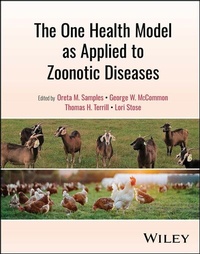
The One Health Model as Applied to Zoonotic Diseases
Beschreibung

Comprehensive, easy-to-understand, and clinically relevant guide to zoonotic healthcare concerns in North America
The One Health Model as Applied to Zoonotic Diseases is an easy-to-understand yet comprehensive explanation of zoonotic healthcare concerns with coverage of diseases and medical conditions seen in North America. With a format that is consistent throughout each chapter, this book provides clinically relevant information on individual diseases, causative agents, symptomatology, diagnostics, and treatment and preventative strategies.
This book also offers an overview of the history of One Health and perspective on the future of One Health in North America
The One Health Model as Applied to Zoonotic Diseases covers sample topics including:
- Arthropod-Borne Diseases, tapeworms, rabbit fever, rickettsia spp., leishmaniasis, chiggers, red bird mite, and mange
- Equine encephalitis, St. Louis encephalitis, West Nile Virus, Zika, American spotted fever, babesia, bourbon virus, Colorado tick fever, and heartland virus
- Lyme disease, Powassan encephalitis, Q-Fever, Rocky Mountain spotted fever, swimmer's itch, and bacterial zoonotic disease
- Anthrax, cat scratch fever, campylobacteriosis, leptospirosis, psittacosis, salmonella, staphylococcus, tuberculosis, rat bite fever, hookworms, and intestinal flukes
- Newcastle disease, avian and swine influenza, foot-and-mouth disease, and creeping eruption
The One Health Model as Applied to Zoonotic Diseases is an essential textbook for veterinary technology and animal science students seeking to work as paramedical professionals in the fields of agriculture and veterinary medicine. It also serves as an ideal reference guidebook for both human and veterinary practitioners.
Weitere Details
Weitere Ausgaben
Andere Ausgaben
Personen
Oreta M. Samples, BS, RVT, MPH, DHSc, Associate Professor and Program Coordinator, Master of Public Health Program, Department of Veterinary Technology and Public Health, Fort Valley State University. George McCommon, DVM, Professor and Department Head, Department of Veterinary Technology and Public Health, Fort Valley State University. Thomas H. Terrill, BS MS, Ph.D., Assistant Professor and Program Coordinator, Master of Animal Science Program, Fort Valley State University. Lori Stose, DVM, Veterinarian, Legacy Animal Medical Center.
Inhalt
List of Contributors xxvii
List of Abbreviations xxix
Preface xxxi
Acknowledgments xxxiii
1 History of One Health 1
Oreta M. Samples
2 An Interface Between Veterinary and Human Medicine 5
Oreta M. Samples
3.0 Arthropod- Borne Diseases of Public Health Concern 9
Oreta M. Samples
3.1 Family Cimicidae (Cimex sp.) 12
Oreta M. Samples
3.2 Chagas Disease 15
Kingsley Kalu
3.3 Tapeworms (Dipylidium caninum) 20
Lori L. Stose
3.4 Rabbit Fever 23
Sanower Warsi, Anurag Singh, Aftab Siddique, and Thomas H. Terrill
3.5 Rickettsia Species 28
Oreta M. Samples and Caroline Obi
3.6 Plague (Yersinia Pestis) 33
Eric C. Enoch and Oreta M. Samples
3.7 Leishmaniasis 39
Sunny Wesey and Dike C. Daniel
3.8 Chiggers (Eutrombicula alfreduges/Trombidium irritans) 47
Oreta M. Samples
3.9 Red Bird Mite (Dermanyssus gallinae) 51
Oreta M. Samples and Anna Mehat
3.10 Mange (Sarcoptes spp.) 57
Lori L. Stose
3.11 Equine Encephalitis (Eastern/Western) 61
George W. McCommon
3.12 St. Louis Encephalitis (Flaviviridae) 64
George W. McCommon
3.13 West Nile Virus (Flaviviridae) 67
George W. McCommon
3.14 Zika Virus 70
George W. McCommon
3.15 American Spotted Fever (Rickettsia Parkeri) 73
Sodiq Omotosho, Jeremiah Arowolo, and Oreta M. Samples
3.16 Babesiosis (Babesia Divergens) 77
Sodiq Omotosho, Jeremiah Arowolo, and Oreta M. Samples
3.17 Bourbon Virus 81
Oreta M. Samples
3.18 Colorado Tick Fever 84
Aftab Siddique and Thomas H. Terrill
3.19 Heartland Virus 88
Oreta M. Samples
3.20 Lyme Disease - Borrelia burgdorferi 92
Lori Stose
3.21 Powassan Virus (Flaviviridae) 96
Aftab Siddique and Thomas H. Terrill
3.22 Q Fever (Coxiella burnetii) 99
Jeremiah Arowolo and Oreta M. Samples
3.23 Rocky Mountain Spotted Fever (Rickettsia rickettsi) 103
Lori L. Stose
4.1 Public Health Implications of Bacterial Zoonotic Diseases 107
Sunny Wesey and Dike C. Daniel
4.2 Anaplasmosis/Ehrlichiosis (Anaplasma phagocytophylum/E. spp.) 115
Oreta M. Samples and Caroline Obi
4.3 Anthrax (Bacillus anthracis) 118
Phaneendra Batchu, Arshad Shaik, Priyanka Gurrapu, and Govind Kannan
4.4 Cat Scratch Fever (Bartonella spp.) 122
Lori L. Stose
4.5 Cholera (Vibrio cholera) 125
Oreta M. Samples and Caroline Obi
4.6 Campylobacteriosis (Campylobacter spp.) 128
Govind Kannan, Phaneendra Batchu, Arshad Shaik, and Priyanka Gurrapu
4.7 Leptospirosis 132
Lori L. Stose
4.8 Psittacosis (Chlamydia psittaci) 139
Christina Miller
4.9 Salmonella (Salmonella spp.) 147
Christina Miller
4.10 Staphylococcus (Staphylococcus aureus) 158
Govind Kannan, Phaneendra Batchu, Priyanka Gurrapu, and Arshad Shaik
4.11 Streptococcus (Streptococcus equi, Streptococcus suis) 163
Aftab Siddique and Thomas H. Terrill
4.12 Tuberculosis (Mycobacterium tuberculosis) 168
Priyanka Gurrapu, Phaneendra Batchu, Arshad Shaik, and Govind Kannan
4.13 Tularemia (F. tularensis) 173
Oreta M. Samples
4.14 Rat- Bite Fever 176
Suzanne Craig
5.1 Tinea capitis/Tinea corporis (Microsporum spp.) 181
Sanower Warsi, Aftab Siddique, and Thomas H. Terrill
5.2 Trichophytosis (Trichophyton spp.) 187
Lori L. Stose
6.0 Parasitic Worm- Associated Diseases of Public Health Concern 193
Sunny Wesey and Dike C. Daniel
6.1 Diphyllobothriasis (Diphyllobothrium dalliae) 199
Sunny Wesey and Dike C. Daniel
6.2 Alveolar Echinococcus (Echinococcus multilocularis) 205
Oreta M. Samples and Macdonald Aloh
6.3 Hydatidosis/Cystic Echinococcus (Echinococcus granulosus) 208
Arshad Shaik, Priyanka Gurrapu, Phaneendra Batchu, and Govind Kannan
6.4 Taeniasis (Taenia saginata) 211
Kingsley Kalu
6.5 Dirofilariasis (Dirofilaria immitis) 215
Lori L. Stose
6.6 Hookworms (Necator americanus) 221
Oreta M. Samples and Macdonald Aloh
6.7 Creeping Eruption (Ancylostoma braziliense/Ancylostoma caninum) 226
Oreta M. Samples
6.8 Uncinaria (Uncinaria stenocephala) 229
Oreta M. Samples
6.9 Trichinosis (Trichinella spiralis) 231
Kingsley Kalu
6.10 Roundworms (Ascaris lumbricoides and Toxocara cati) 234
Aftab Siddique and Thomas H. Terrill
6.11 Swimmer's Itch (Schistosomiasis) 242
Macdonald Aloh and Oreta M. Samples
6.12 Intestinal Flukes (Nanophytues salminocola) 246
Chisom D. Dike and Sunny Wesey
7.1 Hantavirus (Hantavirus spp.) 253
Oreta M. Samples and Jeremiah Arowolo
7.2 Rabies (Lyssavirus) 257
Kingsley Kalu
7.3 New Castle Disease (Orthoavulavirus avian Orthoavulavirus) 261
Aftab Siddique and Thomas H. Terrill
7.4 Avian Influenza (Avian Influenza A) 266
Aftab Siddique and Thomas H. Terrill
7.5 Swine Influenza (H1N1) 271
Aftab Siddique, Sanower Warsi, Anurag Singh, and Thomas H. Terrill
7.6 Foot- and- Mouth Disease (Aphthovirus) 276
Aftab Siddique and Thomas H. Terrill
7.7 Orf (Parapoxvirus Orf Virus) 283
Aftab Siddique and Thomas H. Terrill
8 Reportable Diseases in the United States 289
Oreta M. Samples
8.1 Introduction 289
9 The Future of One Health in North America 291
Oreta M. Samples
Index 293
1
History of One Health
Oreta M. Samples
Department of Veterinary Science and Public Health, Fort Valley State University, Fort Valley, GA, 31030, USA
The concept of One Health is not a new idea in the annals of modern medicine. Originally introduced by William Osler and Rudolf Virchow, it was reintroduced by Calvin Schwabe in 1984 (Schwabe 1984). Within the text "Veterinary Medicine and Human Health," he observed that an interdependence between human and veterinary medicine would encourage collaboration among the various disciplines leading to improved health outcomes in humans and animals and a renewal of healthy environments (King 2008).
According to Rudolf Virchow, "between animal and human medicine, there are no dividing lines ." (King 2008). This statement is attributed to the 19th Century German physician who is also credited with coining the term "zoonoses," providing an endorsement for what would become known as "One Health." The theory was further enhanced by Dr. Rudolf Osler, a student of Virchow. Recognizing that pathology could serve as the cornerstone of all veterinary medical disciplines, he applied the science of autopsy investigations to teach both human and veterinary pathology during his tenure at Montreal Veterinary College as a faculty member (Saunders 1987).
Currently, the idea of One Health is built on the foundation that the health of humans is dependent upon two things: animal health and the health of the environment (Atlas, 2014). Essentially, this leads to a concern for all "living things" as related to specific factors. The first factor that affects living organisms of every kind is the microbiological influence that a vast array of microbes has on both healthy animals and the progression of disease. This is most important, as infectious microbes often are at the heart of zoonotic disease spread. The second factor is that of the physical environments on which all living things depend for survival and the overall "health" of the environments in their ability to sustain life. Finally, the overall interactions that occur between animals and humans may be of a positive or negative nature with similar consequences. When combined, one can see how these factors come together both to support and influence the health of living things while advocating for the support of healthy environments in which to exist (Riegelman 2018).
One may ask: "Why is One Health important now?" In the 21st Century, when global inhabitants are faced with challenges such as the COVID-19 pandemic and global warming, there is a need for immediate protection of the environment to not only prevent the spread of disease, but also safeguard against shrinking ecosystems that are home to species in danger of losing their home environments to such things as rising temperature. The protection of environments and the resident species is all important if the planet is to survive and thrive. Encroachment by mankind on natural habitats continues to force interactions between species that are not "naturally" supposed to happen. Negative interactions occur when mammalian species such as raccoons and opossums are forced to live near humans due to "urban sprawl" efforts. Though naturally adept at foraging for food and living in forested areas, these animals wreak havoc and cause destructive damage when forced to forage for food from garbage cans or shelter in the attics and crawl spaces of human dwellings. This "cohabitation" leads to the possible spread of diseases and parasitic infections because of urine and fecal contamination of areas utilized by humans and companion animals (e.g., pets).
1.1 Purpose of One Health Initiative
The One Health initiative is driven by the three aforementioned factors; however, it serves to address several outcomes that are ever-changing. The achievement of optimal health outcomes for all living beings when faced with health challenges because of interspecies interactions may be among the most important. While some diseases, such as rabies, may simply be avoided by lack of interaction with certain environments or animals, others may be more insidious in the mode of transmission. Such is the case of Escherichia coli being spread to fruit or vegetable crops due to crop irrigation with wastewater containing coliform bacteria. There is also the challenge of one's perception of healthy practices, which may differ from country to country. This is especially true of countries dealing in the import of foodstuffs from other countries.
Another outcome is to recognize the results of connections that may occur between people, animals, and the environment within which all come together. This is most easily demonstrated when pets are not regularly treated with flea and tick preventative. As a result, the pet, while outside, encounters a tick such as the "black-legged tick" (Ixodes scapularis), which attaches itself to the pet's fur. When the animal comes inside the house and settles on the couch, the tick falls off. Later, it attaches itself to feed on the human sitting on the couch. Unbeknownst to humans until they find the engorged insects (sometimes hours or days later), they may have been infected with Anaplasma phagocytophilum, a bacterium that causes the disease anaplasmosis. They may in fact not realize that they have this disease even when symptoms appear, as the signs are often described as "flu-like" and may go undiagnosed. The correct diagnoses may be arrived at when the three factors of human-animal interactions in a supportive environment for the tick Ixodes scapularis are exploited (Center for Disease Control and Prevention 2023a, 2023b).
A third outcome that has become quite important is the need for and ability to identify opportunities that pinpoint novel occurrences of zoonotic diseases through shared/encroachment on environments (see Figure 1.1). An example of this would be the spread of Baylisascaris procyonis, a nematode found in raccoons that is commonly transmitted to the environment through fecal excrement. Eggs within the excrement may be accidentally ingested by humans, then hatch into larvae, which then may migrate to various tissues, resulting in visceral larval migrans (VLM), ocular larval migrans (OLM), or most severely, neural larval migrans (NLM), which may lead to severe eosinophilic meningoencephalitis (Center for Disease Control and Prevention 2023c). Children who happen upon shared raccoon "latrines" often found on woodpiles, crawl spaces, or in wooded areas may accidentally contaminate hands and ingest eggs when subsequently handling food without proper pre-meal hand sanitation.
Figure 1.1 Field identified with warning to hikers regarding presence of ticks which may cause disease to humans.
Source: Schlegelfotos/Shutterstock.
1.2 Common Issues Addressed by One Health
One Health as a global initiative addresses a variety of zoonotic diseases that plague humans worldwide, as well as antimicrobial resistance. Among the diseases addressed are emerging and reemerging zoonotic diseases, endemic diseases, neglected tropical diseases, and vector-borne diseases.
1.2.1 Zoonotic Disease Types
There are many zoonotic diseases that have been documented throughout history. The prevalence of such diseases is often based on specific environmental conditions being conducive to the causative organisms. Secondary to these conditions are the humans or animals that may be affected and whether they are in a state of susceptibility. Oftentimes, emerging diseases first are detected in an animal species, with some of the most notable diseases being West Nile virus, AIDS, and hantavirus.
Emerging diseases are by definition, diseases or infections that are newly seen in a population, also referred to as an "outbreak." While all diseases originate from something, these diseases generally leave these questions initially unanswered. By contrast, a reemerging disease is one which has been regarded as a major health issue at some point in history. Reemergence may occur due to lack of precautions that may have stopped its initial progression, such as vaccines, sanitation efforts, or vector control. Examples of reemerging diseases include tuberculosis, measles, and malaria (John Hopkins University 2024; NIAID 2024).
Endemic zoonotic diseases pose a special threat as they cause constant and regular outbreaks within susceptible populations. Such diseases include rabies, cysticercosis, and leptospirosis. Endemic diseases provide a special challenge, as while many have either preventative vaccines or strategies to limit widespread infection, they may also be capable of infecting various animal populations which cannot realistically be treated to prevent spread to humans. An example is rabies, which can be spread to warm-blooded mammalian species. While companion animals and farm animals can be regularly vaccinated against this viral disease on a yearly or every three-year schedule, wildlife species cannot be realistically vaccinated on a regular basis. Since many wildlife species encroach on areas inhabited by companion/farm animals and humans, they present an ever-present danger.
Neglected tropical diseases are diseases that are known to be problematic in...
