

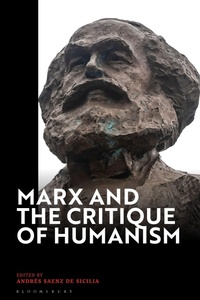
Marx and the Critique of Humanism
1. Auflage
Erschienen am 19. Februar 2026
240 Seiten
978-1-350-52637-2 (ISBN)
Beschreibung
What is the status of 'the human' and 'humanism' in Marx's thought?
Does Marx's critical project rest upon 'humanist' commitments? If so, what are these and how do they shift across his writings and inform his critical theory of capitalist society?
Marx and the Critique of Humanism addresses these questions through a diverse collection of critical interventions from leading Marxist scholars. These contributions offer both a renewed appraisal and contextualisation of the notion of 'the human' across Marx's oeuvre, as well as a range of critical perspectives on the status of humanism within critical social theory today.
The book revaluates Marx's relation to humanism by examining the intellectual context, influences and interlocutors which shaped his theoretical commitments and critical methodology; the concept of 'Gattungswesen' in Marx's early writings; the ways in which 'the human' informs and is transformed by Marx's critique of political economy; the ecological dimensions of Marx's thought; the reception of Marx's humanism by anti-colonial thinkers; and the relation of Marx's thought to post-structuralist and post-humanist critiques of enlightenment humanism. Moving beyond the simplistic picture of a 'humanistic' early Marx and a 'scientific' late Marx, this volume shows instead how a sustained concern with the human evolves in tandem with Marx's broader intellectual development.
Does Marx's critical project rest upon 'humanist' commitments? If so, what are these and how do they shift across his writings and inform his critical theory of capitalist society?
Marx and the Critique of Humanism addresses these questions through a diverse collection of critical interventions from leading Marxist scholars. These contributions offer both a renewed appraisal and contextualisation of the notion of 'the human' across Marx's oeuvre, as well as a range of critical perspectives on the status of humanism within critical social theory today.
The book revaluates Marx's relation to humanism by examining the intellectual context, influences and interlocutors which shaped his theoretical commitments and critical methodology; the concept of 'Gattungswesen' in Marx's early writings; the ways in which 'the human' informs and is transformed by Marx's critique of political economy; the ecological dimensions of Marx's thought; the reception of Marx's humanism by anti-colonial thinkers; and the relation of Marx's thought to post-structuralist and post-humanist critiques of enlightenment humanism. Moving beyond the simplistic picture of a 'humanistic' early Marx and a 'scientific' late Marx, this volume shows instead how a sustained concern with the human evolves in tandem with Marx's broader intellectual development.
Weitere Details
Auflage
1. Auflage
Sprache
Englisch
Verlagsort
London
Großbritannien
Verlagsgruppe
Bloomsbury Publishing PLC
Zielgruppe
Für Beruf und Forschung
Für höhere Schule und Studium
ISBN-13
978-1-350-52637-2 (9781350526372)
Copyright in bibliographic data and cover images is held by Nielsen Book Services Limited or by the publishers or by their respective licensors: all rights reserved.
Schweitzer Klassifikation
Weitere Ausgaben
Person
Andres Saenz de Sicilia is Assistant Professor of Philosophy at Northeastern University London, UK. He is the author of From the Critique of Reason to the Critique of Society: Subsumption in Kant, Hegel and Marx (2024) as well as texts in Radical Philosophy, European Journal of Social Theory, Language Sciences, Valenciana, the SAGE Handbook of Marxism & the SAGE Handbook of Frankfurt School Critical Theory.
Inhalt
Introduction
1. Etienne Balibar, The Marxian concept of Gattungswesen (generic being): a critical genealogy
2. Jacob Blumenfeld, The Redemption of Saint Max: Stirner's Critique of Marx
3. Manuel Disegni, "Man' is actually 'the German'": Humanism and intolerance in German ideology
4. Simon Skempton, Totality as the "Absolute Movement of Becoming": Marx's Aporetic Conception of the Human
5. Werner Bonefeld, On (Negative) Humanism and the Critique of Capital
6. Rocío Zambrana, Method, according to Marx: Toward a Critique of Normative Humanist Approaches
7. Lutti Mira, History and prehistory of human society: The place of humanism in Marxian critique of political economy
8. Arwa Awan, Dialectic in the Tropics: Praxis as a humanism
9. John Bellamy Foster, Marx's Critique of Enlightenment Humanism. A Revolutionary Ecological Perspective
10. Carol Gould, "Nothing Human is Alien to me": Revisiting and Revising Marx's Critical and Constructivist Humanism
1. Etienne Balibar, The Marxian concept of Gattungswesen (generic being): a critical genealogy
2. Jacob Blumenfeld, The Redemption of Saint Max: Stirner's Critique of Marx
3. Manuel Disegni, "Man' is actually 'the German'": Humanism and intolerance in German ideology
4. Simon Skempton, Totality as the "Absolute Movement of Becoming": Marx's Aporetic Conception of the Human
5. Werner Bonefeld, On (Negative) Humanism and the Critique of Capital
6. Rocío Zambrana, Method, according to Marx: Toward a Critique of Normative Humanist Approaches
7. Lutti Mira, History and prehistory of human society: The place of humanism in Marxian critique of political economy
8. Arwa Awan, Dialectic in the Tropics: Praxis as a humanism
9. John Bellamy Foster, Marx's Critique of Enlightenment Humanism. A Revolutionary Ecological Perspective
10. Carol Gould, "Nothing Human is Alien to me": Revisiting and Revising Marx's Critical and Constructivist Humanism
