

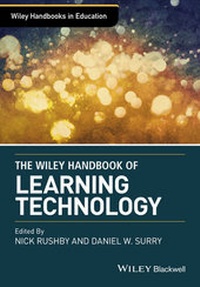
The Wiley Handbook of Learning Technology
Erschienen am 23. Februar 2016
616 Seiten
978-1-118-73663-0 (ISBN)
Beschreibung

The Wiley Handbook of Learning Technology is an authoritative and up-to-date survey of the fast-growing field of learning technology, from its foundational theories and practices to its challenges, trends, and future developments.
* Offers an examination of learning technology that is equal parts theoretical and practical, covering both the technology of learning and the use of technology in learning
* Individual chapters tackle timely and controversial subjects, such as gaming and simulation, security, lifelong learning, distance education, learning across educational settings, and the research agenda
* Designed to serve as a point of entry for learning technology novices, a comprehensive reference for scholars and researchers, and a practical guide for education and training practitioners
* Includes 29 original and comprehensively referenced essays written by leading experts in instructional and educational technology from around the world
Weitere Details
Weitere Ausgaben
Andere Ausgaben

Nick Rushby | Dan Surry
Wiley Handbook of Learning Technology
Buch
04/2016
Wiley
202,50 €
Artikel z.Zt. nicht lieferbar

Software
02/2016
Wiley
70,73 €
Keine Lieferinformation verfügbar
Personen
Nick Rushby is Editor of the British Journal of Educational Technology and Director of Conation Technologies, a strategic training consultancy working in the area of technology based training that he co-founded in 2001. A former editor of Programmed Learning and Educational Technology and Interactive Learning International, he has written and edited numerous books on CBL and CBT.
Dan Surry is Associate Dean for Curriculum and Assessment in the Harrison School of Pharmacy at Auburn University. Associate Editor, and past Editor-in-Chief, of the journal TechTrends and a former North American Corresponding Editor for the British Journal of Educational Technology, Dr. Surry is the co-editor of Technology Integration in Higher Education: Social and Organizational Aspects (with R. Gray Jr. and J. Stefurak, 2010) and Technology as a Tool for Diversity Leadership: Implementation and Future Implications (with J. Lewis and A. Green, 2012).
Dan Surry is Associate Dean for Curriculum and Assessment in the Harrison School of Pharmacy at Auburn University. Associate Editor, and past Editor-in-Chief, of the journal TechTrends and a former North American Corresponding Editor for the British Journal of Educational Technology, Dr. Surry is the co-editor of Technology Integration in Higher Education: Social and Organizational Aspects (with R. Gray Jr. and J. Stefurak, 2010) and Technology as a Tool for Diversity Leadership: Implementation and Future Implications (with J. Lewis and A. Green, 2012).
Inhalt
- Intro
- Title Page
- Copyright Page
- Contents
- Foreword
- Acknowledgements
- Contributors
- Editorial Advisory Board
- Chapter 1 Mapping the Field and Terminology
- 1.1 Living with Change
- 1.2 What is Learning Technology?
- 1.3 Focusing on Learning
- 1.4 What are the Technologies?
- 1.5 Making it Work
- 1.6 Study and Ethical Practice
- 1.7 Current Issues
- 1.8 Innovation and Change
- 1.9 Conclusion
- References
- Chapter 2 How People Learn
- 2.1 Introduction
- 2.2 Human Cognitive Architecture and Learning Processes
- 2.2.1 The construction of cognitive schemas
- 2.2.2 The automation of cognitive schemas
- 2.2.3 Complex Learning and Transfer
- 2.3 Self-Regulated and Self-Directed Learning
- 2.3.1 Learning SRL skills
- 2.3.2 Learning SDL skills
- 2.4 Discussion
- References
- Chapter 3 What is Technology?
- 3.1 Introduction
- 3.2 The Absence of Thinking about Technology Within Learning Technology
- 3.3 Foundational Discussions of Technology
- 3.4 Contemporary Discussions of Technology
- 3.5 Technology as Cause
- 3.6 Technology as Social Intervention
- 3.7 Technology as Social Effect
- 3.8 Technology as the Instantiation of Theory
- 3.9 Technology as a System Within Systems
- 3.10 Technology as Network Effect
- 3.11 Conclusions
- References
- Chapter 4 Learning Theory and Technology: A Reciprocal Relationship
- 4.1 Introduction
- 4.2 Understanding Teachers' and Designers' Conceptions of Learning
- 4.3 Teachers' Beliefs about Technology
- 4.4 Three Views on Learning
- 4.5 Learning as Response Strengthening: Behaviorism
- 4.6 Learning as Knowledge Acquisition: Cognitive Information Processing
- 4.7 Learning as Knowledge Construction: Constructivism
- 4.8 Changes in Theory Prompting Changes in Tools
- 4.9 Changes in Tools Prompting Changes in Theory
- 4.10 Conclusion
- References
- Chapter 5 Evolution of Learning Technologies
- 5.1 Background: Early Technological Infrastructure
- 5.2 Phases of Development of Learning Technologies
- 5.3 1980s: Programmed Learning and Multimedia Resources
- 5.4 Late 1980s to Early 1990s: Hypertext and Simulations
- 5.5 1993: The Internet and the Web
- 5.6 1995: Learning Systems
- 5.7 1998: Mobile Devices and m-Learning
- 5.8 2000: Gaming Technologies
- 5.9 2001: Open Educational Resources
- 5.10 2004: Social and Participatory Media
- 5.11 2005: Virtual Worlds
- 5.12 2007: E-books and Smart Devices
- 5.13 2008: Massive Open Online Courses
- 5.14 2012-14: Big Data and Learning Analytics
- 5.15 Summary
- References
- Chapter 6 Learning Technology at Home and Preschool
- 6.1 Learning Technology
- 6.1.1 Defining preschool
- 6.1.2 Developmentally appropriate technology
- 6.2 Data on Availability and Use of Digital Media
- 6.3 The Debates about Young Children and Technology
- 6.3.1 Screens and screen time
- 6.4 Play and Learning in the Early Years
- 6.4.1 Learning
- 6.5 Digital Media and Technology in Preschool Settings
- 6.5.1 Pedagogy
- 6.6 Digital Media and Technology at Home
- 6.6.1 Support at home
- 6.7 Design
- 6.8 Looking Ahead
- References
- Chapter 7 Problem Spaces: A Framework and Questions for Critical Engagement with Learning Technologies in Formal Educational Contexts
- 7.1 Introduction: Towards a Critical Pedagogy of Learning Technologies
- 7.2 Technology-supported Pedagogy: Problem Spaces
- 7.3 Problem Space 1: Pedagogy and Learning Design-Imperatives for Perpetual Renewal
- 7.4 Problem Space 2: Teacher Professional Development and Research
- 7.5 Problem Space 3: Web 2.0 and School Cultures
- 7.6 Conclusion
- References
- Chapter 8 Learning Technology in Higher Education
- 8.1 Introduction
- 8.2 Students
- 8.3 Instructors
- 8.4 Learning Design
- 8.5 Support
- 8.6 Technology
- 8.7 Institutional Dimensions
- 8.8 Conclusion
- References
- Chapter 9 Learning Technology in Business and Industry
- 9.1 Introduction
- 9.2 Foundations
- 9.3 Status Quo
- 9.3.1 Formal learning
- 9.3.2 Performance support
- 9.3.3 Social media
- 9.4 Interoperability Standards
- 9.5 Emergent Directions
- 9.5.1 The mobile revolution
- 9.5.2 Improving formal learning
- 9.5.3 Performance support opportunities
- 9.5.4 Social extensions
- 9.5.5 Emerging standards
- 9.5.6 Impacting metrics
- 9.5.7 New technology developments
- 9.6 Conclusion
- References
- Chapter 10 Educational Technologies in Distance Education: Off-campus and Online, but on Course?
- 10.1 Introduction
- 10.2 From China's Imperial Examination to MOOCs: A Brief History of Distance Education
- 10.2.1 Correspondence education
- 10.2.2 Distance education in the digital age
- 10.3 Issues in Educational Technology and Distance Education
- 10.3.1 Hype and hope
- 10.3.2 Sustaining and disruptive technology
- 10.3.3 Quality assurance
- 10.3.4 Leadership and management
- 10.4 Research and Scholarship
- 10.5 Concluding Remarks
- References
- Chapter 11 Learning Technology and Lifelong Informal, Self-directed, and Non-formal Learning
- 11.1 Introduction
- 11.2 Educational Technology and Informal Learning
- 11.3 Citizen Science
- 11.4 Educational Technology and Non-formal Education
- 11.5 Telecenters
- 11.6 Evaluation and Quality Assurance
- 11.7 Conclusion
- References
- Chapter 12 Learning with Technologies in Resource-constrained Environments
- 12.1 Introduction
- 12.2 Learning in Resource-constrained Environments
- 12.3 Learning with Technologies
- 12.4 Meaningful Learning within a Triadic Zone of Proximal Development
- 12.5 Integrating Home and School Cultures
- 12.6 The Importance of Affordances and Effectivities
- 12.7 Exploiting Local Knowledge
- 12.8 DIY Citizenship and the Maker Movement
- 12.9 Insensitivity to Prior Knowledge
- 12.10 Mobile Learning: An Ignored Obvious Choice
- 12.11 Open Educational Resources
- 12.12 Massive Open Online Courses
- 12.13 Educators Shift to Cloud-based Tools
- 12.14 Learning through Connected Devices 24/7
- 12.15 Pedagogical Choices for Teaching with Technology
- 12.16 Conclusion
- References
- Chapter 13 Competencies for Designers, Instructors, and Online Learners
- 13.1 Introduction
- 13.2 Standards of Performance
- 13.3 Changes Affecting Learning Technology
- 13.3.1 Societal changes
- 13.3.2 Evolving digital technologies
- 13.4 Evolving Understanding of Learning Processes
- 13.4.1 So what now? professional foundations: improving professional knowledge and skills
- 13.5 Instructional Designer Competence
- 13.5.1 Demonstrating instructional designer competence
- 13.5.2 Societal changes that affect the designer's job
- 13.5.3 Evolving digital technologies that affect the designer's job
- 13.5.4 Evolving understanding of learning processes that affect the designer's job
- 13.5.5 General overarching designer competencies
- 13.6 Instructor Competence
- 13.6.1 Demonstrating instructor competence
- 13.6.2 Societal changes that affect the instructor's job
- 13.6.3 Evolving digital technology that affects the instructor's job
- 13.6.4 Evolving understanding of the learning processes that affect the instructor's job
- 13.7 Online Learner Competence
- 13.7.1 Demonstrating online learner competence
- 13.7.2 Societal changes that affect learner competence
- 13.7.3 Evolving digital technologies that affect learner competency
- 13.7.4 Evolving understanding of learning processes that affect learner competence
- 13.8 Conclusion
- References
- Chapter 14 Digital Learning Environments
- 14.1 Introduction
- 14.2 Organizational Structures
- 14.3 Designing Learning Environments and Learning Experiences
- 14.4 Illustrative Example: The YoTeach! Learning Environment
- 14.5 Guided vs Minimally Guided Instruction within Digital Learning Environments
- 14.6 Illustrative Example: Project Engage!
- 14.7 Repurposed Digital Learning Environments and their Neutrality
- 14.8 Illustrative Example: Twitter and #PhDChat
- 14.9 Conclusion
- References
- Chapter 15 How to Succeed with Online Learning
- 15.1 Introduction
- 15.1.1 The paradox of online learning
- 15.1.2 A natural medium in all its many forms
- 15.2 The Place of Formal and Informal Online Learning in "The Blend"
- 15.2.1 Planned or spontaneous
- 15.2.2 Facilitated
- 15.2.3 Taught, caught, or sought?
- 15.2.4 Connected
- 15.2.5 Synchronous and asynchronous
- 15.3 Live Online Learning
- 15.3.1 A range of applications
- 15.3.2 Getting the audience ready
- 15.3.3 The mechanics of running a live online session
- 15.3.4 Strong leadership and guided choice
- 15.3.5 Create a sense of community
- 15.3.6 A well-designed live online session
- 15.3.7 Keep things fresh, up-to-date and on time
- 15.3.8 Meet special needs
- 15.3.9 Ancillary material
- 15.3.10 Who's sitting at the front?
- 15.4 Asynchronous
- 15.4.1 Social matters
- 15.4.2 Developing good practice
- 15.4.3 Guidance and direction
- 15.4.4 IT and support
- 15.5 The Rise of Online Learning
- 15.6 Online Learning in the Workplace
- 15.7 Looking Ahead
- References
- Chapter 16 Diversity and Inclusion in the Learning Enterprise: Implications for Learning Technologies
- 16.1 Introduction
- 16.2 Overview
- 16.3 Learning, Culture, and Digital Technologies
- 16.4 The Convergence of Digital Technologies and Learning Spaces
- 16.5 Diversity, Learning Technologies, and Teaching
- 16.6 Diversity, Learning Technologies, and Policymaking
- 16.7 Technology Designers: The Invisible Policymakers
- 16.7.1 General technology policy considerations
- 16.7.2 Technology policy considerations for working with learning technology vendors
- 16.7.3 Technology policy considerations for supporting teachers
- 16.7.4 Technology policy considerations for culturally relevant learning
- 16.8 The Ecology of Diversity and Learning Technologies
- References
- Chapter 17 Sins of Omission: The Search for Missing Signs by Abandoned e-Learners
- 17.1 Introduction
- 17.2 Definition of Terms
- 17.3 Review of Research
- 17.4 Cultural Approaches to Online Learning
- 17.4.1 Culture and semiotics
- 17.5 Interdisciplinary Research on Semiotics
- 17.5.1 A picture may be worth much more than a thousand words
- 17.5.2 Semiotic patterns and schematic narrative templates
- 17.5.3 Online navigation and course mapping
- 17.6 A Look at Semiotics and At-risk and Diverse Learners
- 17.7 Other Issues that can Affect Student Retention in Online Courses
- 17.7.1 Access
- 17.7.2 Equity
- 17.8 Theory and Method
- 17.8.1 Modeling systems theory
- 17.8.2 Design and development
- 17.9 Summary
- References
- Chapter 18 Equity, Access, and the Digital Divide in Learning Technologies: Historical Antecedents, Current Issues, and Future Trends
- 18.1 Introduction
- 18.2 Equity of Access
- 18.3 Historical Antecedents
- 18.4 The Digital Divide
- 18.5 Issues in Equity and Access
- 18.5.1 Access to information: open educational resources
- 18.5.2 Access to devices
- 18.6 Current Issues
- 18.7 Technology Integration and Equity of Access
- 18.7.1 The hole-in-the-wall project
- 18.7.2 One laptop per child
- 18.8 Managing Increasing Information
- 18.9 Conclusions and Future Directions
- 18.10 Lessons Learned
- 18.11 Future Research
- References
- Chapter 19 University Learning Technology Control and Security: Requires Teamwork to Succeed
- 19.1 Introduction
- 19.2 Educational Master Plan
- 19.3 Strategic Planning
- 19.4 Operational Planning
- 19.5 Tactical Planning
- 19.6 Technology
- 19.7 Technology Plan: Control
- 19.8 Technology Committee: Control and Team
- 19.9 Technology Security
- 19.10 Higher Education Security Issues
- 19.11 Securing Technology
- 19.12 Learning Technology Group
- 19.13 Information Technology Group: The Security Organization
- 19.14 Fostering Teamwork
- 19.15 Conclusion
- References
- Chapter 20 The Design of Learning
- 20.1 Introduction
- 20.2 The Notion of Design
- 20.2.1 Design-based research
- 20.2.2 Learner-centered design
- 20.2.3 The role of design
- 20.3 Design Challenges
- 20.3.1 Personal inquiry: Learning across contexts
- 20.3.2 SCY: Emerging learning objects
- 20.3.3 LETS GO: Mobile collaboratories
- 20.3.4 Reflection on projects (Empirical reflections)
- 20.3.5 Meta summary
- 20.4 Design and Research
- 20.4.1 DBR and interaction design
- 20.4.2 Focusing on the research results
- 20.4.3 Artistic research
- 20.4.4 Affective design
- 20.4.5 Design knowledge
- 20.4.6 Challenges in expanding design
- 20.5 Discussion
- 20.5.1 Future steps
- Acknowledgements
- References
- Chapter 21 Mobile Learning and Social Networking
- 21.1 Introduction
- 21.2 Mobile Learning as a Learning Technology
- 21.3 Mobile Learning as Innovation
- 21.4 Mobile Learning as Social Intervention
- 21.5 The Evidence and Impact
- 21.6 Social Networking as a Learning Technology
- 21.7 Mobile Learning and a Mobile Society
- 21.8 Mobile Learning - Moving Across the Atlantic, Moving into the Market
- 21.9 Learning with Mobiles as a Social Phenomenon
- 21.10 Learning Technology: No Longer Recognizable
- References
- Chapter 22 The Utility of Games for Society, Business, and Politics: A Frame-reflective Discourse Analysis
- 22.1 Introduction
- 22.2 Fragmentation
- 22.3 Learning and Games
- 22.4 Definitions and Taxonomies
- 22.5 Framing Theory
- 22.6 Frame-reflective Discourse Analysis
- 22.7 Methodological Approach
- 22.8 Frame Analysis of Serious Games
- 22.9 Frame-reflective Discourse Analysis: Research
- 22.10 Frame-reflective Discourse Analysis: Policy
- 22.11 Practical Implications
- 22.12 Conclusion
- References
- Chapter 23 The Investment in Learning Technologies: Evidencing Value for Money?
- 23.1 Introduction
- 23.1.1 How much is spent on e-Learning?
- 23.2 What do We Mean by Value for Money?
- 23.2.1 The two sides to the value for money question
- 23.2.2 And the other side . costs
- 23.3 Getting the Basics Right
- 23.4 Planning the Investment
- 23.5 What Exactly are "Full Costs"?
- 23.6 What Kinds of Learning Investments are More or Less Likely to Deliver Value for Money?
- 23.7 What About the Enabling Software?
- 23.8 Calculating Value for Money
- 23.9 What Can We Conclude About Learning Technologies and Value for Money?
- References
- Chapter 24 Technology Planning in Schools
- 24.1 Introduction
- 24.2 Technology Implementation Theories
- 24.3 Conditions that Facilitate Implementation
- 24.4 RIPPLES
- 24.5 Other Implementation Models
- 24.6 Developing Technology Implementation Plans
- 24.6.1 Learning outcomes
- 24.6.2 Stakeholders
- 24.6.3 Needs assessments
- 24.6.4 Communications
- 24.6.5 Organizational factors
- 24.6.6 Time
- 24.6.7 Policies and procedures
- 24.6.8 Infrastructure
- 24.6.9 Leadership
- 24.6.10 Action plan
- 24.6.11 Budget
- 24.7 Professional Development for Technology Planning
- 24.8 Evaluating Technology Implementation and Integration
- 24.8.1 Accountability
- 24.8.2 Effectiveness
- 24.8.3 Impact
- 24.8.4 Organizational factors
- 24.8.5 Unanticipated outcomes
- 24.9 Researching Technology Implementation
- 24.10 Conclusion
- References
- Chapter 25 Surviving the Next Generation of Organizations-as Leaders
- 25.1 Problematic: Bridging a Gap for a New Generation of Educational Technology Leaders
- 25.1.1 Solving the problem of overspecialization
- 25.1.2 Six common domains of educational technology and educational leader praxis
- 25.1.3 A more common evolution than education professionals realize
- 25.1.4 Organization of the chapter
- 25.2 Mapping Terrain: A Critical Examination of Ideas and Trends in the Educational Technology and Educational Leadership Fields
- 25.2.1 Design: Definition and trends
- 25.2.2 Management and planning
- 25.2.3 Management: Definition and trends
- 25.2.4 Leadership: Definition and trends
- 25.2.5 Leading organization, innovation, emergence, and change
- 25.3 Bridging the Gap: Four Sets of Principles for Educational Technologists Who Will Lead the Next Generation of Organizations
- 25.3.1 Principle set 1: Leading change
- 25.4 Conclusion
- References
- Chapter 26 Futureproofing
- 26.1 Introduction
- 26.2 Factors Shaping Society and Education
- 26.3 Abundance
- 26.4 Acceleration
- 26.5 Integration
- 26.6 Preparing for Unknown Curricula
- 26.7 The Near Term
- 26.8 The Long Term
- 26.9 The Far Term
- 26.10 Conclusion
- References
- Chapter 27 Towards a Research Agenda for Educational Technology Research
- 27.1 Introduction
- 27.2 Two Cities
- 27.2.1 Technology as medium
- 27.2.2 Technology as design
- 27.2.3 Towards a synthesis
- 27.3 The Age of Foolishness and the Age of Wisdom
- 27.3.1 The folly
- 27.3.2 Half-life of knowledge
- 27.3.3 Digital natives and homos zappiens
- 27.3.4 Multitasking
- 27.3.5 The wisdom
- 27.3.6 Cognitive load theory
- 27.3.7 Four-component instructional design model and ten steps to complex learning
- 27.3.8 Cognitive theory of multimedia learning
- 27.3.9 Four-phase model of interest development
- 27.3.10 Apotheosis instead of synthesis
- 27.4 Towards a Research Agenda
- References
- Chapter 28 The Dystopian Futures
- 28.1 Introduction
- 28.2 Dystopian Visions of Learning, Education, and Technology
- 28.2.1 The displacement of "the teacher"
- 28.2.2 The deprofessionalism of "the teacher"
- 28.2.3 The dis-engagement of the learner
- 28.2.4 The "dumbing down" of younger generations
- 28.2.5 The devaluation of knowledge
- 28.2.6 Increased surveillance and accountability
- 28.3 Making Good Use of Dystopian Visions of Learning Technology
- References
- Chapter 29 Utopian Futures for Learning Technologies
- 29.1 Introduction
- 29.2 Technological Utopianism
- 29.2.1 A more recent history of technology utopianism
- 29.3 A Utopian Future for Learning Technologies
- 29.4 A Model for a Utopian Future in Learning Technologies
- 29.5 Key Factors for Change
- 29.5.1 The future of learning: Preparing for change
- 29.6 2020 Forecast: Creating the Future of Learning
- 29.7 Shifts from Educational Institutions to Learning Flows: Mapping the Future of Learning
- 29.7.1 Shifts in learning environments
- 29.8 Organizations: The Future of Learning Institutions in a Digital Age
- 29.9 Learning Technologies
- 29.9.1 IFTF six emerging themes (future stories)
- 29.9.2 Emerging technologies
- 29.10 A Vision for Future Learning Technologies
- References
- Index
- EULA
