

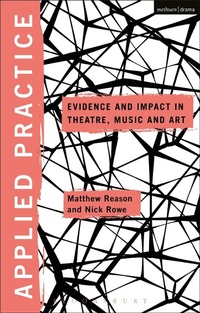
Applied Practice
Evidence and Impact in Theatre, Music and Art
1. Auflage
Erschienen am 10. August 2017
328 Seiten
978-1-4742-8384-7 (ISBN)
Beschreibung

Applied Practice: Evidence and Impact in Theatre, Music and Art engages with a diversity of contexts, locations and arts forms - including theatre, music and fine art - and brings together theoretical, political and practice-based perspectives on the question of 'evidence' in relation to participatory arts practice in social contexts. This collection is a unique contribution to the field, focusing on one of the vital concerns for a growing and developing set of arts and research practices. It asks us to consider evidence not only in terms of methodology but also in the light of the ideological, political and pragmatic implications of that methodology.
In Part One, Matthew Reason and Nick Rowe reflect on evidence and impact in the participatory arts in relation to recurring conceptual and methodological motifs. These include issues of purpose and obliquity; the relationship between evidence and knowledge; intrinsic and instrumental impacts, and the value of participatory research.
Part Two explores the diversity of perspectives, contexts and methodologies in examining what it is possible to know, say and evidence about the often complex and intimate impact of participatory arts.
Part Three brings together case studies in which practitioners and practice-based researchers consider the frustrations, opportunities and successes they face in addressing the challenge to produce evidence for the impact of their practice.
In Part One, Matthew Reason and Nick Rowe reflect on evidence and impact in the participatory arts in relation to recurring conceptual and methodological motifs. These include issues of purpose and obliquity; the relationship between evidence and knowledge; intrinsic and instrumental impacts, and the value of participatory research.
Part Two explores the diversity of perspectives, contexts and methodologies in examining what it is possible to know, say and evidence about the often complex and intimate impact of participatory arts.
Part Three brings together case studies in which practitioners and practice-based researchers consider the frustrations, opportunities and successes they face in addressing the challenge to produce evidence for the impact of their practice.
Weitere Details
Reihe
Auflage
1. Auflage
Sprache
Englisch
Verlagsort
London
Großbritannien
Verlagsgruppe
Bloomsbury Publishing PLC
Zielgruppe
Für höhere Schule und Studium
Illustrationen
4 bw illus
ISBN-13
978-1-4742-8384-7 (9781474283847)
Copyright in bibliographic data and cover images is held by Nielsen Book Services Limited or by the publishers or by their respective licensors: all rights reserved.
Schweitzer Klassifikation
Weitere Ausgaben
Andere Ausgaben
Buch
02/2019
Methuen Drama
50,90 €
Versand in 15-20 Tagen
Buch
08/2017
Methuen Drama
148,56 €
Versand in 15-20 Tagen
Personen
Matthew Reason is Professor of Theatre and Performance at York St John University, UK. Publications include Documentation, Disappearance and the Representation of Live Performance (2006), The Young Audience: Exploring and Enhancing Children's Experiences of Theatre (2010) and, co-edited with Dee Reynolds, Kinesthetic Empathy in Creative and Cultural Contexts (2012).
Nick Rowe is associate professor in Arts and Health at York St John University, UK. Publications include Playing the Other: Dramatising Personal Narratives in Playback Theatre (2007).
Nick Rowe is associate professor in Arts and Health at York St John University, UK. Publications include Playing the Other: Dramatising Personal Narratives in Playback Theatre (2007).
Inhalt
Acknowledgements
Introduction: Evidence, A Rope Comprising of Several Cords
Matthew Reason and Nick Rowe
PART 1 - FRAMING REFLECTION ON EVIDENCE AND IMPACT IN PARTICIPATORY ARTS - Matthew Reason and Nick Rowe
Chapter 1: Purpose, Outcomes and Obliquity: To Plan or Not to Plan - Matthew Reason and Nick Rowe
Chapter 2: Evidence, Knowledge and Persuasion in Arts Impact Research - Matthew Reason
Chapter 3: Intrinsic and Instrumental Impacts in Participatory Art - Matthew Reason
Chapter 4: Participatory Research in the Participatory Arts - Matthew Reason and Nick Rowe
PART 2 - RESEARCHING PARTICIPATORY ARTS: ANALYTICAL PERSPECTIVES
Introduction - Matthew Reason and Nick Rowe
Chapter 5: On the Need for Diversity of Methods in Researching Arts and Health Practice - Stephen Clift, Sidney De Haan Research Centre for Arts and Health, UK
Chapter 6: Do you see what I see? Art, Science and Evidence in Autism Research - Nicola Shaughnessy, University of Kent, UK
Chapter 7: Wrestling with Beauty: Putting the Aesthetic into Arts Evaluation - Katya Johanson and Hilary Glow, Deakin University, Australia
Chapter 8: Capturing the Intangible: Exploring Creative Risk-taking through Collaborative and Creative Methods - Elanor Stannage, York St John University, UK
Chapter 9: Besieged by Inappropriate Criteria: Arts Organisations Developing Grounded Evaluation Approaches - Anni Raw and Mary Robson, Durham University, UK
Chapter 10: The Performance of Prison Theatre Practices: Questions of Evidence - Caoimhe McAvinchey, Queen Mary University of London, UK
Chapter 11: Researching applied arts through ethnographic performance: Perspectives from African contexts - Kennedy C. Chinyowa, Tshwane University of Technology, South Africa
Chapter 12: Thou Art, I am: Discovery and Recovery in the Art Making Process - Olivia Sagan, Bishop Grosseteste University, UK
PART 3 - RESEARCHING PARTICIPATORY ARTS: PRACTICE-ORIENTATED CASE STUDIES
Introduction - Matthew Reason and Nick Rowe
Chapter 13: Dear Younger Me: Writing, Songwriting and Choral Singing While Incarcerated as a Means to Bridge Communities and Build Identities - Mary L. Cohen and Perry Miller, University of Iowa, USA
Chapter 14: Exploring the Perceived Benefits of Shared Musical Experience - Chris Bates and Liz Mellor, Leeds College of Music and York St John University, UK
Chapter 15: The Wisdom of Crowds: Applied Theatre, Social Media and Data Visualisation - Paul Sutton, applied theatre company C&T, UK
Chapter 16: A Community Based Theatre Arts Program for Adults with Disabilities: Evidence through Research, Observation and Individual Transformation - Natalie Russo, Melissa Luke, Luis Columna and Elizabethe Ingram, Syracuse University, USA.
Chapter 17: Bespoke Practices: A Practitioner's Perspective on Documenting And Evaluating the Experiences of Artists with Disabilities - Jennifer Gilbert, UK
Chapter 18: 'There's no pill for that': A Practitioner's Perspective on the Evidence Imperative in the Arts and Mental Health - Linda Boyles, Arts and Mind, UK
Chapter 19: Embracing Indeterminacy in Participatory Storytelling in a Mental Health Context - Catherine Heinemeyer, International Centre for Arts and Narrative (ICAN), UK
Chapter 20: Art Know No Boundaries: Cross Cultural Bridge Building through Transnational Arts Project - Matthew Hahn with Lungile Dlamini & Marius Botha, UK and South Africa
Chapter 21: Foot in Mouth, Mouth in Trough: Doing Good, Evaluation and other Megalomania - Scott Rankin, Big hART, Australia
Afterword: Confidence in Art as EvidenceEndnotes - Ross W. Prior, University of Wolverhampton, UK
Bibliography
Notes on Contributors
Index
Introduction: Evidence, A Rope Comprising of Several Cords
Matthew Reason and Nick Rowe
PART 1 - FRAMING REFLECTION ON EVIDENCE AND IMPACT IN PARTICIPATORY ARTS - Matthew Reason and Nick Rowe
Chapter 1: Purpose, Outcomes and Obliquity: To Plan or Not to Plan - Matthew Reason and Nick Rowe
Chapter 2: Evidence, Knowledge and Persuasion in Arts Impact Research - Matthew Reason
Chapter 3: Intrinsic and Instrumental Impacts in Participatory Art - Matthew Reason
Chapter 4: Participatory Research in the Participatory Arts - Matthew Reason and Nick Rowe
PART 2 - RESEARCHING PARTICIPATORY ARTS: ANALYTICAL PERSPECTIVES
Introduction - Matthew Reason and Nick Rowe
Chapter 5: On the Need for Diversity of Methods in Researching Arts and Health Practice - Stephen Clift, Sidney De Haan Research Centre for Arts and Health, UK
Chapter 6: Do you see what I see? Art, Science and Evidence in Autism Research - Nicola Shaughnessy, University of Kent, UK
Chapter 7: Wrestling with Beauty: Putting the Aesthetic into Arts Evaluation - Katya Johanson and Hilary Glow, Deakin University, Australia
Chapter 8: Capturing the Intangible: Exploring Creative Risk-taking through Collaborative and Creative Methods - Elanor Stannage, York St John University, UK
Chapter 9: Besieged by Inappropriate Criteria: Arts Organisations Developing Grounded Evaluation Approaches - Anni Raw and Mary Robson, Durham University, UK
Chapter 10: The Performance of Prison Theatre Practices: Questions of Evidence - Caoimhe McAvinchey, Queen Mary University of London, UK
Chapter 11: Researching applied arts through ethnographic performance: Perspectives from African contexts - Kennedy C. Chinyowa, Tshwane University of Technology, South Africa
Chapter 12: Thou Art, I am: Discovery and Recovery in the Art Making Process - Olivia Sagan, Bishop Grosseteste University, UK
PART 3 - RESEARCHING PARTICIPATORY ARTS: PRACTICE-ORIENTATED CASE STUDIES
Introduction - Matthew Reason and Nick Rowe
Chapter 13: Dear Younger Me: Writing, Songwriting and Choral Singing While Incarcerated as a Means to Bridge Communities and Build Identities - Mary L. Cohen and Perry Miller, University of Iowa, USA
Chapter 14: Exploring the Perceived Benefits of Shared Musical Experience - Chris Bates and Liz Mellor, Leeds College of Music and York St John University, UK
Chapter 15: The Wisdom of Crowds: Applied Theatre, Social Media and Data Visualisation - Paul Sutton, applied theatre company C&T, UK
Chapter 16: A Community Based Theatre Arts Program for Adults with Disabilities: Evidence through Research, Observation and Individual Transformation - Natalie Russo, Melissa Luke, Luis Columna and Elizabethe Ingram, Syracuse University, USA.
Chapter 17: Bespoke Practices: A Practitioner's Perspective on Documenting And Evaluating the Experiences of Artists with Disabilities - Jennifer Gilbert, UK
Chapter 18: 'There's no pill for that': A Practitioner's Perspective on the Evidence Imperative in the Arts and Mental Health - Linda Boyles, Arts and Mind, UK
Chapter 19: Embracing Indeterminacy in Participatory Storytelling in a Mental Health Context - Catherine Heinemeyer, International Centre for Arts and Narrative (ICAN), UK
Chapter 20: Art Know No Boundaries: Cross Cultural Bridge Building through Transnational Arts Project - Matthew Hahn with Lungile Dlamini & Marius Botha, UK and South Africa
Chapter 21: Foot in Mouth, Mouth in Trough: Doing Good, Evaluation and other Megalomania - Scott Rankin, Big hART, Australia
Afterword: Confidence in Art as EvidenceEndnotes - Ross W. Prior, University of Wolverhampton, UK
Bibliography
Notes on Contributors
Index
