

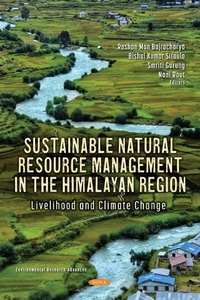
Sustainable Natural Resource Management in the Himalayan Region: Livelihood and Climate Change
Erschienen am 22. Dezember 2020
334 Seiten
978-1-5361-9089-2 (ISBN)
Beschreibung
The greater Himalayan region, stretching from Afghanistan in the west to Myanmar in the east, is home to about a quarter of a billion people who greatly depend on available natural resources for their survival and livelihoods. The ever-increasing population pressure and changing climate have grave implications for the sustenance of human health and habitation in the foreseeable future. The region is confronted with numerous challenges related to forest degradation, land productivity, disaster risk, water management, biodiversity loss, erratic climatic patterns, as well as socio-political capacity. The limits of arable land have essentially been reached, while the need for enhancing production to sustain human nutritive requirements and livelihoods continues to increase. Hence, the intensification of agriculture has become a necessity rather than a choice. Yet, producing greater numbers of crops and quantities of food, fiber and other materials on the same parcel of land runs the risk of degrading the soil fertility, productivity and overall quality. Therefore, means to achieve this without irreversibly damaging the soil and land resource base have become imperative. To this end, agro-forestry, agro-slivi-pastoral systems, and the adoption of a variety of regenerative crops, soil and water management and conservation practices offer the potential to deliver multiple benefits without sacrificing the very resource upon which the human population depends. The need for ecologically sound and sustainable management of natural resources in the Himalayan region, as well as the adaptation of local communities to the impacts of climate change and measures for its mitigation, cannot be over-emphasized. This book presents findings on approaches to sustainable land management and the intensification of agriculture and animal husbandry related to soil organic matter management and carbon sequestration for multiple benefits; and the agroforestry as a crop diversification strategy with livelihood and climate mitigation/adaptation benefits, along with other aspects of forest, biodiversity and water resources management. The book deals with technical, socio-economic, policy and biodiversity issues related to the sustainable use and management of natural resources, namely forests, soil/land, water, crops, animal husbandry and diversity of flora/fauna, as well as disaster risk and vulnerability of communities in the Himalayan region. There is a continuing need to study and research approaches for harmonizing human needs and lifestyles with natural ecosystems and processes so that both may co-exist in a mutually beneficial manner.
Weitere Details
Weitere Ausgaben
Inhalt
- Intro
- Contents
- Preface
- Section I: Forest Resource Management in the Context of Climate Change
- Chapter 1
- Community-Based Natural Resource Management in Nepal
- Abstract
- 1.2. CBNRM Practices in Nepal
- 1.2.1. Community Forestry (CF)
- 1.2.2. Leasehold Forestry (LF)
- 1.2.3. Buffer Zone (BZ) Management
- 1.2.4. Conservation Area Management
- 1.2.5. Collaborative Forest Management
- 1.2.6. Participatory Integrated Watershed Management (PIWM)
- 1.3. Key Outcomes
- 1.3.1. Forest Restoration
- 1.3.2. Rural Livelihoods Diversification
- 1.3.3. Climate Change Mitigation and Adaptation
- 1.3.4. Democratic Resource Governance
- 1.4. Emerging Issues and Challenges
- 1.4.1. Resource Management Conflict
- 1.4.2. Community Participation
- 1.4.3. Techno-Bureaucratic Domination
- 1.4.4. Equity and Social Justice
- Conclusion
- References
- Chapter 2
- Estimation of Carbon Stocks in Bhutanese Forests
- Abstract
- 2.1. Introduction
- 2.2. Forest Management in Bhutan
- 2.2.1. Overview of Forests in Bhutan
- 2.2.2. Forest Management and Governance
- 2.3. Agro-Ecological Zones
- 2.4. Carbon Storage
- 2.5. Loss of Carbon
- 2.6. Strategies to Sequester Carbon
- 2.6.1. Case Study I
- 2.6.2. Case Study II
- 2.7. Carbon Distribution Pattern
- Conclusion
- References
- Chapter 3
- Diversified Agroforestry Systems for Livelihood Security, Sustainability and Climate Resilience of Smallholder Farms in the Himalaya
- Abstract
- 3.1. Introduction
- 3.2. Methods
- 3.3. Results
- 3.4. Discussion
- Conclusion
- References
- Section II: Mountain Farming Systems and Soil Management
- Chapter 4
- Regenerative Approach for Sustainability and Climate Resilience of Mountain Agro-Ecosystems
- Abstract
- 4.1. Introduction
- 4.2. Human Development - A Brief Historical Perspective
- 4.3. Need for Paradigm Shift in Managing Soil Resources
- 4.4. Regenerative Land Management Alternatives
- Future Prospects and Conclusion
- References
- Chapter 5
- Agricultural Change for Rural Transformation in Nepal
- Abstract
- 5.1. Pathways to Intensification of Agriculture
- 5.2. Assessment of Agricultural Sector in Nepal
- 5.3. Understanding the Process of Agricultural Intensification in Nepal
- 5.4. Implications of Agricultural Transformation
- 5.5. Sustainable Agricultural Intensification: A Way Forward for Rural Transformation
- References
- Chapter 6
- Soil Quality and Organic Carbon Management in a Mountainous Landscape of the HKH Region in Pakistan
- Abstract
- 6.1. Introduction
- 6.2. Status of Soil Quality and its Management in the HKH Region of Pakistan
- 6.3. Soil Organic Carbon Management in the HKH Region of Pakistan
- Conclusion
- References
- Chapter 7
- Sustainable Land Management
- Practices in Bhutan
- Abstract
- 7.1. Introduction
- 7.2. Sustainable Land Management Programs and Practices
- 7.3. Salamjee Phashing Zinchoung Tshogpa (SPZT) as a Successful Case of Slm Adoption
- Conclusion
- References
- Chapter 8
- Biochar as a Catalyst to Enhance Productivity of Coffee Agroforestry Systems and Local Livelihoods in the Mid-Hills of Nepal
- Abstract
- 8.1. Introduction
- 8.2. Methods
- 8.2.1. Study Location
- 8.2.2. Determining Biochar Quality
- 8.2.3. Design of Experimental Plots
- 8.2.4. Monitoring of Plant Growth and Productivity
- 8.2.5. Monitoring the Status of Soil Organic Carbon
- 8.3. Key Findings
- 8.3.1. Properties of Biochar
- 8.3.2. Effects on Soil Properties
- 8.3.3. Effects on Carbon Stocks in Soil and Aboveground Biomass
- 8.4. Discussion
- 8.4.1. Significance of Porosity in Biochar Particles
- 8.4.2. Biochar Properties in Relation to Feedstock Varieties
- 8.4.3. Nutrient Values of Coffee Waste Biochar
- 8.4.4. Effects of Biochar on Soil Bulk Density, CEC, Phosphorus and Potassium
- Conclusion and Way Forward
- References
- Section III: Natural Disasters, Resilience and Transformative Thinking
- Chapter 9
- Disaster Risk Reduction and Management for Resilient Mountain Communities in Nepal
- Abstract
- 9.1. Introduction
- 9.2. DRRM Procedure in Nepal
- 9.3. Selected Study Areas
- 9.4. Methods for Sensitization
- 9.5. Program Results
- 9.5.1. Shankarapur Municipality
- 9.5.2. Kathmandu District Coordination Committee
- 9.5.3. Kavrepalanchowk District Coordination Committee
- 9.5.4. Nuwakot District Coordination Committee
- 9.5.5. Suryagadhi Rural Municipality
- 9.5.6. Indrawati Rural Municipality
- 9.5.7. Melamchi Municipality
- 9.5.8. Chautara Municipality
- 9.5.9. Tripurasundari Rural Municipality
- 9.5.10. Bhotekoshi Rural Municipality
- 9.5.11. Sunkoshi Rural Municipality
- 9.5.12. Galchi Rural Municipality
- 9.5.13. Gajuri Rural Municipality
- 9.5.14. Benighat Rorang Rural Municipality
- 9.5.15. Pokhara Metropolitan City
- 9.6. Outlook and Future Prospects for the Program
- References
- Chapter 10
- Human Mindset, Attitudes, and Behavior Influencing Natural Resource Management: Water Quality in Pakistan
- Abstract
- 10.1. Introduction
- 10.2. State of the Art
- 10.2.1. Social Norms and Attitudes
- 10.2.2. Mindset and Behavior
- 10.2.3. Theoretical Frameworks/Models
- 10.2.3.1. Norm Activation Model (NAM)
- 10.2.4. Reasoned/Responsible Action Theory
- 10.2.5. Health Belief Model
- 10.2.6. Research Design for Case Study
- 10.3. Results and Discussion
- 10.3.1. Reasons behind Human Related Water Quality Issues
- 10.3.2. Human Attitudes, Mindset and Behaviors Pertaining to Water Pollution
- 10.3.3. Barriers and Enablers for Improvement of Water Quality Management
- Conclusion
- Recommendations and Future Prospects
- References
- Chapter 11
- Vulnerability of Local Communities to Climate-Related Disasters in the Himalayan Region
- Abstract
- 11.1. Introduction
- 11.2. The Himalaya - Source of Freshwater
- 11.3. Vulnerability Due to Geographic Location
- 11.4. Vulnerability to Landslides
- 11.5. Socioeconomic Vulnerability in the Himalayas
- 11.6. Vulnerability to Glacial Lake Outburst Floods
- 11.7. Future Prospects and Needs
- References
- Section IV: Water Quality, Security and Resource Management
- Chapter 12
- Irrigation Water Quality of Surkhet Valley, Nepal
- Abstract
- 12.1. Introduction
- 12.2. Methods and Materials
- 12.2.1. Data Collection and Sampling
- 12.3. Results and Discussion
- Conclusion
- Acknowledgments
- References
- Chapter 13
- Water Resource Management in Bhutan
- Abstract
- 13.1. Background
- 13.2. Water Resources of Bhutan
- 13.2.1. Water Resource Availability
- 13.2.2. Rivers and Basin
- 13.2.3. Glaciers
- 13.2.4. Glacial Lakes
- 13.2.5. Wetlands
- 13.2.6. Ramsar Sites
- 13.2.7. Springs and Groundwater
- 13.3. Water Demand and Withdrawal in Bhutan
- 13.4. Water Resource Management
- 13.4.1. A Paradox of Water Resources in Bhutan
- 13.4.2. Water Resource Governance, Planning and Management
- 13.4.3. Integrated Water Resource Management
- 13.4.4. Institutions and Agencies in Water Governance
- 13.5. Challenges
- 13.6. Way Forward
- References
- Chapter 14
- Assessment of Water Resources with Reference to Mountain Aquifers and Spring Hydrology in Bhutan
- Abstract
- 14.1. Introduction
- 14.2. The Groundwater Dependence of Surface Water Features
- 14.3. Does Water Always Flow Downhill? The Concept of Spring Sheds in Bhutan
- 14.4. Watersheds and Their Management in Bhutan
- 14.5. Goals and Types of Watershed Intervention
- 14.6. The Debatable Role of Vegetation
- 14.7. Hydrologic Modeling Needs and Knowledge Gaps
- 14.7.1. Precipitation
- 14.7.2. Interception
- 14.7.3. Evaporation and Transpiration
- 14.8. Alternative Water Sources
- 14.8.1. Groundwater Abstraction
- 14.8.2. Infiltration and Impact of Boreholes in Bhutan
- 14.8.3. River Water Quality and Sustainability
- Conclusion
- Acknowledgments
- References
- Chapter 15
- River Water Pollution Due to Vehicle Washing in Bhutan
- Abstract
- 15.1. Introduction
- 15.2. State of River Water Quality in Bhutan
- 15.3. Vehicle Wash Wastewater Issue in Bhutan
- 15.4. Physicochemical Characterization of Vehicle Wash Wastewater
- 15.5. Impact of Vehicle Wash Wastewater on Surface Water Quality
- 15.6. Impact of Vehicle Wash Wastewater on Benthic Macroinvertebrates
- Conclusion
- References
- Section V: Biodiversity and its Conservation
- Chapter 16
- Spiritual Ecology of Water: Water and Prayer in Christianity, Islam, Veda and Avesta
- Abstract
- 16.1. Introduction
- 16.2. Water in Wisdom Tradition and Ecology
- Conclusion
- References
- Chapter 17
- Status and Role of Tributaries in Fish Conservation: Fish Diversity in Nepalese Rivers
- Abstract
- 17.1. Introduction
- 17.2. Methods
- 17.3. Results and Discussion
- Conclusion
- Acknowledgements
- Chapter 18
- Diatom Studies in High Altitude Lakes in the Himalaya
- Abstract
- 18.1. Introduction
- 18.2. Methods and Materials
- 18.2.1. Study Areas
- 18.2.2. Field and Laboratory Procedures
- 18.3. Results and Discussion
- 18.3.1. Taxonomic Studies
- 18.3.2. Diatom Assemblages within Lake Areas
- 18.3.2.1. Rara Lake
- 18.3.2.2. Gokyo Valley Lakes
- 18.3.2.3. Gosainkunda Area Lakes
- 18.3.3. Assemblage Composition and Diversity: Comparison between Lake Areas
- Conclusion
- Acknowledgments
- References
- Chapter 19
- Knowledge and Public Perception toward Conservation of Bats in Bhutan
- Abstract
- 19.1. Introduction
- 19.2. Cultural Myths and Religious Beliefs about Bats
- 19.3. Knowledge and Traditional Beliefs
- 19.4. Local People's Knowledge on Ecological Importance of Bats
- 19.5. Local People's Knowledge on Economic Importance of Bats
- 19.6. Public Perception on Species Diversity and Distribution of Bats
- 19.7. Researcher Perceptions on Bats and Pathogens
- 19.8. Conservation Importance of Bats
- 19.9. Bat Conservation Status in Bhutan
- 19.10. Improving Public Perception of Bats
- Conclusion
- Acknowledgments
- References
- Chapter 20
- Trophy Hunting of Wild Ungulates
- in Northern Pakistan
- Abstract
- 20.1. Introduction
- 20.2. Trophy Hunting in Pakistan
- 20.3. Trophy Hunting in Gilgit-Baltistan
- 20.3.1. The Hunting Statistics
- 20.3.2. Ecological Perspectives
- 20. 3.3. Socioeconomic Perspectives
- Conclusion and Conservation Implications
- References
- Section VI: Policies and Governance in Natural Resource Management
- Chapter 21
- Natural Resource Management Policies and Governance in Nepal
- Abstract
- 21.1. Introduction
- 21.2. Natural Resource Management Paradigms
- 21.3. Natural Resource Governance and Institutions
- 21.4. Natural Resource Management in Nepal's Constitution
- 21.5. Natural Resource Management Policies and Sustainable Development Goals
- 21.6. Emerging Issues in Natural Resource Governance
- Conclusion
- References
- Chapter 22
- Political Ecology of Environmental Conservation: A Case of the Bhutan Himalaya
- 22.1. Introduction
- 22.2. History of Environmental Conservation and Mapping the Conservation Debate
- 22.3. Emergence of Environmental Conservation in Bhutan
- 22.4. Synergies and Trade-Offs of Environmental Conservation
- 22.5. Political Ecological Perspectives: Discussion and Way Forward
- References
- Epilogue
- Concluding Remarks and Future Research Priorities
- 23.1 Overview
- 23.2 Forest Resources
- 23.3 Agriculture and Land Management
- 23.4 Mountain Hazards and Disaster Management
- 23.5 Water Resources
- 23.6 Biodiversity Conservation
- 23.7 Policies and Governance
- 23.8 Future Research Priorities
- About the Editors
- Index
- Blank Page
- Blank Page
