

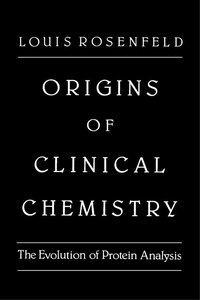
Origins of Clinical Chemistry
The Evolution of Protein Analysis
Erschienen am 2. Dezember 2012
384 Seiten
978-0-323-15292-1 (ISBN)
Beschreibung

Origins of Clinical Chemistry: The Evolution of Protein Analysis covers the history of the application of analytical methods to the plasma protein analysis. This book is divided into 20 chapters that consider the relationship between the limitation of technical accuracy and clinical interpretation. The introductory chapters provide an overview of the concept and issues in protein chemistry, as well as the history of organic chemistry. The succeeding chapters deal with the classification, detection, fractionation, and analysis of proteins. Considerable chapters are devoted to various analytical techniques for protein analysis, including colorimetry, photometry, Svedberg technique, ultracentrifuging, zone electrophoresis, immunohistochemical methods, and radioimmunoassay. The remaining chapters examine the detection and analysis of proteins in several body fluids, such as urine and cerebrospinal fluid. This book will be of great value to clinical, analytical, and organic chemists, as well as to protein scientists and researchers.
Weitere Details
Weitere Ausgaben
Andere Ausgaben

Buch
05/1982
Academic Press
54,31 €
Artikel ist vergriffen; siehe andere Ausgabe
Inhalt
PrefaceAcknowledgmentsIntroduction1. Protein: Concept and Controversy I. Protein: The Ubiquitous Molecule II. Metabolism of Protein III. The Development of Protein Chemistry IV. The Word and the Concept V. The Protein Theory of Mulder VI. Liebig's Analyses VII. Mulder's Conflict with Liebig VIII. Liebig's Laboratory at Giessen IX. Dumas2. The Colloidal State I. The Tyndall Effect II. The Ultramicroscope III. Different Worlds of Matter IV. The Size of Colloidal Particles3. The Origins of Organic Chemistry I. The Vital Force II. The Chemical Nature of Organic Compounds III. The Discovery of Oxygen, Nitrogen, and Hydrogen IV. Lavoisier V. The Diversity of Organic Compounds VI. Wöhler's Synthesis of Urea VII. The New Organic Chemistry VIII. Discovery of the Amino Acids IX. Chemical Techniques for Separating Amino Acids X. The Vast Diversity of Protein Structure XI. Protein Structure: The Fischer-Hofmeister Theory XII. Molecular Size of Proteins4. The Kjeldahl Method for Nitrogen I. Introduction II. The Dumas Method for Nitrogen III. The Carlsberg Laboratory IV. Development of the Kjeldahl Method V. Impact of the Kjeldahl Method VI. Modifications and Improvements VII. Application of the Method to Combined Nitrogen VIII. Description of the Procedure IX. Current Status X. Kjeldahl Analysis of Plasma Proteins5. Classification of Proteins I. Introduction II. Simple Proteins III. Conjugated Proteins IV. Derived Proteins V. The Basis of Plasma Protein Analysis6. Detection of Protein I. Introduction II. Criteria of Purity III. Analysis of Protein7. Protein Fractionation I. Introduction II. Early Distinctions between Albumin and Globulin III. The Precipitating Action of Ammonium Sulfate IV. The Precipitating Action of Sodium Sulfate V. Howe's Method for Fractionating Serum Proteins VI. Advantages and Disadvantages of Howe's Method VII. Inhomogeneity of Salt-Precipitated Fractions VIII. Discrepancy between Electrophoresis and Salt Precipitation Methods IX. Modification and Improvement of Howe's Method X. Precipitation of Globulin with Sodium Sulfite XI. Protein Precipitation with Phosphate Buffers XII. Precipitating Action of Heavy Metals and Alkaloidal Reagents XIII. Precipitation with Organic Solvents8. Nonspecific Tests and Procedures I. Determination of Physical Properties of Protein Solutions II. The Turbidity Procedures9. Colorimetry and Photometry I. Introduction II. Colorimetry III. Nephelometry IV. Turbidimetry V. Photometric Colorimetry VI. The Biuret Reaction VII. Phenol Reaction for Tyrosine VIII. Ultraviolet Absorbance (250-300 nm) IX. Far Ultraviolet Absorbance (200-250 nm) X. Biuret: The Popular Choice XI. Albumin-Specific Dye Binding XII. Direct Colorimetric Analysis of Globulin XIII. Analysis of ¿-Globulin XIV. Normal Serum Protein Values10. Svedberg and the Ultracentrifuge I. Introduction II. Early Work of Svedberg III. The Optical Centrifuge IV. Construction of the "Ultra-Centrifuge" V. Determining the Molecular Weight of Proteins VI. Physical Parameters Affecting the Analysis VII. The Oil-Turbine Ultracentrifuge VIII. Monodisperse Systems IX. Improvements in Design X. The Optical System XI. Later Designs of the Ultracentrifuge XII. The Existence of Proteins as Uniform Molecules XIII. Sedimentation Coefficient XIV. Limitation of Clinical Applications XV. Other Applications11. Tiselius and the Moving Boundary Electrophoresis I. Historical Introduction II. Early Experiments III. Modern Era of Protein Electrophoresis IV. Electrokinetic Phenomena of Protein Solutions V. Electrophoretic Techniques VI. A New Electrophoresis Instrument VII.
