

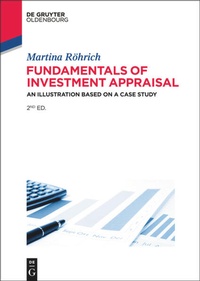
Fundamentals of Investment Appraisal
Beschreibung

How to make sound investment decisions: Fundamentals of Investment Appraisal, 2nd edition, is based on long-term experience with students and is written in an easily understood style. A case study has been constructed to illustrate all methods discussed.
The goal of the book is to pace a sure way through the variety of methods in investment appraisal. Mathematical basics are specifically explained in detail. The book shows clearly why there are different methods in investment appraisal and on where to focus in a given situation. As all methods are introduced by the same case study, it is easy to compare and evaluate the results.
The statements in the text are further consolidated by abstracts and evaluations of each of the methods. Exercises with extensive solutions will lead to the confidence which is necessary for an ease of handling the investment appraisal techniques and for a good preparation for students' exams.
German and international students at universities and other institutions of higher education will find this book an excellent systematic preparation for their exams.
Weitere Details
Weitere Ausgaben
Andere Ausgaben
Vorauflage
Person
Inhalt
- Intro
- Preface
- Abbreviations and Symbols
- Basic Data of the Vehicles
- 1 An Introduction to the Investment Decision
- 1.1 Learning Objectives
- 1.2 Case: Car Sharing Company
- 1.3 Investment Decisions and Business Finance
- 1.4 Classification of Investments and Stages of the Investment Process
- 1.5 Investment Appraisal Techniques
- 1.6 Summary and Evaluation
- 1.7 Exercises with Answers
- 1.7.1 Exercises
- 1.7.2 Answers
- 2 Non-discounting Methods of Investment Appraisal
- 2.1 Learning Objectives
- 2.2 Cost Comparison Method
- 2.2.1 Introduction
- 2.2.2 Comparison of Alternatives
- 2.2.3 Salvage Values
- 2.2.4 Critical Values
- 2.2.5 Replacement Decision
- 2.2.6 Evaluation of the Cost Comparison Method
- 2.3 Profit Comparison Method
- 2.3.1 Introduction
- 2.3.2 Comparison of Alternatives
- 2.3.3 Salvage Values
- 2.3.4 Critical Values
- 2.3.5 Replacement Decision
- 2.3.6 Evaluation of the Profit Comparison Method
- 2.4 Accounting Rate of Return Method
- 2.4.1 Introduction
- 2.4.2 Comparison of Alternatives
- 2.4.3 Salvage Values
- 2.4.4 Replacement Decision
- 2.4.5 Evaluation of the Accounting Rate of Return Method
- 2.5 Payback Method
- 2.5.1 Introduction
- 2.5.2 Comparison of Alternatives
- 2.5.3 Salvage Values
- 2.5.4 Replacement Decision
- 2.5.5 Evaluation of the Payback Method
- 2.6 Summary and Evaluation of the Non-Discounting Methods
- 2.7 Exercises with Answers
- 2.7.1 Exercises
- 2.7.2 Answers
- 3 Discounting Methods of Investment Appraisal
- 3.1 Learning Objectives
- 3.2 Time Value of Money
- 3.2.1 Basic Example
- 3.2.2 Compounding and Discounting
- 3.2.3 Future Value and Present Value of an Annuity
- 3.2.4 Annual Equivalent Factor and Sinking Fund Factor
- 3.2.5 Summary of Time Value of Money Calculations
- 3.3 Net Present Value Method
- 3.3.1 Introduction
- 3.3.2 Role of Financing
- 3.3.3 Relevance of Differential Investments
- 3.3.4 Comparison of Alternatives
- 3.3.5 Replacement Decision
- 3.3.6 Evaluation of the Net Present Value Method
- 3.4 Annuity Method
- 3.4.1 Introduction
- 3.4.2 Comparison of Alternatives
- 3.4.3 Replacement Decision
- 3.4.4 Evaluation of the Annuity Method
- 3.5 Internal Rate of Return Method
- 3.5.1 Introduction
- 3.5.2 Comparison of Alternatives
- 3.5.3 Internal Rate of Return versus Net Present Value
- 3.5.4 Evaluation of the Internal Rate of Return Method
- 3.6 Discounting Payback Method
- 3.6.1 Introduction
- 3.6.2 Comparison of Alternatives
- 3.6.3 Replacement Decision
- 3.6.4 Evaluation of the Discounting Payback Method
- 3.7 Summary and Evaluation of the Discounting Methods
- 3.8 Exercises with Answers
- 3.8.1 Exercises
- 3.8.2 Answers
- 4 Investment Decision Making under Conditions of Uncertainty
- 4.1 Learning Objectives
- 4.2 Uncertainty and Risk
- 4.3 Correction Method
- 4.3.1 Introduction
- 4.3.2 Comparison of Alternatives
- 4.3.3 Evaluation of the Correction Method
- 4.4 Sensitivity Analysis
- 4.4.1 Introduction
- 4.4.2 Comparison of Alternatives
- 4.4.3 Evaluation of the Sensitivity Analysis
- 4.5 Risk Analysis
- 4.5.1 Introduction
- 4.5.2 Comparison of Alternatives
- 4.5.3 Evaluation of the Risk Analysis
- 4.6 Decision Tree Analysis
- 4.6.1 Introduction
- 4.6.2 Comparison of Alternatives: Fixed Planning
- 4.6.3 Comparison of Alternatives: Flexible Planning
- 4.6.4 Evaluation of the Decision Tree Analysis
- 4.7 Summary and Evaluation
- 4.8 Exercises with Answers
- 4.8.1 Exercises
- 4.8.2 Answers
- 5 Advanced Topics of Investment Appraisal
- 5.1 Learning Objectives
- 5.2 Taxation
- 5.2.1 Introduction
- 5.2.2 Comparison of Alternatives
- 5.2.3 Evaluation of Taxation
- 5.3 Inflation
- 5.3.1 Introduction
- 5.3.2 Comparison of Alternatives
- 5.3.3 Evaluation of Inflation
- 5.4 Complete Financial Plan
- 5.4.1 Introduction
- 5.4.2 Comparison of Alternatives
- 5.4.3 Evaluation of the Complete Financial Plan
- 5.5 Scoring Model
- 5.5.1 Introduction
- 5.5.2 Comparison of Alternatives
- 5.5.3 Evaluation of the Scoring Model
- 5.6 Macroeconomic Net Present Value Method
- 5.6.1 Introduction
- 5.6.2 Comparison of Alternatives
- 5.6.3 Evaluation of the Macroeconomic Net Present Value Method
- 5.7 Summary and Evaluation
- 5.8 Exercises with Answers
- 5.8.1 Exercises
- 5.8.2 Answers
- 6 Index of Questions and Solutions
- 7 References
- 8 Mathematical Tables
- 9 Index
