

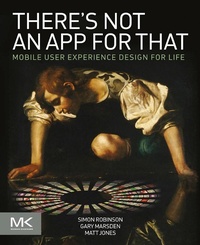
There's Not an App for That
Mobile User Experience Design for Life
Erschienen am 14. September 2014
448 Seiten
978-0-12-416699-8 (ISBN)
Beschreibung
There's Not an App for That will make your work stand out from the crowd. It walks you through mobile experiences, and teaches you to evaluate current UX approaches, enabling you to think outside of the screen and beyond the conventional. You'll review diverse aspects of mobile UX: the screens, the experience, how apps are used, and why they're used. You'll find special sections on "challenging your approach", as well as a series of questions you can use to critique and evaluate your own designs. Whether the authors are discussing real-world products in conjunction with suggested improvements, showcasing how existing technologies can be put together in unconventional ways, or even evaluating "far out" mobile experiences of the future, you'll find plenty of practical pointers and action items to help you in your day-to-day work.
- Provides you with new and innovative ways to think about mobile design
- Includes future mobile interfaces and interactions, complete with real-world, applied information that teaches you how today's mobile services can be improved
- Illustrates themes from existing systems and apps to show clear paths of thought and development, enabling you to better design for the future
Weitere Details
Weitere Ausgaben
Personen
Simon Robinson is a researcher in the Future Interaction Technology Lab at Swansea University. His work so far has focused on mobile technologies that allow people to immerse themselves in the places, people and events around them, rather than just in their mobile devices. His research - much of which has been part of the thinking behind this book - has been featured in New Scientist magazine, on CBC Radio, and in other international media venues; and, has also been published in many international academic conferences and journals. In the past few years his emphasis has turned toward developing similarly face-on user experiences for resource-constrained communities in regions such as South Africa and India. Simon is an avid rock climber, and loves the fact that climbing doesn't need a touchscreen to be thoroughly enjoyable.More at simon.robinson.acGary Marsden was a professor of computer science at the University of Cape Town, pioneer and passionate advocate of HCI for development, and community builder. He became internationally known for his work in mobile interface design, design, and ICT for development (ICT4D) - for which he was a recipient of the ACM SIGCHI's Social Impact Award in 2007. He went to great lengths to show how mobile technologies were revolutionizing how developing countries were advancing apace. In doing so, he raised the profile of what developing world actually meant. Gary died suddenly of a heart attack on December 27, 2013, and is survived by his wife Gil and his two children, Holly and Jake.Matt Jones is a professor and Head of Department of Computer Science, Swansea University. His research work focuses on human-centered computing with particular emphasis on mobile and ubiquitous computing and resource-constrained communities in regions such as India and South Africa. His work in these contexts has been recognized by an IBM Faculty Award and, from 2014, by a Royal Society Wolfson Research Merit Award. Matt has had many active collaborations and interactions with industry, NGO and Governmental stakeholders including Microsoft Research, Nokia Research and IBM Research. In his spare time he tries to live life face-on with his energetic family, and enjoys nothing more than an exhilarating early morning cycle ride to the glorious beaches of the Gower.
Inhalt
1. Introduction
2. From Touch To Feeling
3. Inspired By Food
4. Inspired By Fashion
5. Inspired By Fitness
6. Inspired By Materials
7. From Heads Down To Face On
8. In Your Face Technology
9. In The World Approaches
10. From Clinical To Clutter
11. Inspired By Mass
12. Inspired By Uncertainty
13. From Private And Personal To Public And Performance
14. Mobiles As Props
15. Extravagant Computing
16. From Distanced To Mindful Interaction
17. Designing Mindful Communication Apps
18. Mindfulness Without Apps
19. From Some To All
20. Bringing Things Together
