

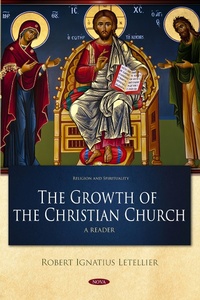
Growth of the Christian Church: A Search for Faith, Form and Freedom (A Reader)
Erschienen am 6. April 2022
357 Seiten
978-1-68507-853-9 (ISBN)
Beschreibung
This volume is the second of two devoted to the growth of the Christian Church over the two millennia of its existence. The volumes are meant to supplement each other-the first as history of the development of established faith in Jesus Christ; the second as a series of articles and citations that throw deeper light on the implications of the Church's development and beliefs. This Reader is intended to bring the themes incipient to the evolution of Christianity into closer focus. The chapters are designed to examine some of the major areas of the faith.
Weitere Details
Weitere Ausgaben
Inhalt
- Intro
- Contents
- List of Figures
- Introduction
- Chapter 1
- Conciliar Documents on Revelation
- Dei Filius
- Language and Terminology
- Theocentiricty
- Rationalism
- Revelation
- Signs of Revelation
- Dei Verbum
- Motivation
- Use of the Bible
- The Role of Christ
- Anthropology
- Models of Revelation
- Human Experience and Revelation
- Chapter 2
- Trinitarian Structure in the Economy of Salvation
- The Holy Trinity
- The Roles of the Persons of the Trinity
- The Action of God in the History of Salvation: Creating and Maintaining Creation
- The Father and the Son
- Incarnation and Redemption
- Christ Incarnate and Christ Pre-Existent
- The Mystery of the Phased Plan
- The Meaning of the Humanity of Jesus
- The Role of the Church, the Temple of the Holy Spirit
- The Holy Spirit in the Life of the Triune God
- Bibliography
- Chapter 3
- The Scriptural Roots of Laudato Si'
- Introduction: Historical Interest in the Natural Order
- Pope Francis and Lautato Si'
- The Foundational Role of Genesis
- The Meaning of 'Dominion' (Gen 1:28)
- The Primordial Chapters as Archetypes of the Human Condition
- The Striking Use of the Torah
- Creation, Law and Salvation in the Psalms
- The Voice of the Prophets
- The Babylonian Captivity and Discerning the Truth about Nature
- The Uniqueness of All Living Creatures
- A Renewed Sense of the Purpose and Destiny of Creation
- The Supreme Example of Jesus
- The Witness of the Saints
- Conclusion
- Bibliography
- Chapter 4
- Imperfection in Creation. Augustine of Hippo: The City of God Book 13: On Original Sin
- Book Thirteenth
- Argument
- Chapter 5
- The Incarnation: Why God Became Man?
- Anselm of Canterbury: Cur Deus Homo?
- Thomas Aquinas: Whether it was Necessary for Christ to Suffer?
- Book First
- Chapter I
- Chapter II
- Chapter III
- Chapter IV
- Chapter V
- Chapter VI
- Thomas Aquinas
- Summa Theologica Question IIIa Question 46
- Chapter 6
- The Nature of Jesus Christ. Logos Eikon Onoma Musterion: Interrelations in the Four Great Christological Hymns of the New Testament
- John 1:1-18
- Colossians 1: 1-12-23
- Philippians 2:1-16
- Ephesians 1:11-23
- Bibliography
- Chapter 7
- Conversion and Discipleship: Paul of Tarsus and Aurelius Augustinus
- Biblical Conversion
- Saul of Tarsus to the Apostle Paul: "Saul, Saul, Why Are You Persecuting Me?"
- Luke's Narrative in the Acts of the Apostles 9:1-43
- Paul's Own Account of His Conversion in the Acts of the Apostles 22:1-30
- Witness in the Early Church: Testimonies from the Early Historians
- The Roman Martyrs and the Deaths of the Apostles Peter, Paul and John
- § 1. The Neronian Persecution
- § 2. The Death of Peter and Paul
- Chapter 5
- Chapter 6
- § 3. The Death of the Apostle John
- § 3. The Spread of the Faith in Britain
- Spiritual Autobiography
- Aurelius Augustinus Hipponensis: "Take and Read!"
- Confessions Books 6, 7, 8
- Book 6
- Book 7
- Chapter 8
- Scholasticism and Philosophy
- Some Points on Scholasticism
- Some Observation on Kant
- Chapter 9
- The Commingling of Philosophy and Revelation:
- Augustine's Confessions and the City of God
- Augustine's Two Books and Their Purpose
- Augustine's Philosophy
- The Philosophy of History
- Augustine and Platonism
- The Teleological Dynamic of Christianity
- The Conversion Experience
- The Moral Implications of the Two Cities
- The Concerns of the Confessions
- The Conversion Narrative and Spiritual Biography
- The Complexity of Human Motivation
- The Issue of Time
- Books 11-13
- Bibliography
- Chapter 10
- Anicius Manlius Severinus Boethius and The Consolation of Philosophy
- Book I.
- Song I. Boethius' Complaint
- I
- Song II. His Despondency
- II
- Song III. The Mists Dispelled
- III
- Song IV. Nothing can subdue Virtue
- IV
- Song V. Boethius's Prayer
- Chapter 11
- Pilgrimage: Public Worship and Private Spirituality
- Itinerarium Egeriae, Chapters 24-49
- [Daily Service at Jerusalem]
- [The Lord's Day]
- [Epiphany]
- [Octave of Epiphany]
- [The Purification of the Blessed Virgin Mary]
- [The Lenten Fast]
- [Sunday]
- [Monday]
- [Tuesday]
- [Wednesday]
- [Thursday]
- [Friday]
- [Saturday]
- [Fasting]
- [Seventh Week]
- [Saturday]
- [Palm Sunday]
- [Holy Week]
- [Monday before Easter]
- [Tuesday before Easter]
- [Wednesday before Easter]
- [Thursday before Easter]
- [Good Friday]
- [Easter Eve]
- [Easter]
- [Sunday after Easter]
- [Easter to Pentecost]
- [Ascension Day]
- [Pentecost]
- Outline of Egeria's Pilgrimage
- The Book of Margery Kempe
- Chapter 12
- Vision and Text in the Mysticism of the Late Middle Ages
- 1. Fourteenth-Century Contexts
- 2. Some Forms of Spiritual Response
- Revelations of Divine Love
- Chapter I
- Chapter II
- A Treatise of Prayer
- 3. Birgitta and the Pilgrim Way of Peace
- 4. Margery Kempe, the Fool for God
- 5. The Books of Bride and Margery
- 6. The Books: Prophecy, Passion and Spiritual Union
- Appendix I
- The Structure of St Bride's Book
- Appendix II
- The Structure of Margery Kempe's Book
- Book I
- Book II
- Chapter 13
- Papal Primacy: Three Documents
- Isaiah 22
- Matthew 16
- John 21
- Dictatus Papae
- Pope Gregory VIII, 1075
- Unam Sanctam
- Pope Boniface VIII, 18 November 1302
- Pastor Aeternus
- Pope Pius IX, 18 July 1870
- Dogmatic Constitution Pastor Aeternus of the Supreme Pontiff Pius IX
- Bishop Pio, Servant of the Servants of God, with the Approval of the Sacred Council. A Perpetual Memory.
- Chapter I - Establishment of Apostolic Primacy in Blessed Peter
- Chapter II - Perpetuity of the Primacy of Blessed Peter in the Roman Pontiffs
- Chapter III - Of the Strength and Nature of the Primacy of the Roman Pontiff
- Chapter IV - Of the Infallible Magisterium of the Roman Pontiff
- Chapter 14
- Chronology of Major Historical, Theological and Philosophical Events: 4000 BC to 1900 AD
- The Roman Empire and Dark Ages, 1-1000
- 1000(Early Mediaeval Period 1000-1150
- 1150(High Mediaeval Period 1150-1300
- 1300(Late Mediaeval Period 1300-1500
- 1400(15th Century of Dissent: Emergence of the Renaissance and the Concomitant Decline of the Medieval World
- 1500(16th Century: A Century of Division
- 1600(17th Century: A Century of Conflict
- 1700(18th Century: A Century of New Scientific, Philosophical and Political Solutions
- 1800(19th Century: A Century of More Scientific, Philosophical and Political Solutions
- 1900(The 20th Century: The Modern Age
- Conclusion
- References
- About the Author
- Index of Names
- Index of Terms
- Blank Page
