

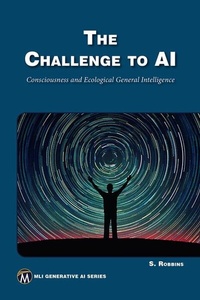
The Challenge to AI
Consciousness and Ecological General Intelligence
1. Auflage
Erschienen am 15. Dezember 2023
315 Seiten
978-1-5015-1844-7 (ISBN)
Beschreibung

This book invites readers to explore the intricate world where AI, consciousness, and human cognition intersect. This groundbreaking book considers the profound differences between man and machine, challenging existing notions in AI and cognitive science. It argues that the key to understanding intelligence lies not in software, but in the hardware of our brain - a complex biochemical system far removed from current AI architectures. Through a deep examination of time, perception, language, and the nature of thought, the book presents a compelling case for the indispensability of biology and consciousness in cognition. To achieve this, to engineer this, will indeed be a challenge for AI.
FEATURES
- Presents an alternative to the conventional computer metaphor, offering a new framework for understanding the mind
- Introduces a fresh perspective on the role of time in AI and philosophy, highlighting its critical importance
- Explores the biochemical basis of cognition, challenging the traditional focus on symbol manipulation and neural networks
Alle Preise
Weitere Details
Reihe
Sprache
Englisch
Verlagsort
New York
USA
Zielgruppe
Für Beruf und Forschung
US School Grade: College Graduate Student
Illustrationen
35 Illustrations, black and white
Dateigröße
20,64 MB
ISBN-13
978-1-5015-1844-7 (9781501518447)
Copyright in bibliographic data and cover images is held by Nielsen Book Services Limited or by the publishers or by their respective licensors: all rights reserved.
Schweitzer Klassifikation
Weitere Ausgaben
Andere Ausgaben
Buch
01/2024
1. Auflage
De Gruyter
49,95 €
Versand in 3-4 Wochen
E-Book
12/2023
1. Auflage
Mercury Learning and Information
ab
49,95 €
Als Download verfügbar
Inhalt
- Cover
- Titlepage
- Copyrightpage
- Contents
- Preface
- Chapter 1 Introduction: AGI-The Gleam in the Eye of AI
- The Commonsense Mousetrap
- Time and Transformations
- The Image of Things
- The Image as Sentience
- The Challenge to AI
- References
- Chapter 2 Gibson and the Resonating Brain
- Bergson's Forgotten Question
- Storing Features-A Current Memory Model
- Velocity Flows and Gibson
- Storing Event Invariance Structures?
- Symmetry, Resonance: No Storage
- A Diagrammatic Gap: The Phenomenal Past
- References
- Chapter 3 Bergson and the Image of the External World
- Bergson, Time, and Direct Perception
- The Classic Metaphysic of Space and Time
- The Temporal Metaphysic
- The Scale of Time
- Direct Specification and the Problem of Illusion
- A Concrete Resonance
- Affordances: The Image as Virtual Action
- Real Virtuality and AI
- Virtual Action-The Difficult Details
- The Biochemical Basis of the Scale of Time
- Current Models of LSD's Action
- Tying LSD to Perception
- Increasing the Velocities Underlying Perception
- LSD-Modulated Perception as Objective
- AI: The Problem of Ecological Interaction With the Environment
- References
- Chapter 4 Retrieving Experience: Implicitly and Explicitly
- Lashley's Rats: Engrams-Missing
- Highly Superior Autobiographical Memory (HSAM)
- Redintegrating Experience: Direct Memory
- More on Redintegration
- Parametric Variation of Memory Cues in Concrete Events
- Analogical Reminding
- Connectionist Neural Nets and Their Failure in Analogy
- Connectionist Analogy: More Dynamic Problems
- Explicit Memory: Conscious Localization in the Past
- Childhood Amnesia, the Explicit, and Piaget
- A COST Trajectory-Causality, Object, Space, and Time
- The First Two Stages (0-4 months)
- Stage 3 (5-7 months)
- Stage 4 (8-11 months)
- Stage 5 (12-18 months)
- Stage 6 (19+ months)
- The Birth of the Symbolic
- The Simultaneity of the Symbolic State-Cassirer
- The Dynamical Lens and Simultaneity in Piaget
- Note on the Image and the "Image Memory"
- References
- Chapter 5 Conscious Cognition
- The Abstract and the Concrete
- The Piagetian Base of Systematicity
- C.S. Peirce and Abduction
- AI and Deduction
- AI and Induction
- AI versus Abduction
- Abduction and Surprise
- Abduction and the Source of Hypotheses
- Abduction and Analogical Reminding
- Abduction, Imagination, and Counterfactuals
- Abduction and Relevance
- Abduction and Causal Reasoning
- Abduction and the Problem of the Frame
- Underestimating Abduction
- Robots versus Ecological Intelligence
- Consciousness, Cognition, and Mousetraps
- References
- Chapter 6 Reaching for Cups-Voluntary Action
- Lashley and the Syntax of an Act
- Chomsky and Syntax of the Sentence
- Atemporal Ideas and the Dynamic Scheme
- The Dynamic Scheme-Libet's Experiment
- Actualizing the Image
- Organisms: Existence and Change
- Organisms as Aging
- The Limits of Mathematical Law
- Time Is a Force
- Mechanical Causality and Repeatability
- Dynamical Causality, Consciousness, and "Force"
- References
- Chapter 7 Generative AI and Human Speech
- Preliminary: Bergson and Speech
- Machine Speech Recognition (1950s to the GPTs)
- Human Speech Perception: The Three Theories
- The Motor Theory of Speech Perception
- The Direct Realist Theory
- The General Learning Approach
- Bergson and the Motor Theory of Comprehension
- The Auditory Aphasic Phenomena
- Brief Stop at Vision
- Learning the Motor Diagram
- Meaning and Generative AI
- Words as Vectors
- The Attention Mechanism
- Linguistic Understanding and the GPT
- Generative AI and the Destruction of Chomsky
- Comprehension and the Whole of Mind
- An Active Memory
- "Filling In"
- The Storage of the Elements (Words)
- Some Form of Internal Keyboard
- MT/DRT and Bergson
- The Virtual
- The Progression-The Virtual to Perception
- A Psychical Cause
- References
- Chapter 8 The Problem of Affect
- Subject and Object: Bergson's Unique Panpsychism
- Affect: Why It Feels Like Something?
- The Bergsonian Framework for Affect
- Solms on Affect
- Feelings
- The Source of Feeling
- The Conflation with the Hard Problem
- Adding Friston and Free Energy
- The Hard Problem and Feelings
- Engineering Consciousness, Entropy and Mathematical Law
- Approximation is Not Enough
- References
- Chapter 9 Space, Time, and the Requirements for a Conscious Device
- Ecological Scale and Advanced Turing Tests
- Test 1
- Test 2
- Test 3
- Having Tea in the Chinese Room
- The Requirements for a Conscious "Device"
- Space and Time Revisited
- The "Confirmations"
- Saving SR via Multiple Reference Systems
- Simultaneous Causal Flows
- A Final Note on Time
- References
- Index
