

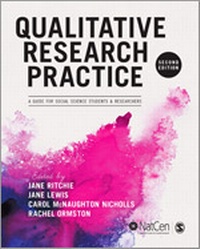
Qualitative Research Practice
A Guide for Social Science Students and Researchers
2. Auflage
Erschienen am 19. November 2013
456 Seiten
978-1-4462-9620-2 (ISBN)
Beschreibung
Why use qualitative methods? What kinds of questions can qualitative methods help you answer? How do you actually do rigorous and reflective qualitative research in the real world?
Written by a team of leading researchers associated with NatCen Social Research (the National Centre for Social Research) this textbook leads students and researchers through the entire process of qualitative research from beginning to end - moving through design, sampling, data collection, analysis and reporting. In this fully revised second edition you will find:
A practical account of how to carry out qualitative research which recognises a range of current approaches and applications
A brand new chapter on ethics
A brand new chapter on observational research
Updated advice on using software when analysing your qualitative data
New case studies which illustrate issues you may encounter and how problems have been tackled by other researchers.
This book is an ideal guide for students, practitioners and researchers faced with the challenges of doing qualitative research in both applied and academic settings in messy real-life contexts.
Written by a team of leading researchers associated with NatCen Social Research (the National Centre for Social Research) this textbook leads students and researchers through the entire process of qualitative research from beginning to end - moving through design, sampling, data collection, analysis and reporting. In this fully revised second edition you will find:
A practical account of how to carry out qualitative research which recognises a range of current approaches and applications
A brand new chapter on ethics
A brand new chapter on observational research
Updated advice on using software when analysing your qualitative data
New case studies which illustrate issues you may encounter and how problems have been tackled by other researchers.
This book is an ideal guide for students, practitioners and researchers faced with the challenges of doing qualitative research in both applied and academic settings in messy real-life contexts.
Rezensionen / Stimmen
Full of useful and informative chapters that take the students through the key stages within qualitative research. -- Professor Margaret Hogg I think this is an excellent book - whenever students ask for advice on DOING qualitative research (rather than writing essays on it), I reach for this. -- Dr Ben Baumberg An excellent primer for anyone who is new to qualitative research, and also a very useful reference book for people with more experience. -- Helen Kara * SRA Research Matters *Alle Preise
Weitere Details
Auflage
Second Edition
Sprache
Englisch
Verlagsort
London
Großbritannien
Zielgruppe
Für höhere Schule und Studium
ISBN-13
978-1-4462-9620-2 (9781446296202)
Copyright in bibliographic data and cover images is held by Nielsen Book Services Limited or by the publishers or by their respective licensors: all rights reserved.
Schweitzer Klassifikation
Weitere Ausgaben
Personen
Jane Ritchie is a psychologist and worked exclusively in social policy research throughout her career. She founded the Qualitative Research Unit at NatCen Social Research in 1985 and was the Unit's Director until 1998. She was one of the originators of the qualitative analytic tool, Framework, and teaches and writes about qualitative methods. Jane Lewis was Director of the Qualitative Research Unit at NatCen Social Research from 1998-2007, and then Director of Research and Evaluation at the National Children's Bureau. Her career has since focused on research utilisation and implementation in child and family services. She ran the national support agency for evidence-informed practice Research in Practice and is now centrally involved in the development of UK implementation science and practice as a Director of the Colebrooke Centre for Evidence and Implementation.
One of the editors of the textbook Qualitative Research Practice, Dr Carol McNaughton Nicholls is a Senior Research Director at NatCen Social Research Crime and Justice Research Team. Carol has over 14 years of experience managing all aspects of complex, sensitive qualitative and mixed method projects and regularly delivers high impact research and evaluations to government in the UK. She specialises in research on sexual abuse, violence and exploitation with victims, perpetrators and professionals, and has previously researched homelessness, drug use, mental ill health and related policy and practice issues. Carol is passionate about the power of qualitative research to explore difficult but important social issues in a way that puts at the heart of the research those who have been affected by these issues, and also about the role researchers have to ensure their research informs real social and political change. Carol is also a Trustee of the Rape and Sexual Assault Support Centre (RASASC) in London, has published widely on a range of issues, regularly presents at national and international conferences and seminars, and is a trainer for NatCen Learning.
Profile: http://www.natcen.ac.uk/about-us/people/staff/carol-mcnaughton-nicholls Rachel Ormston is a Senior Research Director at ScotCen Social Research, based in Edinburgh. She joined ScotCen in 2005 and works across both qualitative and quantitative methods. Rachel has particular experience in using qualitative methods in evaluation research.
One of the editors of the textbook Qualitative Research Practice, Dr Carol McNaughton Nicholls is a Senior Research Director at NatCen Social Research Crime and Justice Research Team. Carol has over 14 years of experience managing all aspects of complex, sensitive qualitative and mixed method projects and regularly delivers high impact research and evaluations to government in the UK. She specialises in research on sexual abuse, violence and exploitation with victims, perpetrators and professionals, and has previously researched homelessness, drug use, mental ill health and related policy and practice issues. Carol is passionate about the power of qualitative research to explore difficult but important social issues in a way that puts at the heart of the research those who have been affected by these issues, and also about the role researchers have to ensure their research informs real social and political change. Carol is also a Trustee of the Rape and Sexual Assault Support Centre (RASASC) in London, has published widely on a range of issues, regularly presents at national and international conferences and seminars, and is a trainer for NatCen Learning.
Profile: http://www.natcen.ac.uk/about-us/people/staff/carol-mcnaughton-nicholls Rachel Ormston is a Senior Research Director at ScotCen Social Research, based in Edinburgh. She joined ScotCen in 2005 and works across both qualitative and quantitative methods. Rachel has particular experience in using qualitative methods in evaluation research.
Inhalt
The Foundations of Qualitative Research - Rachel Ormston, Liz Spencer, Matt Barnard, Dawn Snape
The Applications of Qualitative Methods to Social Research - Jane Ritchie and Rachel Ormston
Design Issues - Jane Lewis and Carol McNaughton Nicholls
Ethics of Qualitative Research - Stephen Webster, Jane Lewis and Ashley Brown
Designing and Selecting Samples - Jane Ritchie, Jane Lewis, Gilliam Elam, Rosalind Tennant and Nilufer Rahim
Designing Fieldwork - Sue Arthur, Martin Mitchell, Jane Lewis and Carol McNaughton Nicholls
In-depth Interviews - Alice Yeo, Robin Legard, Jill Keegan, Kit Ward, Carol McNaughton Nicholls and Jane Lewis
Focus Groups - Helen Finch, Jane Lewis, and Caroline Turley
Observation - Carol McNaughton Nicholls, Lisa Mills and Mehul Kotecha
Analysis: Principles and Processes - Liz Spencer, Jane Ritchie, Rachel Ormston, William O'Connor and Matt Barnard
Traditions and approaches
Analysis in practice - Liz Spencer, Jane Ritchie, William O'Connor, Gareth Morrell and Rachel Ormston
Generalisability
Writing up qualitative Research - Clarissa White, Kandy Woodfield, Jane Ritchie and Rachel Ormston
The Applications of Qualitative Methods to Social Research - Jane Ritchie and Rachel Ormston
Design Issues - Jane Lewis and Carol McNaughton Nicholls
Ethics of Qualitative Research - Stephen Webster, Jane Lewis and Ashley Brown
Designing and Selecting Samples - Jane Ritchie, Jane Lewis, Gilliam Elam, Rosalind Tennant and Nilufer Rahim
Designing Fieldwork - Sue Arthur, Martin Mitchell, Jane Lewis and Carol McNaughton Nicholls
In-depth Interviews - Alice Yeo, Robin Legard, Jill Keegan, Kit Ward, Carol McNaughton Nicholls and Jane Lewis
Focus Groups - Helen Finch, Jane Lewis, and Caroline Turley
Observation - Carol McNaughton Nicholls, Lisa Mills and Mehul Kotecha
Analysis: Principles and Processes - Liz Spencer, Jane Ritchie, Rachel Ormston, William O'Connor and Matt Barnard
Traditions and approaches
Analysis in practice - Liz Spencer, Jane Ritchie, William O'Connor, Gareth Morrell and Rachel Ormston
Generalisability
Writing up qualitative Research - Clarissa White, Kandy Woodfield, Jane Ritchie and Rachel Ormston
