


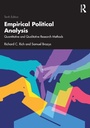
Empirical Political Analysis
Quantitative and Qualitative Research Methods
10. Auflage
Erschienen am 29. Mai 2026
374 Seiten
978-1-040-57381-5 (ISBN)
Beschreibung

Empirical Political Analysis introduces readers to the foundations of social science research. Organized around the stages of the research process, this textbook prepares readers to conduct both quantitative and qualitative research, from the formation of theory through the design of research projects, to the collection and analysis of data.
The book offers a clear and concise presentation of basic concepts and tools that can be applied in a wide range of research settings and highlights ethical conduct in the research process. It will help you both to achieve sound results in your own research and to critically evaluate research presented by others.
Key features:
? Offers comprehensive coverage of quantitative and qualitative research methods in political science - this book is one of the key texts in the field of political research methods since it was first published over 25 years ago
? Covers the research process from start to finish-hypothesis formation, literature review, research design, data gathering, data analysis, and research report writing. Includes in-depth examples of political science research to give discipline-specific instruction on political analysis
? Features a "Practical Research Ethics" box in every chapter to make students aware of common ethical dilemmas and potential solutions to them. Includes learning goals, key terms, and research examples to help students engage and explore the most important concepts
New to this edition:
? Updated directions for conducting a literature review
? Updated and international case studies
? New material on understanding research design - what constitutes a sound research design and how this contributes to being able to justify research findings
This is the ideal introductory resource for advanced undergraduate and postgraduate students, researchers, and instructors in political science, sociology, public administration, and related fields.
The book offers a clear and concise presentation of basic concepts and tools that can be applied in a wide range of research settings and highlights ethical conduct in the research process. It will help you both to achieve sound results in your own research and to critically evaluate research presented by others.
Key features:
? Offers comprehensive coverage of quantitative and qualitative research methods in political science - this book is one of the key texts in the field of political research methods since it was first published over 25 years ago
? Covers the research process from start to finish-hypothesis formation, literature review, research design, data gathering, data analysis, and research report writing. Includes in-depth examples of political science research to give discipline-specific instruction on political analysis
? Features a "Practical Research Ethics" box in every chapter to make students aware of common ethical dilemmas and potential solutions to them. Includes learning goals, key terms, and research examples to help students engage and explore the most important concepts
New to this edition:
? Updated directions for conducting a literature review
? Updated and international case studies
? New material on understanding research design - what constitutes a sound research design and how this contributes to being able to justify research findings
This is the ideal introductory resource for advanced undergraduate and postgraduate students, researchers, and instructors in political science, sociology, public administration, and related fields.
Weitere Details
Auflage
10th edition
Sprache
Englisch
Verlagsort
London
Großbritannien
Verlagsgruppe
Taylor & Francis Ltd
Zielgruppe
Für höhere Schule und Studium
Illustrationen
63 Line drawings, black and white; 63 Illustrations, black and white
Dateigröße
7,20 MB
ISBN-13
978-1-040-57381-5 (9781040573815)
Copyright in bibliographic data and cover images is held by Nielsen Book Services Limited or by the publishers or by their respective licensors: all rights reserved.
Schweitzer Klassifikation
Weitere Ausgaben
Andere Ausgaben
Richard C. Rich | Samuel Brazys
Empirical Political Analysis
Quantitative and Qualitative Research Methods
Buch
05/2026
10. Auflage
Routledge
160,50 €
Versand in 15-20 Tagen
Richard C. Rich | Samuel Brazys
Empirical Political Analysis
Quantitative and Qualitative Research Methods
Buch
05/2026
10. Auflage
Routledge
364,50 €
Versand in 15-20 Tagen
Personen
Richard C. Rich, PhD, studies and teaches about environmental policy, public policy analysis, and research methods. He was Editor of the State University of New York Press Urban Public Policy book series that won the Aaron Wildavsky Award for Contributions to Policy Analysis. He was formerly Chair of the Department of Political Science, Director of the Center for Environmental and Energy Studies, and Director of the School of Public and International Affairs at Virginia Tech.
Samuel Brazys, PhD, studies and teaches at the intersection of international political economy and the political economy of international development. He is Editor of the Journal of International Development. He is currently the Vice-Principal for Research, Innovation, and Impact in the College of Social Sciences and Law at University College Dublin.
Samuel Brazys, PhD, studies and teaches at the intersection of international political economy and the political economy of international development. He is Editor of the Journal of International Development. He is currently the Vice-Principal for Research, Innovation, and Impact in the College of Social Sciences and Law at University College Dublin.
Inhalt
Chapter 1. Research as a Process
Chapter 2. Building Theories and Hypotheses
Chapter 3. Developing Your Literature Review
Chapter 4. Designing Your Research and Choosing Your Methods
Chapter 5. From Abstract to Concrete: Operationalization and Measurement
Chapter 6. Creating Complex Indicators: Using Scaling Techniques
Chapter 7. Research Design: Attributing Causation Through Control
Chapter 8. Who, What, Where, When: The Problem of Sampling
Chapter 9. Survey Research: Characterizing a Broader Population
Chapter 10. Experimental Methods
Chapter 11. Content and Quantitative Text Analysis
Chapter 12. Comparative Methods: Research Across Populations
Chapter 13. Data: Studying Individuals and Groups
Chapter 14. Open Science and Data Wrangling: Preparing Observations for Analysis
Chapter 15. Describing and Visualizing One Variable: Univariate Distributions and Statistics
Chapter 16. Evaluating and visualizing relationships between two variables: Bivariate analysis
Chapter 17. Causal Inference with Multivariate Observational Data: Relationships Among Several Variables
Chapter 18. Direct Observation: Systematically Watching Behavior
Chapter 19. Focus Group Research
Chapter 20. Elite and Specialized Interviewing
Chapter 21. The Research Report: Diagramming a Sample Article
Chapter 22. Summary: Overview of a Research Process
Chapter 2. Building Theories and Hypotheses
Chapter 3. Developing Your Literature Review
Chapter 4. Designing Your Research and Choosing Your Methods
Chapter 5. From Abstract to Concrete: Operationalization and Measurement
Chapter 6. Creating Complex Indicators: Using Scaling Techniques
Chapter 7. Research Design: Attributing Causation Through Control
Chapter 8. Who, What, Where, When: The Problem of Sampling
Chapter 9. Survey Research: Characterizing a Broader Population
Chapter 10. Experimental Methods
Chapter 11. Content and Quantitative Text Analysis
Chapter 12. Comparative Methods: Research Across Populations
Chapter 13. Data: Studying Individuals and Groups
Chapter 14. Open Science and Data Wrangling: Preparing Observations for Analysis
Chapter 15. Describing and Visualizing One Variable: Univariate Distributions and Statistics
Chapter 16. Evaluating and visualizing relationships between two variables: Bivariate analysis
Chapter 17. Causal Inference with Multivariate Observational Data: Relationships Among Several Variables
Chapter 18. Direct Observation: Systematically Watching Behavior
Chapter 19. Focus Group Research
Chapter 20. Elite and Specialized Interviewing
Chapter 21. The Research Report: Diagramming a Sample Article
Chapter 22. Summary: Overview of a Research Process
