

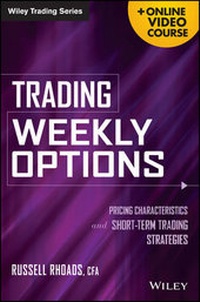
Trading Weekly Options
Beschreibung

Weekly options are traded on all major indices, as well as high volume stocks and ETFs. They continue to surge in popularity, accounting for as much as twenty percent of daily options volume. And while existing options strategy can be used with weeklys, they are particularly conducive to premium selling strategies and short-term trades based on a news item or technical pattern. With this timely guide, and its companion video, you'll learn exactly how to use weeklys to make more money from option selling strategies and how to make less expensive bets on short-term market moves.
Written by Russell Rhoads, a top instructor at the CBOE's Options Institute, Trading Weekly Options + Video skillfully explains the unique pricing and behavioral characteristics of weekly options and shows how to take advantage of those unique features using traditional option strategies.
* The first book and video combination product focused solely on weekly options
* Outlines the most effective trading strategies associated with weekly options, including taking advantage of the accelerating time-decay curve when an option approaches expiration
* Filled with the practical, real-world insights of author Russell Rhoads, an expert in this field
Created with both the experienced and beginning option traders in mind, this book and video package will help you make the most of your time trading weekly options.
Alle Preise
Weitere Details
Weitere Ausgaben
Andere Ausgaben

Person
Inhalt
Acknowledgments xi
Chapter 1 Introducing Weekly Options 1
Chapter 2 Short-Term Index Options 9
Chapter 3 Weekly Options on Equities and Exchange-Traded Products 19
Chapter 4 Option Pricing Factors and Short-Dated Option Contracts 25
Chapter 5 Time Decay and Short-Dated Options 31
Chapter 6 Implied Volatility and Weekly Options 39
Chapter 7 Developing Your Trading Plan 55
Chapter 8 Long Option Trades 61
Chapter 9 Short Option Trades 69
Chapter 10 Covered Calls and Buy-Writes 83
Chapter 11 Hedging with Short-Dated Options 97
Chapter 12 Bullish Spread Trading 113
Chapter 13 Bearish Spread Trading 131
Chapter 14 Neutral Spread Trading 147
Chapter 15 Split Strike Long Spreads 165
Chapter 16 Calendar Spreads 187
Chapter 17 Diagonal Spreads 201
Chapter 18 Trading Earnings Releases with Short-Dated Options 215
Chapter 19 Leveraged Exchange-Traded Products 235
Chapter 20 VIX-Related Exchange-Traded Products 243
About the Video 247
About the Author 249
Index 251
CHAPTER 1
Introducing Weekly Options
■ Evolution of Weekly Options
On Friday October 28, 2005, the Chicago Board Options Exchange (CBOE) launched the first weekly contract. Weekly contracts were first launched in 2005 on the S&P 500 (SPX) and S&P 100 (OEX) market indexes. The popular thinking, however, is that weekly, or short-dated, options have only been available since the summer of 2010 because many traders focus on equity options and only became aware of short-dated options when they became available on stocks. Weekly options on exchange traded funds followed shortly after short dated options on stocks the following month. When shorter dated options in equities and exchange-traded funds (ETFs) hit the markets in 2010, many more traders started to pay attention to these contracts and rapid growth in trading volume quickly followed.
Weeklys is a term that is specific to options trading at CBOE and is actually a service mark of CBOE. However it is a term that seems to have taken on general meaning for all short dated option contracts. Other option exchanges list short-dated options as well but they use different terminology. For instance, the NYSE ARCA Options exchange uses the term Short Term Options Series. Other than the name, contracts listed at this exchange or any other option exchange that start trading on Thursday and expire the following Friday have all the same characteristics as weeklys.
From 2005 until 2010 SPX and OEX Weeklys were the only weekly option contracts listed at CBOE or any other options exchange in the United States. Toward the end of this five-year period that precedes the introduction of equity weeklys in 2010, the average daily volume of SPX Weeklys was around 16,000 contracts and the average daily volume of OEX Weeklys was just over 15,000 contracts. In late 2012 the average daily volume for SPX Weeklys had jumped to 100,000 contracts—some days with volume topping 200,000 contracts. Also, as a percentage of total SPX option trading, short dated SPX options had grown to over 20 percent of average daily volume as of late 2012.
After weekly options on equities were introduced, there was another change to the structure of the options that has probably aided in the success of these contracts. Originally these contracts would be issued on a Friday morning the week before they were set to expire. After about a month of weekly options on stocks being listed on a Friday morning and typically expiring the following Friday, the decision was made to list these contracts a day earlier on Thursdays. This final change resulted in what is commonly thought of as weekly options, weeklys, or short-dated options. There are some other small deviations on this that will be discussed in the next couple of chapters.
Barring a holiday, a weekly option series will begin trading on the market opening on a Thursday and cease trading the following Friday. The result is an option contract that has a life of seven trading days between listing and expiration. In addition to the seven trading day options that are listed for expiration on nonstandard expiration weeks there are also some series that are listed to assure there are five expiration weeks in a row. If a stock or market has options expiring in five consecutive weeks, it is commonly referred to as having serial options available for trading.
■ Popularity of Weekly Options
Many academic studies have been commissioned to determine what makes a successful listed derivative product. Needless to say, exchanges are very curious to know what the right formula is to bringing traders, investors, and liquidity providers together to trade a financial product. Although there is much time, thought, and effort that goes into a new exchange-listed product, the success or failure seems to have an aspect of luck as well. At first glance, the rapid acceptance of short-dated options on equities is a bit perplexing. Weeklys had been around for years on SPX and OEX and without attracting the dramatic volume that equity options did. However, considering what strategies are most popular with equity options relative to strategies with options on indexes, there is an understanding how the emergence of short-term options on stocks fueled the eventual growth for both short-dated equity and index option contracts.
Figure 1.1 compares the daily SPX Put–Call Ratio trading to equity-option trading at CBOE for the first six months in 2012. A put–call ratio is calculated by dividing the volume of put options traded by the number of call options traded in a particular period. The higher line on this chart represents a ratio of SPX puts to SPX calls traded each day. The lower line on this chart represents a ratio of equity put option volume divided by equity call option volume each day.
FIGURE 1.1 SPX and Equity Put–Call Ratios, January 2012 to June 2012
Source: www.CBOE.com.
Note the higher line representing the SPX Put–Call Ratio; it is consistently above 1.00 and often above 2.00. The SPX Put–Call Ratio over 1.00 is interpreted as more SPX put options trade in a day than SPX call options. If total SPX option volume is 600,000 contracts in a single day and the SPX Put–Call Ratio equals 2.00 that would mean twice as many SPX put options than call contracts traded in a single day. For a day with the total volume at 600,000 this would mean 400,000 puts and 200,000 calls traded on the day.
Now consider the solid line that represents equity put volume divided by equity call volume. The light gray line is under 1.00 on a pretty consistent basis. This means that more equity call options trade than equity put options on a daily basis. If 3,000,000 equity options trade in a single day at the CBOE and the Equity Put–call ratio equals 0.50, then half as many equity put options as the number of call options traded on the day. For a day with 3,000,000 contracts changing hands this would mean put volume was 1,000,000 and call volume 2,000,000. So how does this relate to the success of short-dated options since 2010?
Before joining the Options Institute at the CBOE, my career spanned a wide variety of trading and institutional investment firms. The majority of the firms I worked for would use equity and index options in completely different ways. If a portfolio manager gave the trading desk a ticket to trade index options, this trade was going to be a trade using SPX put options. With very few exceptions the trade would involve using put options to hedge a portfolio. The hedge would often be a very straightforward opening purchase of out-of-the-money SPX put options. In the case that the order was to buy index options, it would be a purchase of SPX puts to close out a long position.
If an order ticket was given to the desk to trade equity options it would be to trade a call option. This order would typically be an opening transaction that involved selling calls versus shares that were currently owned. This is a very common strategy known as a covered call. Portfolio managers often work with target prices to exit stocks or possibly lower their exposure to the stock. A method of exiting the stock is to sell a call option and take on the obligation to sell shares. If the covered call is held until expiration, it would either be assigned with shares being called away or expire with no value and a profit to the portfolio. If a buy order came in for an equity call option, it would be to close out the trade. Closing out the covered call would involve a purchase of call options to close out the obligation to sell the underlying shares that goes along with that trade.
When selling a call option against shares of stock that is owned, one secondary motivation will be to benefit from the time decay of the option contract. In certain circumstances it makes sense to focus on the nearest expiring option contract when considering a covered call. Sometimes this would result in a trade not being executed. The next expiration date may be too far out on the calendar or the premium received would not make sense to have an obligation to sell shares for the time until expiration. Now for over 200 equity securities there are always options that will be expiring in a very short period of time which gives more flexibility to considering a covered call. These shorter dated call options are ideal for taking advantage of time decay. This short-dated time decay is the basis of several other strategies covered in this book.
Equity call options are often used for covered calls while the most common use of index options is to hedge portfolios. The daily volume for SPX put contracts is consistently higher than the volume of SPX calls because hedging is a primary motivator to trade index options. Also, since the majority of index option trading is on the put side and, for hedging purposes, the attractiveness of index options that have only a few days until expiration may not have been apparent before the introduction of short-dated equity options.
Generally a portfolio manager would want to hedge a portfolio for more than just a few days. Because of the longer time frame relative to expiration a portfolio manager would not see the value in buying short-dated puts to gain portfolio protection. However, under several scenarios SPX Weeklys make sense for hedging purposes. Index options will be fully introduced in Chapter 3. Chapter 24 will discuss how SPX Weeklys actually make sense and are being used for hedging purposes. The recognition of the use of shorter dated SPX options for hedging purposes has resulted in steady volume growth for SPX Weeklys. Figure 1.2 is a chart depicting the...

