

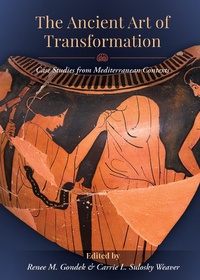
Ancient Art of Transformation
Case Studies from Mediterranean Contexts
Erschienen am 16. März 2019
240 Seiten
978-1-78925-107-4 (ISBN)
Beschreibung

The Ancient Art of Transformation: Case Studies from Mediterranean Contexts examines instances of human transformation in the ancient and early Christian Mediterranean world by exploring the ways in which art impacts, aids, or provides evidence for physical, spiritual, personal, and social transitions. Building on Arnold van Gennep's notion of universal rites of passage, papers in this volume expand the definition of "transformation" to include widespread transitions such as shifts in political establishments and changes in cultural identity. In considering these broadly defined "passages," authors have observed particular changes in the visual record, whether they be manifest, enigmatic, or symbolic.
While several papers address transitions that are incomplete, resulting in intermediary, hybrid states, others suggest that the medium itself can be integral to interpreting a transition, and in some cases, be itself transformed. Together, the volume covers not only a broad chronological span (c. 5th century BC to 4th century AD), but also an expansive geographical range (Egypt, Greece, and Italy). Reflecting upon issues central to a variety of Mediterranean cultures (Egyptians, Etruscans, Greeks, Romans, and early Christians), The Ancient Art of Transformation documents how personal, societal, and historical changes become permanently fixed in the material record.
The Ancient Art of Transformation examines the visual manifestation of human transformation in the ancient and early medieval Mediterranean world, exploring the role of art and visual culture in enabling, hindering, or documenting physical, spiritual, personal, and social transitions such as pregnancy and birth, initiations, marriage, death and funerals. The definition of "transformation" is also expanded to address instances of less personal and more widespread transitions such as shifts in political establishments and changes in cultural identity in geographic locations. Additionally, although the ancient material record documents certain rites of passage such as marriage and death extensively, artifacts and their accompanying images are often studied simply to reconstruct these social processes. Authors here suggest that material evidence itself can be integral to interpreting a transition, and in some cases, be itself transformed. Further, several papers address transitions that are incomplete, resulting in intermediary, hybrid states that are very often reflected in the visual record such as Athenian vase-painting imagery forecasting the bride as a mother, displays of nudity that reflect intermediate life stages in Etruscan art and Octavian's visual transformation into Pharaoh and Augustus in Egyptian architecture and material culture. At its core the volume establishes current methods for understanding how ancient visual culture shaped, informed, and was affected by processes of transformation. Together, these papers offer a close examination of various types of visual evidence from several cultures and periods (e.g., Etruscan, Greek, Roman, early Christian), and document how personal, societal, and historical changes become permanently fixed in the material record.
While several papers address transitions that are incomplete, resulting in intermediary, hybrid states, others suggest that the medium itself can be integral to interpreting a transition, and in some cases, be itself transformed. Together, the volume covers not only a broad chronological span (c. 5th century BC to 4th century AD), but also an expansive geographical range (Egypt, Greece, and Italy). Reflecting upon issues central to a variety of Mediterranean cultures (Egyptians, Etruscans, Greeks, Romans, and early Christians), The Ancient Art of Transformation documents how personal, societal, and historical changes become permanently fixed in the material record.
The Ancient Art of Transformation examines the visual manifestation of human transformation in the ancient and early medieval Mediterranean world, exploring the role of art and visual culture in enabling, hindering, or documenting physical, spiritual, personal, and social transitions such as pregnancy and birth, initiations, marriage, death and funerals. The definition of "transformation" is also expanded to address instances of less personal and more widespread transitions such as shifts in political establishments and changes in cultural identity in geographic locations. Additionally, although the ancient material record documents certain rites of passage such as marriage and death extensively, artifacts and their accompanying images are often studied simply to reconstruct these social processes. Authors here suggest that material evidence itself can be integral to interpreting a transition, and in some cases, be itself transformed. Further, several papers address transitions that are incomplete, resulting in intermediary, hybrid states that are very often reflected in the visual record such as Athenian vase-painting imagery forecasting the bride as a mother, displays of nudity that reflect intermediate life stages in Etruscan art and Octavian's visual transformation into Pharaoh and Augustus in Egyptian architecture and material culture. At its core the volume establishes current methods for understanding how ancient visual culture shaped, informed, and was affected by processes of transformation. Together, these papers offer a close examination of various types of visual evidence from several cultures and periods (e.g., Etruscan, Greek, Roman, early Christian), and document how personal, societal, and historical changes become permanently fixed in the material record.
Weitere Details
Weitere Ausgaben
Andere Ausgaben
Renee M. Gondek | Carrie L. Sulosky Weaver
The Ancient Art of Transformation
Case Studies from Mediterranean Contexts
Buch
12/2018
Oxbow Books
51,50 €
Versand in 3-4 Wochen
