

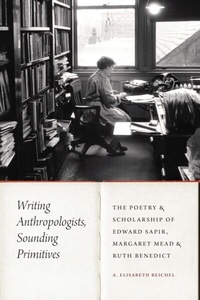
Writing Anthropologists, Sounding Primitives
The Poetry and Scholarship of Edward Sapir, Margaret Mead, and Ruth Benedict
1. Auflage
Erschienen am 1. August 2021
462 Seiten
978-1-4962-2752-2 (ISBN)
Beschreibung

Writing Anthropologists, Sounding Primitives re-examines the poetry and scholarship of three of the foremost figures in the twentieth-century history of U.S.-American anthropology: Edward Sapir, Margaret Mead, and Ruth Benedict. While they are widely renowned for their contributions to Franz Boas's early twentieth-century school of cultural relativism, what is far less known is their shared interest in probing the representational potential of different media and forms of writing. This dimension of their work is manifest in Sapir's critical writing on music and literature and Mead's groundbreaking work with photography and film. Sapir, Mead, and Benedict together also wrote more than one thousand poems, which in turn negotiate their own media status and rivalry with other forms of representation.
A. Elisabeth Reichel presents the first sustained study of the published and unpublished poetry of Sapir, Mead, and Benedict, charting this largely unexplored body of work and relevant selections of the writers' scholarship. In addition to its expansion of early twentieth-century literary canons, Writing Anthropologists, Sounding Primitives contributes to current debates about the relations between different media, sign systems, and modes of sense perception in literature and other media. Reichel offers a unique contribution to the history of anthropology by synthesizing and applying insights from the history of writing, sound studies, and intermediality studies to poetry and scholarship produced by noted early twentieth-century U.S.-American cultural anthropologists.
Access the OA edition here.
A. Elisabeth Reichel presents the first sustained study of the published and unpublished poetry of Sapir, Mead, and Benedict, charting this largely unexplored body of work and relevant selections of the writers' scholarship. In addition to its expansion of early twentieth-century literary canons, Writing Anthropologists, Sounding Primitives contributes to current debates about the relations between different media, sign systems, and modes of sense perception in literature and other media. Reichel offers a unique contribution to the history of anthropology by synthesizing and applying insights from the history of writing, sound studies, and intermediality studies to poetry and scholarship produced by noted early twentieth-century U.S.-American cultural anthropologists.
Access the OA edition here.
Rezensionen / Stimmen
"This book greatly expands the literary canons of the early 20th century by extensively excavating previously unpublished archival and unexamined published material. Steeping the text in sophisticated theory and detailed history, Reichel demonstrates how these anthropologists' science challenged social Darwinian theories of evolution."-L. D. Baker, Choice "So many of our visions of ourselves, and our images of what constitutes culture, alight on the written. Writing Anthropologists, Sounding Primitives interrupts this narrative with a thoughtful intervention."-James Dowthwaite, American Literary History "Reichel has made a signal contribution both to the history of anthropology and to anthropology today."-Richard Handler, Anthropological Quarterly "The only scholarly work with access to the complete archive, Writing Anthropologists, Sounding Primitives offers the first sustained literary study of the published and unpublished poetry written by three of the iconic figures of twentieth-century cultural anthropology. A. Elisabeth Reichel's nuanced readings of individual poems and her persuasive explanation of their transdisciplinary relevance are certain to promote further scholarly engagement with the remarkably variegated array of creative projects that these anthropologists produced."-Donald E. Pease, author of The New American Exceptionalism "Writing Anthropologists, Sounding Primitives is the definitive study of the often-noted but rarely examined poetry of three important and complexly interrelated Boasian anthropologists. In this innovative analysis, A. Elisabeth Reichel focuses on the broader perspectives of inter-media relations and anthropological notions of Primitivism."-Ira Jacknis, research anthropologist at the Phoebe A. Hearst Museum of Anthropology at the University of California, Berkeley "Harnessing intermediality and sound studies theories, A. Elisabeth Reichel explores Sapir's, Mead's, and Benedict's poetry alongside their multi-media anthropological research. This timely interdisciplinary American studies monograph astutely elucidates highly problematic practices and politics of sound production and listening when imagining 'Others.'"-Nassim W. Balestrini, professor of American studies and intermediality at the University of Graz, Austria "The poet-anthropologist cuts a dashing figure in the pages of this book. . . . A. Elisabeth Reichel's close readings through a critical lens of the published and unpublished poems and correspondence of the Benedict-Sapir-Mead trio bring out the underlying currents connecting their poetry to their anthropology, and vice versa. Given the recent vogue for 'multimodal anthropologies,' Writing Anthropologists, Sounding Primitives represents a groundbreaking contribution to the 'archaeology' of the current conjuncture by exploring the first, tentative forays of these three illustrious figures across cultures via multiple media and genres."-David Howes, professor of anthropology and co-director of the Centre for Sensory Studies at Concordia University, Montreal "A groundbreaking transdisciplinary work. Uncovering and collecting an invaluable archive, A. Elisabeth Reichel provides the first extensive literary analyses of these key anthropologists-artists' poems and their relation to cultural theory and modernist aesthetics. Setting this work in the context of their broader multimedia experiments Reichel further illuminates, with complexity and nuance, larger debates over media alterity and cultural alterity."-Eric Aronoff, author of Composing Cultures: Modernism, American Literary Studies and the Problem of Culture "Thoughtfully argued and painstakingly researched, Writing Anthropologists, Sounding Primitives shows why three of the twentieth century's most influential anthropologists turned to poetry to express their ideas about cultural difference. A. Elisabeth Reichel's work gives new meaning to the truism that ethnography is a form of writing worthy of literary analysis. . . . A compelling, informative read."-Brian Hochman, author of Savage Preservation: The Ethnographic Origins of Modern Media TechnologyWeitere Details
Reihe
Sprache
Englisch
Verlagsort
Lincoln
USA
Zielgruppe
Für Beruf und Forschung
Illustrationen
6 photographs, 9 illustrations, index
Dateigröße
4,62 MB
ISBN-13
978-1-4962-2752-2 (9781496227522)
Copyright in bibliographic data and cover images is held by Nielsen Book Services Limited or by the publishers or by their respective licensors: all rights reserved.
Schweitzer Klassifikation
Weitere Ausgaben
Andere Ausgaben
A. Elisabeth Reichel
Writing Anthropologists, Sounding Primitives
The Poetry and Scholarship of Edward Sapir, Margaret Mead, and Ruth Benedict
Buch
08/2021
University of Nebraska Press
94,08 €
Versand in 15-20 Tagen
Person
A. Elisabeth Reichel is an assistant professor of American studies (Akademische RAEtin) at OsnabrUEck University.
Inhalt
List of Illustrations
Series Editors' Introduction
Acknowledgments
Editorial Note on Archival Sources
Introduction: Poets, Anthropologists, Primitives
1. Of Mumbling Melody, Soft Singing, and Slow Speech: Constructions of Sonic Otherness in the Poetry of Edward Sapir
2. On Alternating Sounds: Musical Alterities in Sapir's Poetry and Critical Writings
Interlude: French Canadian Folk Songs in Translation
3. "For You Have Given Me Speech!": Gifted Literates, Illiterate Primitives, and Margaret Mead
4. Toward Unnerving the Us: The Poetry and Scholarship of Ruth Benedict
Conclusion: Cultural and Media Evolutionism in Boasian Anthropology and Beyond
Appendix: The Complete Poetry of Edward Sapir, Ruth Benedict, and Margaret Mead
The Poetry of Edward Sapir
The Poetry of Ruth Benedict
The Poetry of Margaret Mead
Notes
Bibliography
Index
Series Editors' Introduction
Acknowledgments
Editorial Note on Archival Sources
Introduction: Poets, Anthropologists, Primitives
1. Of Mumbling Melody, Soft Singing, and Slow Speech: Constructions of Sonic Otherness in the Poetry of Edward Sapir
2. On Alternating Sounds: Musical Alterities in Sapir's Poetry and Critical Writings
Interlude: French Canadian Folk Songs in Translation
3. "For You Have Given Me Speech!": Gifted Literates, Illiterate Primitives, and Margaret Mead
4. Toward Unnerving the Us: The Poetry and Scholarship of Ruth Benedict
Conclusion: Cultural and Media Evolutionism in Boasian Anthropology and Beyond
Appendix: The Complete Poetry of Edward Sapir, Ruth Benedict, and Margaret Mead
The Poetry of Edward Sapir
The Poetry of Ruth Benedict
The Poetry of Margaret Mead
Notes
Bibliography
Index
