

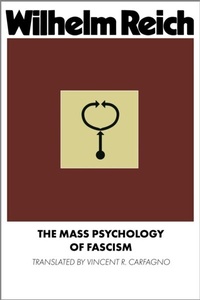
The Mass Psychology of Fascism
Beschreibung
Wilhelm Reich's classic study, written during the years of the German crisis, is a unique contribution to the understanding of one of the crucial phenomena of our times-fascism. Reich firmly repudiates the concept that fascism is the ideology or action of a single individual or nationality, or any ethnic or political group. He also denies a purely socio-economic explanation as advanced by Marxist ideologists. He understands fascism as the expression of the irrational character structure of the average human being whose primary, biological needs and impulses have been suppressed for thousands of years. The social function of this suppression and the crucial role played in it by the authoritarian family and the church are carefully analyzed. Reich shows how every form of organized mysticism, including fascism, relies on the unsatisfied orgastic longing of the masses. The importance of this work today cannot be underestimated. The human character structure that created organized fascist movements still exists, dominating our present social conflicts. If the chaotic agony of our times is ever to be eliminated, we must turn our attention to the character structure that creates it; we must understand the mass psychology of fascism.
Alle Preise
Weitere Details
Personen
Inhalt
- Intro
- Title Page
- Epigraph
- Preface to the Third Edition
- Glossary
- I. Ideology as a Material Force
- The cleavage
- Economic and ideological structure of the German society, 1928-1933
- How mass psychology sees the problem
- The social function of sexual repression
- II. The Authoritarian Ideology of the Family in the Mass Psychology of Fascism
- Führer and mass structure
- Hitler's background
- On the mass psychology of the lower middle class
- Family ties and nationalistic feelings
- Nationalistic self-confidence
- The "domestication" of the industrial workers
- III. The Race Theory
- Its contents
- The objective and subjective functions of ideology
- Racial purity, blood poisoning, and mysticism
- IV. The Symbolism of the Swastika
- V. The Sex-Economic Presuppositions of the Authoritarian Family
- VI. Organized Mysticism as an International Anti-Sexual Organization
- The interest in the church
- The fight against "cultural Bolshevism"
- The appeal to mystical feelings
- The goal of the cultural revolution in the light of fascist reaction
- VII. Sex-Economy in the Fight Against Mysticism
- The three basic elements of religious feeling
- Anchoring of religion by means of sexual anxiety
- Healthy and neurotic self-confidence
- VIII. Some Questions of Sex-Political Practice
- Theory and practice
- The struggle against mysticism until now
- Sexual happiness contra mysticism
- The individual uprootment of the religious feeling
- The practice of sex-economy and objections to it
- The nonpolitical man
- IX. The Masses and the State
- 1936: Speak the truth-but how & when?
- "What takes place in the masses of people?"
- The "socialist yearning"
- The "withering away of the state"
- The program of the Communist Party of the Soviet Union (Eighth Party Congress, 1919)
- The "introduction of Soviet democracy"
- The development of the apparatus of the authoritarian state from rational social relationships
- The social function of state capitalism
- X. Biosocial Function of Work
- The problem of "voluntary work discipline"
- XI. Give Responsibility to Vitally Necessary Work!
- What is "work-democracy"?
- What is new in work-democracy?
- XII. The Biologic Miscalculation in the Human Struggle for Freedom
- Our interest in the development of freedom
- Biologic rigidity, incapacity for freedom, and mechanical authoritarian view of life
- The arsenal of human freedom
- XIII. On Natural Work-Democracy
- Investigation of the natural social forces for the purpose of overcoming the emotional plague
- Work in contrast to politics
- Notes on objective criticism and irrational caviling
- Work is inherently rational
- Vitally necessary and other work
- Notes
- Notes: Preface to the Third Edition
- Notes 1
- Notes 2
- Notes 3
- Notes 4
- Notes 5
- Notes 6
- Notes 8
- Notes 9
- Notes 10
- Notes 12
- Notes 13
- Index
- Also by Wilhelm Reich
- About the Author
- Contents
- Copyright
