

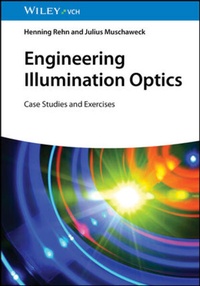
Engineering Illumination Optics
Beschreibung

"Engineering Illumination Optics" explores the field of illumination optics, focusing on the mathematical and physical calculations behind the design and their application in a wide variety of use cases. The book provides a solid knowledge of the radiometric foundation and of the fundamental concepts of illumination optics to empower the reader to develop a deep understanding of the interaction of light sources with dedicated optics. It covers the necessary calculation methods and formulas as a basis for efficient illumination design.
This book helps readers avoid costly design errors by focusing on the essentials and quick estimates to ensure they can perform precise calculations and judge their accuracy. Numerous exercises based on real-world problems with detailed solutions make the book an ideal self-study tool and reference to hone readers? practical skills.
Written by a team of highly qualified authors, Engineering Illumination Optics includes information on sample topics including:
* Angles and solid angles, refraction, paraxial optics, laser beams, and conic sections
* Rays, etendue, light tubes, radiometry, black body and solar radiation, and spectral calculus, color, and vision
* Light sources, solar collection, astronomy, daylighting, horticulture lighting, light detection, projectors and stage lights, and headlamps
* Principles of optics and their application for the design process, covering predesign calculus, evaluation of datasheets and product specifications, and the according selection of suitable light sources
"Engineering Illumination Optics" is an essential reference for optical engineers and designers in general and specialty lighting, in particular architectural, stage, and medical lighting, and horticulture, who are seeking to learn how to solve problems using fundamental principles and practical calculations. Advanced students in adjacent fields and physicists in industry will also find the book valuable.
Weitere Details
Weitere Ausgaben
Andere Ausgaben
Personen
Julius Muschaweck has more than 25 years of experience in illumination optics, including the roles of Senior Principal Key Expert at OSRAM, and Principal Optical Scientist at ARRI. As an independent consultant, founder and owner of his company, JMO, Julius Muschaweck aims to help companies perfect their illumination optics through innovative solutions and expertise.
Inhalt
List of Knowledge Corner Topics xi
List of Simulations xiii
Preface xv
Acronyms xvii
1 Introduction 1
1.1 Goals, or How to Use This Book 1
1.2 Structure 4
1.2.1 Exercises and Solutions 4
1.2.2 Insights from the Knowledge Corner café 7
1.3 Quick Estimates 10
1.4 Introducing the Wisenheimers 12
2 Warm Up 15
2.1 Angles and Solid Angles 15
2.2 Refraction 28
2.3 Paraxial Optics 38
2.4 Laser beams 45
2.5 Conic sections 52
2.5.1 Parabola 57
2.5.2 Ellipse 66
2.5.3 Hyperbola 78
3 Theory 91
3.1 Rays 91
3.2 Etendue 93
3.3 Light tubes 101
3.4 Radiometry 124
3.5 Black-Body and Solar Radiation 160
3.6 Spectral Calculus, Color and Vision 175
3.6.1 Spectral quantities 175
3.6.2 Color 183
3.6.3 Color filters 193
3.6.4 Light Mixing 196
4 Practice 219
4.1 Light Sources 219
4.2 Lighting 234
4.3 Solar Collection, Astronomy and Space 252
4.4 Daylighting 259
4.5 Horticulture Lighting 268
4.6 Light Detection 274
4.7 Projectors and Stage Lights 291
4.8 Headlights 318
5 Design 333
5.1 Predesign Calculus 333
5.1.1 Spotlights 333
5.1.2 Solar Simulators 336
5.1.3 Medical Lighting 349
5.2 Evaluation of datasheets and product specifications 360
5.3 Selecting a light source 373
6 Conclusions 389
6.1 Formulas to Remember 390
6.1.1 Snells Law, Expressed as a Conservation Law 390
6.1.2 Conic Sections 390
6.1.3 Etendue Calculations 390
6.1.4 Etendue Estimation by Simulation 391
6.1.5 Etendue and Coherence 391
6.1.6 Luminance and Etendue 391
6.1.7 The Radiometry Diamond 392
6.1.8 Efficiency Limit 392
6.1.9 Lambertian Emitters 392
6.1.10 Inverse Square Law 393
6.1.11 cos4 Law 393
6.1.12 cosn beams 393
6.1.13 Stefan?Boltzmann Law 394
6.1.14 Color Weight 394
6.1.15 Maximum Concentration 394
6.2 Takeaways and Recommendations 394
Reference 396
Index 397
Chapter 1
Introduction
To become a good optical designer for illumination applications, an engineer must acquire a very specific set of technical skills: he or she must understand the underlying theory, must know the toolbox of optical elements and know how to combine them, and must be a proficient user of (at least one) optical design software. In addition to reading books, experiencing projects, and learning from senior colleagues, as an engineer on your way to expanding your skills, you must also think through problems on your own, use your own mind, stumble over obstacles, and find your way to a solution - all by yourself. This may be hard, sometimes exhausting or even embarrassing. However, solving problems by yourself is an indispensable part of the journey.
For an introduction to approaches, processes and methods, we recommend our book Designing Illumination Optics [1]. In addition, we are also planning to publish a tutorial with the tentative title Design Elements of Illumination Optics intended to help readers to understand the function and design parameters of individual optical elements. Other books that we find useful and frequently consult ourselves are Julio Chaves' Introduction to Nonimaging Optics [2] for the nonimaging part of illumination optics, Michael Kidger's two books on Fundamental and Intermediate Optical Design [3, 4] for the imaging aspects, the SPIE Field Guide on Illumination [5] for short, concise definitions, and John Koshel's great edition of selected chapters on Illumination Engineering [6].
The book you hold in your hands is the result of our own continuing journey and has its roots in a large number of live and online training courses we held over the years. Hence, the book contains a curated selection of exercises and problems, inspired by real problems we faced and the solutions of which we found instructive. Our goal was to touch upon numerous facets and fields of illumination design such as lighting design [7], imaging optics (e.g. to calculate image brightness [8, 9]), medical optics [10] or horticulture [11], to name just a few examples.
1.1 Goals, or How to Use This Book
This text is a technical book aimed at professionals from many fields who want to dive deeper into optics or, specifically, practical illumination design. It is a collection of knowledge - much of it in terms of formulas - but it is not a textbook. Rather, it is intended as a resource and a guide for the many lateral entrants to the field of illumination optics as well as for those studying optics theory, optical design, and the function of optical elements or struggling to understand the details and inner workings of an optical design software. While the book does follow a story line (as laid out in Section 1.2), it is perfectly fine to scan the lists of exercises, knowledge items and simulations provided throughout the text and to jump back and forth between places of particular interest to you.
This book's primary goal is to let you learn by studying typical problems, solving them by yourself. We provide solutions to all exercises, but we strongly encourage you to not peek ahead to the solution before trying really hard to think through the problem yourself. What is printed in this book is mere information, but the ultimate goal is to build knowledge. Information is the score, but knowledge is the music [12]. It takes hard work, and time, to learn how to play.
On the way, we aim to expand your theoretical knowledge, to acquaint you with illumination laws and quantities, and to develop your intuitive feeling for units and numbers. You will expand your understanding of the laws by applying them repeatedly. After completing the exercises in this book, you will be able to deal with a wide variety of situations and to apply the appropriate fundamental laws with confidence.
Since this book is a practical guide and not a textbook, many basic laws are presented without proof (but with appropriate citations). We do not aim to replace a university course: we are simply showing the way toward solutions and designs, trying to adequately balance the level of detail to avoid overwhelming one half of the readers while boring the other half.
Designing good illumination optical systems requires creative thinking, juggling, combining and (rarely) inventing optical elements. But still quite early in the process, this creative thinking must be guided and fenced in by numbers that result from calculations. This book deals with the calculation part. In illumination optics, simple calculations can often be of great help to guide the optical designer. We aim to show you how. Always calculate before you embark on specific design work. If you fail to do this, you will likely end up with inefficient solutions (while not knowing they are inefficient) or failed attempts to violate fundamental laws (not knowing why you failed). Accordingly, this book also serves as a handbook of illumination pre-design.
Some books try to avoid formulas ("each formula will cut your number of readers in half", as the saying goes) and explain topics merely by pictures and descriptions. Such a presentation style, i.e. a style that invokes the readers' visualization capabilities, is very helpful to understand how things work in principle. However, solving specific engineering problems also requires skill and experience in using formulas and numbers. An engineer must be able to perform precise calculations, often with the help of computers. However, such calculations are always prone to errors.
To avoid such errors, we found two approaches extremely beneficial in our work as optical designers. First, it is useful to develop some skill in "keeping a mental tab" on results by using approximations, quick estimates and mental arithmetic to judge whether a result can be correct. The most dangerous results are just a little too good to be true! Second, simulations may help. Ray tracing software just traces the propagation of rays, knowing nothing about our beautiful calculations, and this is exactly what we want: Confirmation or refutation by an independent referee.
This is the reason why this book introduces and discusses all topics with the help of many (really many!) calculations.1
To help you develop the "third eye" that comes with mental tab-keeping, we present many formulas that are simple enough to be used regularly (in contrast to, e.g. the world formula on the left side of Figure 1.1, which includes everything but is quite impossible to apply to daily work), but still profound enough to guide you in the world of illumination optics (e.g. the etendue and radiance formulas on the right side of Figure 1.1).
Figure 1.1 Left: Lagrange density with bosonic and fermionic parts and the Higgs field, on a T-shirt from CERN. Right: Important formulas for etendue and radiance.
Talking about a "third eye": It is generally not easy to visualize the flow of light in an optical system just by looking at it from the outside. One approach for helping ourselves in this regard is to think of ourselves as being tiny - just a few -, but endowed with superpowers: We are able to fly, neither extreme temperatures nor immense radiation doses afflict us, we can swim through glass like it was water, and we have keen hyperspectral eyes with a sense for quantitatively correct radiometric values. Thus endowed, we take a mental virtual tour through the optical system and imagine what we see when the book, employing our "Lightman" character (see Section 1.4).
You will learn that many parameters of commercial light sources and luminaires can be calculated with some knowledge of the source at hand and a basic knowledge of the optics inside. Vice versa, you will learn how to interpret datasheet values, to fill the gaps in the datasheets, and to derive information about components and technologies.
Occasionally, we feel puzzled by little inconsistencies that are commonly glossed over. For example, we all (should) know that according to the celebrated inverse square law, irradiance (flux per area) and intensity (flux per solid angle) are related by , where is the distance of the irradiance sensor to a point-like source, toward which it is oriented. But what about the units? is measured in . Therefore, would be measured in (which would be the physical unit of radiance - which is not applicable here), whereas the physical units of irradiance must be . We will reveal the mystery of the appearing and disappearing solid angle unit during the discussion of the spherical excess (Eq. 2.26), and we make it a somewhat unconventional habit to write, for example, as opposed to when we mean solid angle (and not surface area!) of a sphere. Similar puzzles will be solved at appropriate places.
In summary: To become a proficient illumination optics designer, you will have to get your feet wet with formulas and calculations. Let's leave the beach and go swimming!
In illumination optics, many important properties of your systems can be calculated, and we show how to achieve this. Sometimes, you can analytically derive results such as a light distribution to an incredible degree of correspondence to the simulation (cf. Exercise 3.13 and Simulation 3.6). In other cases, you need the help of a spreadsheet or a...
