

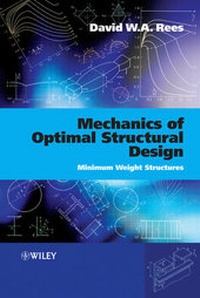
Mechanics of Optimal Structural Design
Beschreibung

Rezensionen / Stimmen
"The usual formulation is strength-to-weight ratio, but Rees (engineering and design, Brunel U.) points out that the goal is to reduce weight without reducing strength, not vice versa, so a better expression would be the weight-to-strength ratio, and that is what he explores." (Book News, December 2009)Weitere Details
Weitere Ausgaben
Andere Ausgaben
Person
David Rees, Brunel University, UK, is a senior lecturer in the School of Engineering and Design at Brunel University. He has published four books on solid mechanics and structures Basic Engineering Plasticity (Elsevier, 2006); Mechanics of Solids and Structures (World Scientific I.C. Press, 2000); and Basic Solid Mechanics (Macmillan, 1997) as well as over 100 journal papers in the fields of plasticity, creep, fatigue, fracture and engineering design. His research covers the fields of multi-axial plasticity and creep, cyclic deformation and interactions between creep and fatigue, autofrettage and buckling of cylinders and discs and sheet metal formability.
Inhalt
Preface xi
Glossary of Terms xv
Key Symbols xix
Chapter 1 Compression of Slender Struts 1
1.1 Introduction 1
1.2 Failure Criteria 1
1.3 Solid Cross-Sections 3
1.4 Thin-Walled, Tubular Sections 6
1.5 Thin-Walled, Open Sections 13
1.6 Summary of Results 24
References 25
Exercises 25
Chapter 2 Compression of Wide Struts 29
2.1 Introduction 29
2.2 Failure Criteria 29
2.3 Cellular Sections 31
2.4 Open Sections 37
2.5 Corrugated Sandwich Panel 57
2.6 Summary of Results 60
References 61
Exercise 61
Chapter 3 Bending of Slender Beams 65
3.1 Introduction 65
3.2 Solid Cross-Sections 66
3.3 Thin-Walled, Tubular Sections 69
3.4 Open Sections 76
3.5 Summary of Results 88
References 89
Exercises 89
Chapter 4 Torsion of Bars and Tubes 91
4.1 Introduction 91
4.2 Solid Cross-Sections 92
4.3 Thin-Walled, Open Sections 99
4.4 Thin-Walled, Closed Tubes 109
4.5 Multi-Cell Tubes 121
References 130
Exercises 130
Chapter 5 Shear of Solid Bars, Tubes and Thin Sections 135
5.1 Introduction 135
5.2 Bars of Solid Section 136
5.3 Thin-Walled Open Sections 143
5.4 Thin-Walled, Closed Tubes 159
5.5 Concluding Remarks 170
References 171
Exercise 171
Chapter 6 Combined Shear and Torsion in Thin-Walled Sections 173
6.1 Introduction 173
6.2 Thin-Walled, Open Sections 173
6.3 Thin-Walled, Closed Tubes 177
6.4 Concluding Remarks 189
References 190
Exercises 190
Chapter 7 Combined Shear and Bending in Idealised Sections 193
7.1 Introduction 193
7.2 Idealised Beam Sections 193
7.3 Idealised Open Sections 201
7.4 Idealised Closed Tubes 210
References 221
Exercises 221
Chapter 8 Shear in Stiffened Webs 223
8.1 Introduction 223
8.2 Castellations in Shear 223
8.3 Corrugated Web 226
8.4 Flat Web with Stiffeners 231
References 237
Exercises 237
Chapter 9 Frame Assemblies 239
9.1 Introduction 239
9.2 Double-Strut Assembly 239
9.3 Multiple-Strut Assembly 244
9.4 Cantilevered Framework 247
9.5 Tetrahedron Framework 253
9.6 Cantilever Frame with Two Struts 256
9.7 Cantilever Frame with One Strut 259
References 264
Exercises 264
Chapter 10 Simply Supported Beams and Cantilevers 265
10.1 Introduction 265
10.2 Variable Bending Moments 265
10.3 Cantilever with End-Load 271
10.4 Cantilever with Distributed Loading 281
10.5 Simply Supported Beam with Central Load 292
10.6 Simply Supported Beam with Uniformly Distributed Load 303
10.7 Additional Failure Criteria 316
References 322
Exercises 323
Chapter 11 Optimum Cross-Sections for Beams 325
11.1 Introduction 325
11.2 Approaching Optimum Sections 326
11.3 Generalised Optimum Sections 328
11.4 Optimum Section, Combined Bending and Shear 330
11.5 Solid, Axisymmetric Sections 331
11.6 Fully Optimised Section 341
11.7 Fully Optimised Weight 345
11.8 Summary 355
References 356
Exercises 356
Chapter 12 Structures under Combined Loading 357
12.1 Introduction 357
12.2 Combined Bending and Torsion 357
12.3 Cranked Cantilever 359
12.4 Cranked Strut with End-Load 362
12.5 Cranked Bracket with End-Load 365
12.6 Portal Frame with Central Load 368
12.7 Cantilever with End and Distributed Loading 371
12.8 Centrally Propped Cantilever with End-Load 377
12.9 End-Propped Cantilever with Distributed Load 385
12.10 Simply Supported Beam with Central-Concentrated and Distributed Loadings 390
12.11 Centrally Propped, Simply Supported Beam with Distributed Load 395
References 400
Exercises 400
Chapter 13 Encastré Beams 403
13.1 Introduction 403
13.2 Central-Concentrated Load 403
13.3 Uniformly Distributed Load 418
13.4 Combined Loads 437
References 463
Exercises 463
Chapter 14 Plastic Collapse of Beams and Frames 465
14.1 Introduction 465
14.2 Plane Frames 466
14.3 Beam Plasticity 468
14.4 Collapse of Simple Beams 474
14.5 Encastré Beams 478
14.6 Continuous Beams 481
14.7 Portal Frames 486
14.8 Effect of Axial Loading upon Collapse 497
14.9 Effect of Shear Force upon Collapse 500
14.10 Effect of Hardening upon Collapse 505
References 507
Exercises 507
Chapter 15 Dynamic Programming 511
15.1 Introduction 511
15.2 Single-Span Beam 511
15.3 Two-Span Beam 513
15.4 Three-Span Beam 515
15.5 Design Space 517
Reference 520
Exercises 520
Appendix A Mechanical Properties 521
A. 1 Non-Metals 521
A. 2 Metals and Alloys 522
References 524
Appendix B Plate Buckling Under Uniaxial Compression 525
B. 1 Wide and Slender Struts 525
B. 2 Plates with Supported Sides 527
B. 3 Inelastic Buckling 530
B. 4 Post-Buckling 533
References 534
Appendix C Plate Buckling Under Biaxial Compression and Shear 537
C. 1 Biaxial Compression 537
C. 2 Pure Shear 539
C.3 Inelastic Shear Buckling 541
References 541
Appendix D Secondary Buckling 543
D. 1 Buckling Modes 543
D. 2 Local Compressive Buckling 544
D. 3 Global Buckling 545
D. 4 Local Shear Buckling 547
References 547
Bibliography 549
Index 553
