

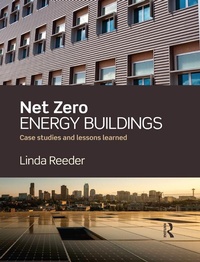
Net Zero Energy Buildings
Case Studies and Lessons Learned
Erschienen am 31. März 2016
282 Seiten
978-1-317-28999-9 (ISBN)
Beschreibung

This book presents 18 in-depth case studies of net zero energy buildings-low-energy building that generate as much energy as they consume over the course of a year-for a range of project types, sizes, and U.S. climate zones. Each case study describes the owner's goals, the design and construction process, design strategies, measurement and verification activities and results, and project costs.
With a year or more of post-occupancy performance data and other project information, as well as lessons learned by project owners and developers, architects, engineers, energy modelers, constructors, and operators, each case study answers the questions:
What were the challenges to achieving net zero energy performance, and how were these challenges overcome? How would stakeholders address these issues on future projects?
Are the occupants satisfied with the building? Do they find it comfortable? Is it easy to operate?
How can other projects benefit from the lessons learned on each project?
What would the owners, designers, and constructors do differently knowing what they know now?
A final chapter aggregates processes to engage in and pitfalls to avoid when approaching the challenges peculiar to designing, constructing, and owning a net zero energy building.
By providing a wealth of comparable information, this book which will flatten the learning curve for designing, constructing, and owning this emerging building type and improve the effectiveness of architectural design and construction.
With a year or more of post-occupancy performance data and other project information, as well as lessons learned by project owners and developers, architects, engineers, energy modelers, constructors, and operators, each case study answers the questions:
What were the challenges to achieving net zero energy performance, and how were these challenges overcome? How would stakeholders address these issues on future projects?
Are the occupants satisfied with the building? Do they find it comfortable? Is it easy to operate?
How can other projects benefit from the lessons learned on each project?
What would the owners, designers, and constructors do differently knowing what they know now?
A final chapter aggregates processes to engage in and pitfalls to avoid when approaching the challenges peculiar to designing, constructing, and owning a net zero energy building.
By providing a wealth of comparable information, this book which will flatten the learning curve for designing, constructing, and owning this emerging building type and improve the effectiveness of architectural design and construction.
Rezensionen / Stimmen
Linda Reeder's book comes along at an exciting time-building design professionals have committed to achieving net zero energy in their projects but need to know more about how to design for it. Reeder presents detailed case studies of projects that cover a range of building types, sizes and geographic locations, and all have been measured to perform at net zero energy or better. Her practical and readable study is a clear and solid contribution to the literature of change we need to build a clean energy future.Edward Mazria, Founder and CEO of Architecture 2030
Net Zero Energy Buildings provides a broad look at the current state of the net zero energy building movement. Linda Reeder highlights all the seminal early-21st-century net zero projects, from new large office buildings, historic retrofits, to K-12 schools across a range of climate zones in the US. Not only does Reeder provide 18 case studies to show cost effective and mainstream net zero projects in operations, but she also provides unique insights into common best practices critical for any owner or designer looking to go net zero in their next project.
Shanti Pless, Senior Research Engineer, NREL
Net Zero Energy Buildings provides exactly the kind of information designers, builders, and building owners need today: detailed, technical information on how net-zero-energy performance is being achieved in state-of-the-art buildings. The 18 inspiring projects that Linda Reeder profiles here are reshaping our understanding of what is possible in creating green, sustainable buildings that will help us achieve a carbon-neutral future. This superb book adds immeasurably to the literature on net-zero-energy buildings.
Alex Wilson, President, Resilient Design Institute
"...illustrates the potential for renewable energies integrated into building design as applicable to the building site climatic zone, and the solar, wind, and other temperature variables of typical US sites."
Building Engineer, March 2017
Weitere Details
Sprache
Englisch
Verlagsort
London
Großbritannien
Verlagsgruppe
Taylor & Francis Ltd
Zielgruppe
Für Beruf und Forschung
Illustrationen
123 s/w Tabellen, 76 Farbfotos bzw. farbige Rasterbilder, 18 farbige Zeichnungen
123 Tables, black and white; 18 Line drawings, color; 76 Halftones, color
Dateigröße
32,90 MB
ISBN-13
978-1-317-28999-9 (9781317289999)
Copyright in bibliographic data and cover images is held by Nielsen Book Services Limited or by the publishers or by their respective licensors: all rights reserved.
Schweitzer Klassifikation
Weitere Ausgaben
Andere Ausgaben
Buch
10/2024
1. Auflage
Routledge
63,50 €
Versand in 10-20 Tagen
Buch
06/2016
1. Auflage
Routledge
154,50 €
Artikel z.Zt. nicht lieferbar
Person
Linda Reeder, FAIA, LEED AP is an Associate Professor at the School of Engineering, Science and Technology of Central Connecticut State University. She practiced as an architect for more than a decade before becoming a professor in the Construction Management program. She has previously published a book and numerous articles on sustainable design and construction.
Inhalt
Introduction Part I: Office Buildings 1. Bullitt Center 2. DPR Construction Phoenix Regional Office 3. National Renewable Energy Laboratory Research Support Facility 4. Packard Foundation Headquarters 5. Wayne N. Aspinall Federal Building and U.S. Courthouse Part II: Educational and Community Buildings 6. Berkeley West Branch Public Library 7. Bosarge Family Education Center 8. Center for Sustainable Landscapes 9. Hood River Middle School Music and Science Building 10. Lady Bird Johnson Middle School 11. Locust Trace AgriCenter Academic Building 12. Painters Hall Community Center Part III: Retail 13. TD Bank Cypress Creek Branch 14. Walgreens in Evanston Part IV: Production Homes and Multi-Family Housing 15. Camp Lejeune Midway Park Duplex 16. Eco-Village Community 17. zHome Townhomes 18. Paisano Green Community Public Housing Part V: Lessons Learned 19. Shared Lessons for Future Net Zero Energy Projects
