

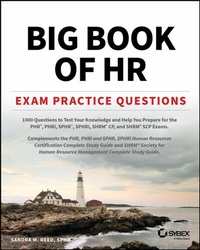
Big Book of HR Exam Practice Questions
Beschreibung

Prepare for HR certification exams faster and smarter with over 1000 expertly written practice questions
In the Big Book of HR Exam Practice Questions: 1000 Questions to Test Your Knowledge and Help You Prepare for the PHR, PHRi, SPHR, SPHRi and SHRM CP/SCP Certification Exams, human resources certification expert Sandra M. Reed delivers an essential test-prep resource for the Human Resources Certification Institute's PHR, PHRi, SPHR, SPHRi and SHRM CP and SCP exams. The book offers over 1000 challenging and well-written questions covering the entire range of subjects covered by the tests, updated for the 2024 exams.
In the book, you'll find content exploring United States labor law, talent planning and acquisition, business strategy, total rewards, learning and development, risk management and compliance, diversity, equity, and inclusion, and much more. You'll also discover:
- Easy-to-find info that makes the book perfect as a go-to, on-the-job resource for practicing HR professionals
- Extensive materials offering full coverage of the subjects tested on the exams, helping you to reduce test anxiety and improve information recall
- Online recommendations for additional expert resources that will take your study efforts to the next level
- Complimentary access to Sybex's easy-to-use online test bank that includes all the practice questions from the book
An effective and powerful study resource for people preparing for the HRCI's PHR, SPHR, and SHRM CP and SCP exams, Big Book of HR Exam Practice Questions is also the perfect desk reference for aspiring and practicing human resource practitioners.
Weitere Details
Weitere Ausgaben
Andere Ausgaben
Person
ABOUT THE AUTHOR
Sandra M. Reed, SPHR, SHRM-SCP is a leading expert in the certification of Human Resource Professionals. She is the bestselling author of the PHR and SPHR Professional in Human Resources Certification Complete Study Guide and the HRCI???s Official Guide to the Human Resource Body of Knowledge. She is the founder of a business consulting group specializing in strategy and leadership development in small businesses.
Inhalt
About This Book xxiii
Chapter 1 Introduction 1
Know Your Why 4
The Exam Content 5
Types of Questions 6
Multiple Choice/Multiple Option 7
Drag and Drop 7
Fill in the Blank 8
Exam Preparation 8
What You Think About Matters 11
Using This Book to Practice 12
Conclusion 13
Chapter 2 U.S. Labor Law 15
Labor Law Employment Law Cheat Sheet 18
Labor Law Practice Questions 21
Key Concept Research Questions 42
Test Your Labor Law Terminology Knowledge 42
Conclusion 44
Additional Resources 44
Websites 45
Podcasts 45
YouTube Channels 46
Chapter 3 Business Management and Strategy 47
Business Management and Strategy Questions 51
Key Concept Research Questions 65
Test Your Business Management and Strategy Terminology Questions 65
Conclusion 67
Additional Resources 67
Websites 67
Podcasts 68
YouTube Channels 68
Chapter 4 Talent Planning and Acquisition 69
Talent Planning and Acquisition Practice Questions 73
Key Concept Research Questions 88
Test Your Talent Planning and Acquisition Terminology 88
Conclusion 90
Additional Resources 91
Websites 91
Podcasts 92
YouTube Channels 92
Chapter 5 Learning and Development 95
Learning and Development Practice Questions 99
Key Concept Research Questions 112
Test Your Learning and Development Terminology Knowledge 112
Conclusion 115
Additional Resources 115
Websites 115
Podcasts 116
YouTube Channels 116
Chapter 6 Total Rewards 117
Total Rewards Practice Questions 122
Key Concept Research Questions 136
Test Your Total Rewards Terminology Knowledge 136
Conclusion 138
Additional Resources 138
Websites 139
Podcasts 139
YouTube Channels 140
Chapter 7 Risk Management 141
Risk Management Practice Questions 145
Key Concept Research Questions 158
Test Your Risk Management Terminology Knowledge 158
Conclusion 160
Additional Resources 160
Websites 160
Podcasts 161
YouTube Channels 161
Chapter 8 Employee Engagement and Retention 163
Employee Engagement and Retention Practice Questions 167
Key Concept Research Questions 179
Test Your Engagement and Retention Terminology Knowledge 180
Conclusion 182
Additional Resources 183
Websites 183
Podcasts 183
YouTube Channels 184
Chapter 9 Employee and Labor Relations 185
Employee and Labor Relations Practice Questions 190
Key Concept Research Questions 202
Test Your Employee and Labor Relations Terminology Knowledge 202
Conclusion 204
Additional Resources 204
Websites 204
Podcasts 205
YouTube Channels 205
Chapter 10 Ethical Practice and Corporate Social Responsibility 207
Ethical Practice and Corporate Social Responsibility Questions 211
Key Concept Research Questions 222
Test Your Ethical Practice and Corporate Social Responsibility Terminology Knowledge 222
Conclusion 225
Additional Resources 225
Websites 225
Podcasts 226
YouTube Channels 226
Chapter 11 Managing a Global Workforce 227
Global Human Resource Management Practice Questions 231
Key Concept Research Questions 243
Test Your Global HR Management Terminology Knowledge 243
Conclusion 245
Additional Resources 246
Websites 246
Podcasts 246
YouTube Channels 247
Chapter 12 Diversity, Equity, and Inclusion 249
Diversity, Equity, and Inclusion Practice Questions 254
Key Concept Research Questions 267
Test Your DEI Terminology Knowledge 267
Conclusion 269
Additional Resources 269
Websites 270
Podcasts 270
YouTube Channels 271
Chapter 13 Workforce Analytics and Technology 273
Workforce Analytics and Technology Practice Questions 277
Key Concept Research Questions 290
Test Your Workforce Analytics and Technology Terminology Knowledge 291
Conclusion 293
Additional Resources 293
Websites 293
Podcasts 294
YouTube Channels 294
Chapter 14 Human Resource Competencies 295
Human Resource Competencies Practice Questions 300
Key Concept Research Questions 313
Test Your Human Resource Competencies Terminology Knowledge 315
Conclusion 316
Additional Resources 317
Websites 317
Podcasts 318
YouTube Channels 318
Chapter 15 Leadership 319
Leadership Practice Questions 323
Key Concept Research Questions 335
Test Your Leadership Terminology Knowledge 336
Conclusion 337
Additional Resources 338
Websites 338
Podcasts 338
YouTube Channels 339
Chapter 16 Organizational Development and Design 341
Organizational Development and Design Practice Questions 345
Key Concept Research Questions 359
Test Your Organizational Development and Design Terminology Knowledge 360
Conclusion 362
Additional Resources 362
Websites 362
Podcasts 363
YouTube Channels 363
Appendix A Answers to Review Questions 365
Chapter 2: U.S. Labor Law 366
Chapter 3: Business Management and Strategy 377
Chapter 4: Talent Planning and Acquisition 391
Chapter 5: Learning and Development 403
Chapter 6: Total Rewards 414
Chapter 7: Risk Management 425
Chapter 8: Employee Engagement and Retention 435
Chapter 9: Employee and Labor Relations 448
Chapter 10: Ethical Practice and Corporate Social Responsibility 460
Chapter 11: Managing a Global Workforce 473
Chapter 12: Diversity, Equity, and Inclusion 488
Chapter 13: Workforce Analytics and Technology 500
Chapter 14: Human Resource Competencies 515
Chapter 15: Leadership 529
Chapter 16: Organizational Development and Design 543
Appendix B Answers to Terminology Knowledge Test 559
Chapter 2: U.S. Labor Law 560
Chapter 3: Business Management and Strategy 560
Chapter 4: Talent Planning and Acquisition 561
Chapter 5: Learning and Development 562
Chapter 6: Total Rewards 563
Chapter 7: Risk Management 564
Chapter 8: Employee Engagement and Retention 565
Chapter 9: Employee and Labor Relations 565
Chapter 10: Ethical Practice and Corporate Social Responsibility 566
Chapter 11: Managing a Global Workforce 567
Chapter 12: Diversity, Equity, and Inclusion 568
Chapter 13: Workforce Analytics and Technology 569
Chapter 14: Human Resource Competencies 569
Chapter 15: Leadership 570
Chapter 16: Organizational Development and Design 571
Appendix C Answers to Research Challenge Questions 573
Chapter 2: U.S. Labor Law 574
Chapter 3: Business Management and Strategy 575
Chapter 4: Talent Planning and Acquisition 576
Chapter 5: Learning and Development 577
Chapter 6: Total Rewards 579
Chapter 7: Risk Management 580
Chapter 8: Employee Engagement and Retention 582
Chapter 9: Employee and Labor Relations 583
Chapter 10: Ethical Practice and Corporate Social Responsibility 584
Chapter 11: Global Human Resource Management 586
Chapter 12: Diversity, Equity, and Inclusion 587
Chapter 13: Workforce Analytics and Technology 588
Chapter 14: Human Resource Competencies 589
Chapter 15: Leadership 590
Chapter 16: Organizational Development and Design 591
Index 595
Chapter 1
Introduction
"You are what you do, not what you say you'll do."
Carl Jung
Welcome to The Big Book of HR Practice Questions! Your decision to invest in your professional development speaks volumes about your commitment to excellence and your dedication to advancing in the field of human resources (HR).
As the opening quote suggests, the process of preparing to sit for a certification exam requires taking action. It is not enough to simply think about or say that you want to accomplish something. True mastery of any topic requires work, patience, consistency, and access to resources that support a successful outcome. This book is designed to be a functional practice question guide for exams offered by the Human Resource Certification Institute and the Society for Human Resource Management.
- The Human Resource Certification Institute (HRCI): The Human Resource Certification Institute (HRCI) is an organization that offers certifications for HR professionals, validating their expertise and competency in various HR domains. Through rigorous examination and ongoing professional development, HRCI aims to elevate standards in the HR industry and empower professionals to advance their careers. This book is mapped to HRCI's exam content outlines for four exams:
- Professional in Human Resources (PHR): The PHR certification caters to HR professionals who possess one to four years of experience in executing programs with a tactical/logistical focus, highlighting their operational duties within the organization's HR department.
- Professional in Human Resources, international (PHRi): The PHRi certification is tailored for HR practitioners situated in a single international setting (non U.S.-based company), affirming their professional-level proficiency, knowledge, and skills to advance their careers in HR. Through the PHRi, individuals showcase their expertise in universally recognized technical and operational HR principles within an international context.
- Senior Professional in Human Resources (SPHR): The SPHR credential targets senior HR leaders in the United States with four years or more experience in strategizing rather than executing HR policies. SPHR professionals typically oversee HR department objectives and strategize and implement business plans and technology, all while comprehending the broader HR requirements of the organization.
- Senior Professional in Human Resources, international (SPHRi): The SPHRi certification is tailored for HR leaders located outside of the United States, acknowledging their senior-level competency in generally accepted HR principles encompassing strategy, policy development, and service delivery within a single international setting.
- The Society for Human Resource Management (SHRM): The Society for Human Resource Management (SHRM) is a professional association dedicated to advancing the HR profession by providing resources, training, and networking opportunities to its members. Through advocacy, research, and education, SHRM strives to empower HR professionals worldwide to become strategic partners in their organizations' success. They have developed an exam Body of Applied Skills and Knowledge (BASK) for two exams that this practice guide is mapped to:
- SHRM Certified Professional (SHRM-CP): An individual pursuing an SHRM-CP certification typically engages in HR or HR-related tasks or is aspiring toward a career in HR, with a focus on operational responsibilities. It's advisable for candidates to possess a basic understanding of HR concepts as they prepare for the certification.
- SHRM Senior Certified Professional (SHRM-SCP): The SHRM-SCP certification is designed for individuals who have a minimum of three years of experience in executing strategic-level HR or HR-related responsibilities. Alternatively, it's also suitable for SHRM-CP holders who have maintained their certification for at least three years and are either currently working in or transitioning into strategic-level roles within the HR domain.
What sets this book apart is its practical approach. Each question is carefully crafted to mirror real-world scenarios and challenges encountered in a typical day in HR. Each question is also designed to get you familiar with how the questions are presented on the HRCI and SHRM exams. By engaging with the questions in this book, you'll not only test your understanding of key concepts but also hone your ability to critically think through situations, make informed decisions, and apply your work experience to find the correct answers.
Many athletes are familiar with the age-old adage, "Practice makes perfect." Yet, imagine a professional golfer heading to the driving range, swinging away for hours with the wrong form and the wrong club, and lacking the proper mindset. That practice might end up engraining the wrong techniques rather than properly refining the skills necessary for success.
This same principle applies to exam preparation! It's not just about practice; it's about perfect practice. To stack the odds in your favor, you need the right tools and resources for effective performance, and that's where this book comes in. It's designed to be an important resource in your preparation cache.
Success when facing a difficult exam requires planning and effort, not unlike when preparing for a marathon, embarking on a job search, or taking on new responsibilities at work. It will take perseverance and a commitment to yourself. The journey begins by understanding your own motivation.
Know Your Why
Mae Jemison was the first African American woman to travel in space, a physician, an engineer, and a passionate advocate for STEM education and exploration. From an early age, Dr. Jemison was captivated by the mysteries of the universe. This curiosity fueled her passion for science and drove her to pursue studies in chemical engineering and medicine. This led her to apply to NASA's astronaut program, despite facing barriers as a woman and African American. Jemison's personal "why" was rooted in a deep-seated desire to understand and explore the cosmos, propelling her to space aboard the Space Shuttle Endeavour in 1992. A true space pioneer and role model, Jemison's story reminds us that overcoming internal and external barriers to success requires a whole lot of guts, planning, and perseverance.
Why are you taking a professional certification exam? The answer to the question "why" serves decision-making, drives behaviors, and satisfies in a way experts call intrinsic motivation. Intrinsic motivation refers to the internal desire or drive to engage in an activity or pursue a goal solely for the enjoyment, satisfaction, or inherent interest it brings. This type of motivation often leads to higher levels of engagement, persistence, and creativity in tasks or goals pursued. Of course, there is nothing wrong with being motivated by external factors either; in fact, for some, the idea of recognition or monetary rewards is a key driver. When pursuing successful HR certification, it is useful to understand your own intrinsic and extrinsic motivators, such as the following:
- Self-investment: People often take professional certification exams to invest in themselves, aiming to boost their skills and knowledge for personal and professional development.
- Pay increase: Getting certified can help bump up your earnings by more than 25%. This is accomplished by showing employers and clients that you've got the expertise and competencies they're looking for, which can lead to better job opportunities and higher salaries.
- Role-modeling: When you become certified, you're not just doing it for yourself; you're also setting an example for others around you, inspiring them and encouraging them to keep pushing forward in their own careers.
- Excellence: Sitting down for a professional certification exam isn't just about passing a test; it's about showing your commitment to being the best in your field, demonstrating your dedication and staying on top of industry trends and standards.
This process is tough, and at times it might even be stressful. Knowing your why is your benchmark, the place that tethers you to the reasons you get up early to study, stay up late making flashcards, and watch MBA-level videos while on the treadmill. A quick mindset shift can help when those study days seem long. As Simon Sinek said, "Working hard for something we don't care about is called stress. Working hard for something we love is called passion."
The Exam Content
The profession of human resources has a framework from which university courses are taught, research is conducted, and best practices are formed. This framework is built around the human resource body of knowledge (HRBoK), and exam content often reflects these guidelines. While each exam has its own functional area categories, there are core knowledge and competency themes that are covered across all of the HRCI and SHRM exams. This book includes exam questions in the following HR domains:
