

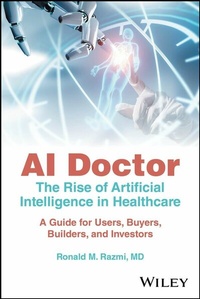
AI Doctor
Beschreibung

AI Doctor: The Rise of Artificial Intelligence in Healthcare provides a timely and authoritative overview of the current impact and future potential of AI technology in healthcare. With a reader-friendly narrative style, this comprehensive guide traces the evolution of AI in healthcare, describes methodological breakthroughs, drivers and barriers of its adoption, discusses use cases across clinical medicine, administration and operations, and life sciences, and examines the business models for the entrepreneurs, investors, and customers.
Detailed yet accessible chapters help those in the business and practice of healthcare recognize the remarkable potential of AI in areas such as drug discovery and development, diagnostics, therapeutics, clinical workflows, personalized medicine, early disease prediction, population health management, and healthcare administration and operations. Throughout the text, author Ronald M. Razmi, MD offers valuable insights on harnessing AI to improve health of the world population, develop more efficient business models, accelerate long-term economic growth, and optimize healthcare budgets.
Addressing the potential impact of AI on the clinical practice of medicine, the business of healthcare, and opportunities for investors, AI Doctor: The Rise of Artificial Intelligence in Healthcare:
* Discusses what AI is currently doing in healthcare and its direction in the next decade
* Examines the development and challenges for medical algorithms
* Identifies the applications of AI in diagnostics, therapeutics, population health, clinical workflows, administration and operations, discovery and development of new clinical paradigms and more
* Presents timely and relevant information on rapidly expanding generative AI technologies, such as Chat GPT
* Describes the analysis that needs to be made by entrepreneurs and investors as they evaluate building or investing in health AI solutions
* Features a wealth of relatable real-world examples that bring technical concepts to life
* Explains the role of AI in the development of vaccines, diagnostics, and therapeutics during the COVID-19 pandemic
AI Doctor: The Rise of Artificial Intelligence in Healthcare. A Guide for Users, Buyers, Builders, and Investors is a must-read for healthcare professionals, researchers, investors, entrepreneurs, medical and nursing students, and those building or designing systems for the commercial marketplace. The book's non-technical and reader-friendly narrative style also makes it an ideal read for everyone interested in learning about how AI will improve health and healthcare in the coming decades.
Weitere Details
Weitere Ausgaben
Andere Ausgaben
Person
RONALD M. RAZMI, MD is a cardiologist and the co-founder and Managing Director of Zoi Capital, a venture capital firm that invests in the applications of AI in healthcare. Dr. Razmi completed his medical training at the Mayo Clinic and holds an MBA from Northwestern University's Kellogg School of Management. He was a McKinsey consultant before launching a population health management software company at the dawn of digital health. He saw firsthand the confluence of clinical, technical, and business factors that need to come together for new technologies to gain a foothold in healthcare. He is a co-author of the Handbook of Cardiovascular Magnetic Resonance Imaging.
Inhalt
Foreword
FROM THE EARLIEST DAYS of Alan Turing's 1950s speculations about the possibility of computers developing some general form of intelligence, scholars have thought that healthcare would be an ideal application area for such capabilities. After all, everyone desires more effective health care, medical practice has never approached perfection, and computers and their applications have increased by nearly a billion-fold in computational abilities over these years. So, it is not beyond the realm of imagination to think that the computer and its sophisticated machine learning abilities can form an ideal technology to help revolutionize the practice of medicine and public health. After all, if we can capture all the healthcare situations in which patients have found themselves, record the decisions their clinicians have made in their care, and evaluate the outcomes in those myriad trials, we (and our tools) should be able to learn what works best for which kinds of patients in what conditions, and perhaps even why, based on a growing understanding of the biology that underlies medicine. That knowledge should then form the basis of clinical decision support, which should help doctors, nurses, technicians, and patients themselves make optimal choices and thus lead to an era of precision medicine, achieving the best possible outcomes for each individual patient.
Despite the optimism embedded in such projections, this vision has largely not been fulfilled. Of course, the practice of medicine has improved greatly over the past seventy years, but mostly because we have developed better tools to examine the operations of the human body, a much-improved understanding of the biological and environmental processes and genetic influences that cause disease, and highly targeted medications and procedures that can interfere with disease processes. Yet most of the traditional tasks of medicine-diagnosis, prognosis, and treatment-are still rife with uncertainty.
The vast increases in computer power have enabled widespread application of imaging tools such as CT and MRI, have contributed to sequencing and analyzing the human genome, and have made it possible to create electronic health records for billions of patients around the world, whose data had previously largely remained in inaccessible paper collections of handwritten notes. Nevertheless, despite tremendous advances in what we now call artificial intelligence (AI), we see surprisingly few successful applications of those technologies in healthcare. The ones that are successful tend to focus on very specific clinical problems, such as interpreting retinal fundus images to identify patients developing diabetic retinopathy or examining mammograms to estimate the risk of a patient developing breast cancer. And even in such narrow domains, success is often elusive.
Ron Razmi has spent the past three years wrestling with this conundrum, and in this book reviews what he has learned from that struggle. Ron is a Renaissance man of healthcare, who trained and practiced as a cardiologist, then was a consultant for one of the world's largest consulting companies, became a digital health entrepreneur, and now serves as a venture capitalist, helping others to realize the above dreams.
My own interest in medical AI began in 1974 when I joined the computer science faculty at MIT and quickly found myself attracted to the problems of how one could represent medical knowledge in a formal way in computer programs and how those programs could use that knowledge to apply diagnostic reasoning, therapy planning, and prognoses to individual patient cases. I began to work with a cohort of brilliant doctors who were excited to formalize these ideas for a very different reason: they taught the next generation of medical students and wanted to know how to teach the best ways to reason about clinical decision-making. They thought that capturing what they knew and how they reasoned would crystalize what they wanted to pass on to their students. My motivation was to build decision support systems that could improve the practice of most doctors by providing a built-in "second opinion" on their challenging cases. Replacing doctors' decision-making was never the goal, as we realized that our systems were unlikely to be perfect, so a man-machine team was likely to make better decisions than either alone.
At that time, most medical records were still kept as handwritten paper notes and the machine learning methods we today take for granted had not yet been developed, so our approach was to ask experienced doctors how they thought through difficult problems and then to write computer programs to simulate that thinking. Those programs, based on symbolic pattern matching or on chaining of symbolic inference rules, did a good job of handling the "textbook" cases but broke down on more complex cases where, for example, a patient suffered from an unusual combination of disorders. We tried to fix this problem by developing methods that reasoned about the pathophysiology of multiple diseases, but unfortunately, even today, with our much better understanding of biology and genetics, variations among patients and their responses to treatments are often unexplainable.
Fortunately, by the mid-1990s, many academic medical centers had implemented electronic medical/health/patient records, so it became possible to learn relationships among symptoms, lab data, drug prescriptions, procedures, and their outcomes from such empirical data. By the end of the 2000s, government subsidy for EHR adoption had made such systems ubiquitous, today implemented in about 98% of all US hospitals. At the same time, research on machine learning, starting with the tried-and-true methods of statistics, had been extended to model much more complex relationships among data.
In the 2010s, a new method was developed to represent concepts as vectors in a high-dimensional space-i.e. as long lists of numbers-derived from the frequency and nearness of co-occurrence of the concepts in papers, medical notes, etc. Concepts whose meanings are similar to each other are often found in similar contexts, so their representations wind up near each other in that space. Furthermore, relations also take on a numerical relationship. For example, the vector of the distance and direction of the difference between the embeddings of "bone marrow" and "red blood cells" is similar to that between "adrenal gland" and "cortisol". So, that vector is approximately a representation of "produces". At the same time, an older idea, to build learning systems inspired by neuroscience, became practical because of the enormous improvements in computer power. To learn a model that can, say, predict the outcome of a medical intervention on a patient in a certain clinical state, we can start with a random neural network and train it on a large body of known cases of the state of a patient, the treatment, and the outcome. Initially, the network will predict randomly, but each time it makes an error, we can assign blame for that error proportionally to the parts of the network that computed the wrong outcome and adjust their influence to reduce the error. As we keep doing so, often repeatedly for thousands or even millions of cases, the error is reduced and the model becomes more accurate. The numerical representation of concepts makes this possible, so those two insightful methods now account for most machine learning approaches. Indeed, the Large Language Models that are so much in the news today are trained very much as just described, where their task is simply to predict the next word from previous ones in a vast number of human-written (or spoken) texts.
In the past dozen or so years, therefore, many projects have succeeded in using repositories of clinical data to learn predictive models that could estimate the likelihood that a patient would develop some disease within a certain period of time, whether particular interventions were likely to cure them, how long they might live with an incurable disease, etc.
Nevertheless, much technical work remains to be done. We learned that systems built from data at one hospital might not work nearly as well at another because the patient populations differed in genetics, socioeconomic status, attitudes toward complying with medical advice, the prevalence of environmental influences in their neighborhood, etc. Medical records were often incomplete: a patient treated at multiple institutions might have records at only some of them, clerical errors dropped some data, heterogeneous vendors could have incompatible data formats that prevented their matching, etc. Clinical practice, often based on local traditions, might differ, so the tests and treatments used in different hospitals may not be the same. Most significantly, medical records do not typically record why some action was taken, yet that reasoning may be the most useful predictor of how well a patient eventually thrives. Finally, faced with a clinical situation in which two alternative therapies seem reasonable, in each case only one of them is chosen, so we have no way to know what would have happened had the other-the counterfactual therapy-been chosen.
Clinical trials address this problem by randomizing the choice of intervention, so we can know that nothing about the case has influenced the treatment choice, so its success or failure must depend only on the patient's condition and treatment, and not on confounders that in a non-trial context probably...
