

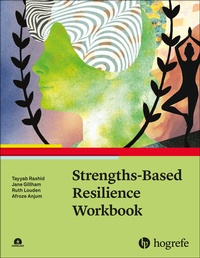
Strengths-Based Resilience Workbook
1. Auflage
Erschienen am 8. Juli 2024
X, 172 Seiten
978-1-61676-582-8 (ISBN)
Beschreibung
In a world full of stress and uncertainty, pursuing resilience becomes increasingly important. The Strengths-Based Resilience Workbook shows you how to tap into your natural capacity to navigate life's challenges and thrive.
The Strengths-Based Resilience program, rooted in rigorous science and enriched by the practical insights of positive psychology, cognitive-behavioral therapy, and mindfulness, comprises 14 meticulously designed modules that steer a course toward resilience. You will acquire skills to build and harness your strengths, increasing your ability to deal with everyday challenges and pursue meaningful goals.
The program helps you to envision a world where irritation gives way to gratitude, where each interaction plants the seeds for closer relationships, and where the quest for individual purpose evolves into a collective journey. With clear instructions and a comprehensive list of resources, this workbook can be your steadfast companion on the path to resilience. It invites you to document your progress across 14 unique topics, each supplemented by hands-on practices.
As you work through each module, you'll experience a fulfilling learning process and a personally rewarding transformation, converting the abstract concept of resilience into practical, actionable skills. Use this workbook as your guide for shaping a more resilient self and, consequently, a more resilient world.
Rezensionen / Stimmen
Today, as so many individuals, families, organizations, and communities are struggling, cultivating resilience is paramount. Drawing on the science of positive psycholog, this rigorous and practical workbook provides a roadmap that can help us navigate life's challenges. by Tal Ben-Shahar, Founder of Happiness Studies Academy; New York Times bestselling author of HappierWeitere Details
Auflage
2025
Sprache
Englisch
Verlagsort
Cambridge
USA
Zielgruppe
Für Beruf und Forschung
People undergoing therapy/coaching, clinical psychologists, psychotherapists, college counselors, and coaches.
Illustrationen
including online material
Dateigröße
5,84 MB
ISBN-13
978-1-61676-582-8 (9781616765828)
DOI
10.1027/00582-000
Schweitzer Klassifikation
Weitere Ausgaben
Personen
Tayyab Rashid, PhD, CPsych, is a licensed school and clinical psychologist at the Health and Wellness Centre of the University of Toronto Scarborough (UTSC). Tayyab's exper tise includes strengths-based assessment and interventions, positive education, posttraumatic growth, and multicultural counseling. Tayyab is coauthor with Martin Seligman, the founder of positive psychology, of Positive Psychotherapy (2018). Tayyab's outstanding work has been recognized with, e.g. the Outstanding Practitioner Award (2017) from the International Positive Psychology Association.
Jane Gillham, PhD, is a licensed clinical psychologist, educator, and researcher at Swarthmore College. Her research focuses on promoting resilience and well-being in youths and especially how schools, families, and communities help youths thrive. Jane is cocreator of the Penn Resilience Program (PRP), as well as several other well-being programs for youths. Jane also serves as a scientific advisor to CorStone, a nonprofit organization devoted to promoting resilience and well-being in young people, especially those in poor and marginalized communities.
Ruth Louden, MEd, is a Career Coach in private practice. She is a trained facilitator in Strengths-Based Resilience (SBR) and holds a Foundations in Applied Mindfulness Meditation Certificate from the University of Toronto. Ruth managed a wide range of educational programs for co-operative education, career development and employment transition. She holds a MEd from the University of Toronto's Ontario Institute for Studies in Education (OISE) specializing in Career and Work and a MES from York University specializing in Quality of Work Life.
Afroze Anjum, PhD, CPsych, is a licensed school psychologist on the Toronto District School Board. Afroze's exper tise includes strengths-based, school-based interventions that incorporate character strengths, resilience, mindfulness, and adaptive problem solving, to cope with challenges such as depression and anxiety in children. She has worked as a researcher and training facilitator for the Penn Resilience Program and the Positive Psychology for Youth Project. Afroze is currently part of the Toronto District School Board's Wellbeing Committee in the wake of COVID-19.
Jane Gillham, PhD, is a licensed clinical psychologist, educator, and researcher at Swarthmore College. Her research focuses on promoting resilience and well-being in youths and especially how schools, families, and communities help youths thrive. Jane is cocreator of the Penn Resilience Program (PRP), as well as several other well-being programs for youths. Jane also serves as a scientific advisor to CorStone, a nonprofit organization devoted to promoting resilience and well-being in young people, especially those in poor and marginalized communities.
Ruth Louden, MEd, is a Career Coach in private practice. She is a trained facilitator in Strengths-Based Resilience (SBR) and holds a Foundations in Applied Mindfulness Meditation Certificate from the University of Toronto. Ruth managed a wide range of educational programs for co-operative education, career development and employment transition. She holds a MEd from the University of Toronto's Ontario Institute for Studies in Education (OISE) specializing in Career and Work and a MES from York University specializing in Quality of Work Life.
Afroze Anjum, PhD, CPsych, is a licensed school psychologist on the Toronto District School Board. Afroze's exper tise includes strengths-based, school-based interventions that incorporate character strengths, resilience, mindfulness, and adaptive problem solving, to cope with challenges such as depression and anxiety in children. She has worked as a researcher and training facilitator for the Penn Resilience Program and the Positive Psychology for Youth Project. Afroze is currently part of the Toronto District School Board's Wellbeing Committee in the wake of COVID-19.
Inhalt
Introduction
Section I: Regular Practice
Regular Practice 1: Mindfulness and
Relaxation
Core Concepts of Mindfulness and Relaxation
Practice 1: Stretch and Relax
Practice 2: Breathe
Practice 3: Take a Mindful Minute
Practice 4: Use Positive Imagery
Practice 5: Visualize Lovingkindness
Regular Practice 2: Gratitude Journal
Core Concepts of Gratitude
Practice: Reflect on Your Gratitude Journal
Section II: The Modules
Module 1: Resilience
Module 2: Fixed and Growth Mindsets
Module 3: Cognitive Accuracy
Module 4: Cognitive Flexibility
Module 5: Character Strengths
Module 6: Signature Strengths
Module 7: Problem Solving and Strengths
Module 8: Grudge and Gratitude
Module 9: Empathy
Module 10: Slowness and Savoring
Module 11: Positive Relationships
Module 12: Positive Communication
Module 13: Altruism
Module 14: Meaning and Purpose
Conclusion
Section I: Regular Practice
Regular Practice 1: Mindfulness and
Relaxation
Core Concepts of Mindfulness and Relaxation
Practice 1: Stretch and Relax
Practice 2: Breathe
Practice 3: Take a Mindful Minute
Practice 4: Use Positive Imagery
Practice 5: Visualize Lovingkindness
Regular Practice 2: Gratitude Journal
Core Concepts of Gratitude
Practice: Reflect on Your Gratitude Journal
Section II: The Modules
Module 1: Resilience
Module 2: Fixed and Growth Mindsets
Module 3: Cognitive Accuracy
Module 4: Cognitive Flexibility
Module 5: Character Strengths
Module 6: Signature Strengths
Module 7: Problem Solving and Strengths
Module 8: Grudge and Gratitude
Module 9: Empathy
Module 10: Slowness and Savoring
Module 11: Positive Relationships
Module 12: Positive Communication
Module 13: Altruism
Module 14: Meaning and Purpose
Conclusion
