

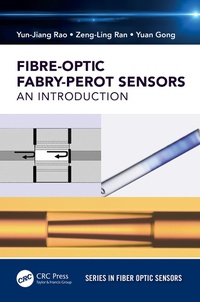
Fiber-Optic Fabry-Perot Sensors
An Introduction
Erschienen am 27. April 2017
204 Seiten
978-1-351-64732-8 (ISBN)
Beschreibung

The authors deliver a complete overview of fiber-optic Fabry-Perot (FFP) sensing technology, integrating the knowledge and tools of multiple fields including optics, sensing, micromachining, instrumentation, physics, and materials science. The main chapters discuss operating principles, microstructures, fabrication methods, signal demodulation, and instrumentation. This treatment spans the full range of structures (intrinsic/extrinsic, multimode fiber vs single-mode fibers), as well as advanced micromachining technologies and major interrogating and multiplexing methods for the formation of multi-point, quasi-distributed sensing networks. Readers will also gain a summary of state-of-the-art applications in oil, gas, and electricity industries, aerospace technology, and biomedicine.
Yun-Jiang Rao is Dean of the School of Communication & Information Engineering, and Director of the Key Lab of Optical Fiber Sensing & Communications at the University of Electronic Science and Technology of China. Zeng-Ling Ran and Yuan Gong are both associate professors at the Optical Fiber Technology Research Laboratory of the University of Electronic Science and Technology of China.
Yun-Jiang Rao is Dean of the School of Communication & Information Engineering, and Director of the Key Lab of Optical Fiber Sensing & Communications at the University of Electronic Science and Technology of China. Zeng-Ling Ran and Yuan Gong are both associate professors at the Optical Fiber Technology Research Laboratory of the University of Electronic Science and Technology of China.
Rezensionen / Stimmen
"This book strikes a good balance between fundamental materials science and technology developments with diverse topics ranging from epitaxial growth of high-aluminum and high-indium composition III-nitride thin-film and nanostructural materials to development of native GaN substrates, from fundamental understandings of electronic and optical properties to processing techniques which are of central important to improve device performance, and from continued push to new emitter wavelengths to new frontiers in solar cells, intersubband (ISB) optoelectronics, lighting communications, and quantum light emitters.... I believe this book will be a great resource to researchers and engineers, both in academia and industry, to learn and be inspired by the latest developments and potentials of III-nitride materials and devices."-Shuji Nakamura, 2014 Nobel Laureate in Physics and Professor of Materials, University of California Santa Barbara
Weitere Details
Reihe
Sprache
Englisch
Verlagsort
London
Großbritannien
Verlagsgruppe
Taylor & Francis Ltd
Zielgruppe
Für höhere Schule und Studium
Für Beruf und Forschung
Produkt-Hinweis
Reflowable
Illustrationen
1 Line drawings, color; 79 Line drawings, black and white; 7 Halftones, color; 33 Halftones, black and white
Dateigröße
6,66 MB
ISBN-13
978-1-351-64732-8 (9781351647328)
Copyright in bibliographic data and cover images is held by Nielsen Book Services Limited or by the publishers or by their respective licensors: all rights reserved.
Schweitzer Klassifikation
Weitere Ausgaben
Andere Ausgaben
Buch
12/2024
1. Auflage
CRC Press
106,61 €
Versand in 10-20 Tagen

Buch
01/2018
1. Auflage
CRC Press
81,86 €
Artikel wird leider nicht erscheinen
Buch
05/2017
1. Auflage
CRC Press
185,62 €
Artikel wird leider nicht erscheinen
Buch
04/2017
1. Auflage
CRC Press
237,59 €
Artikel z.Zt. nicht lieferbar
Personen
Yun-Jiang Rao is dean of the School of Communication & Information Engineering, and director of the Key Lab of Optical Fiber Sensing & Communications at the University of Electronic Science and Technology of China. Prior to joining there, he was a research fellow/senior research fellow at the University of Kent at Canterbury, UK. He is a fellow of the International Society of Optical Engineering and has been working on fiber-optic Fabry-Perot sensors since he joined the groups of two outstanding pioneers of fiber-optic sensors, Prof. Brian Culshaw and Prof. David Jackson, in the early 1990s. He has authored or co-authored more than 300 peer-reviewed papers in scientific journals and international conference proceedings, which gained >2000 citations in Web of Science (H-index of 28) and >6000 citations in Google Scholar (H-index of 38). He serves as an associate editor of IEEE/OSA Journal of Lightwave Technology, and Optics and Laser Technology, and is also the editor-in-chief of Photonic Sensors.
Zeng-Ling Ran is an associate professor at the Optical Fiber Technology Research Laboratory of the University of Electronic Science and Technology of China.
Yuan Gong is an associate professor at the Optical Fiber Technology Research Laboratory of the University of Electronic Science and Technology of China.
Zeng-Ling Ran is an associate professor at the Optical Fiber Technology Research Laboratory of the University of Electronic Science and Technology of China.
Yuan Gong is an associate professor at the Optical Fiber Technology Research Laboratory of the University of Electronic Science and Technology of China.
Inhalt
Contents
Series Preface
Preface
Authors
Chapter 1 Principles
Chapter 2 Microstructures of FFPI Sensors
Chapter 3 Fabrication Techniques for FFPI Sensors
Chapter 4 Physical and Biochemical Sensors Based on FFPIs
Chapter 5 Interrogation and Multiplexing Techniques for FFP Sensors
Chapter 6 Applications
Index
Series Preface
Preface
Authors
Chapter 1 Principles
Chapter 2 Microstructures of FFPI Sensors
Chapter 3 Fabrication Techniques for FFPI Sensors
Chapter 4 Physical and Biochemical Sensors Based on FFPIs
Chapter 5 Interrogation and Multiplexing Techniques for FFP Sensors
Chapter 6 Applications
Index
