

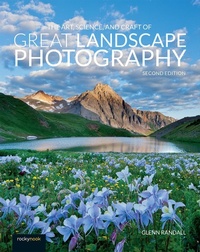
Art, Science, and Craft of Great Landscape Photography
Beschreibung
The Art, Science, and Craft of Great Landscape Photography, 2nd Edition teaches photographers how to convert their visual peak experiences-moments of extraordinary natural beauty that evoke a sense of wonder and awe-into stunning images that elicit the same awestruck emotion in their viewers.
Author Glenn Randall is an experienced wilderness photographer, and whether you want to venture into the mountains for once-in-a-lifetime shots of raw nature, or simply hone your landscape photography skills from the safety of your back deck, Randall explains the art, science and craft behind creating stunning landscape photographs.
This fully updated edition of the best-selling first edition includes nearly all new imagery throughout the book, as well as a new first chapter, "Photographic Essentials," to help beginners to landscape photography get up to speed quickly. Additionally, this second edition takes into account how Randall''s techniques have changed and evolved since the first edition published-from photographic practices to how he uses smart phones and apps as important and powerful tools for landscape photography.
After discussing photographic essentials, Randall focuses on the art of landscape photography. He describes his three-step process for composing a photograph and shows how good composition is an organic process that begins with rules but ultimately transcends them. Randall then explores the science behind successful landscape photographs, which requires understanding key concepts from geography, optics, vision, and psychology. These concepts include:
With some practice and by applying the techniques that Randall teaches you, you will soon be ready to master the finer nuances of creating magnificent landscape photographs.
TABLE OF CONTENTS Introduction Chapter 1: Photographic Essentials Chapter 2: Landscape Photography Looks So Easy Chapter 3: In Search of Extraordinary Landscapes Chapter 4: Visualization Chapter 5: The Art and Science of Light Chapter 6: The Art and Science of Composing Compelling Images Chapter 7: The Perfect Exposure Chapter 8: Digital Capture and Processing of High-Contrast Scenes Chapter 9: Take a Walk on the Wide Side Chapter 10: The Landscape at Night Chapter 11: The Psychology of the Compelling Landscape Index
Weitere Details
Weitere Ausgaben
Inhalt
- Cover
- Table of Contents
- Introduction
- From Peak Experience to Well-Crafted Image
- Chapter 1: Digital Photography Fundamentals
- The Exposure Triangle
- Depth of Field and Hyperfocal Distance
- Exposure Modes
- Auto-focus Modes
- Meter Modes
- RAW Versus JPEG
- White Balance
- Chapter 2: Landscape Photography Looks So Easy
- Depth Perception
- Limited Dynamic Range
- Limited Sensory Input
- Brightness Constancy
- Color Constancy
- Clutter
- Focus
- Chapter 3: In Search of Extraordinary Landscapes
- Have an Image in Mind Before Leaving Home
- Time in an Area Is the Greatest Luxury
- Map and Compass Fundamentals
- Always Carry a Compass and a Smartphone with a Sunrise/Sunset App
- Keep Other Seasons in Mind as You Scout
- Shoot Study Frames and Take Notes So You Can Relocate Favorite Subjects
- The Diligent Local Photographer Should Always Have the Best Photos of Nearby Areas
- Whenever Possible, Scout Sunrises the Day Before
- When Scouting for Flowers, Density Trumps Breadth
- Steep Slopes Are Problematic
- Sometimes the Best Possible Shot Is an ERNI
- Sit Tight, Don't Gun and Run-Usually
- As You're Scouting, Look for Other Possible Vantage Points
- Chapter 4: Visualization
- Using Maps to Help Visualize Photographs
- Searching for the Position of the Sun, Moon, and Galactic Center
- Planning an Image of the Full Moon Over Longs Peak
- Chapter 5: The Art and Science of Light
- Lighting Fundamentals
- Blue Skies and Red Sunsets
- White Clouds and White Haze
- Rainbows
- Calculating Rainbow Positions
- Rainbows and Polarizers
- The Rarest Light of All
- Chapter 6: The Art and Science of Composing Compelling Images
- The Essentials of Graphic Design
- Focus-Stacking
- Balance and Depth
- Color
- Chapter 7: The Perfect Exposure
- How Light Meters Work
- Exposure Danger Zones
- Histograms
- The Four Basic Exposure Strategies
- The PhD Strategy
- The Limiting Factor Exposure Strategy
- The Rembrandt Solution
- Graduated Neutral-Density Filters
- The Digital Version of the Rembrandt Solution
- HDR
- The Universal Exposure Strategy
- Chapter 8: Digital Capture and Processing of High-Contrast Scenes
- Countershading
- How Our Visual System Processes High-Contrast Scenes
- Capturing Rembrandt Solution Images in the Field
- Merging Rembrandt Solution Images in Photoshop
- The Rembrandt Solution Lite
- HDR: A Technique That Has Come of Age
- Setting up an HDR Image
- Tone-Mapping HDR Images in Lightroom
- Keeping It Real with HDR
- Final Thoughts on Realism and HDR
- Chapter 9: Take a Walk on the Wide Side
- Setting up a Single-Row Panorama
- Finding the Nodal Point
- Camera Settings for Single-Row Panoramas
- Stitching Panoramas
- Shooting and Processing High-Contrast Panoramas
- Multi-Row Panoramas
- Chapter 10: The Landscape at Night
- Equipment for Night Photography
- Focusing and Composing at Night
- Exposure at Night
- Maximum Shutter Speed Chart
- Photographing the Milky Way
- Holding Detail in the Land
- Processing Milky Way Images
- The Modified Rembrandt Solution
- Shooting Milky Way Panoramas
- Photographing Star Trails
- Processing Star Trails Images
- Closing the Gaps in Star Trails Images
- Photographing the Aurora
- Photographing Moonlit Landscapes
- Can Night Photographs Be Authentic?
- Chapter 11: The Psychology of the Compelling Landscape
- Landscape Photography and Evolution
- On Culture and Creativity
- Index
- A
- B
- C
- D
- E
- F
- G
- H
- I
- J
- K
- L
- M
- N
- O
- P
- Q
- R
- S
- T
- U
- V
- W
- Y
- Z
