

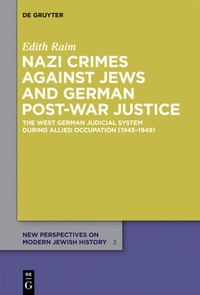
Nazi Crimes against Jews and German Post-War Justice
Beschreibung

Of all victims of Nazi persecution, German Jews had to suffer the Nazi yoke for the longest time. Throughout the Third Reich, they were exposed to anti-Jewish propaganda, discrimination, anti-Semitic laws and increasingly to outrages and offences by non-Jewish Germans. While the International Military Tribunal and the subsequent American Military Tribunals at Nuremberg dealt with a variety of Nazi crimes according to international law, these courts did not consider themselves cognizant in adjudicating wrongdoings against German citizens and those who lost German citizenship based on the so-called "Nuremberg laws," such as Germany's Jews. Until recently, scholarship failed to explore this task of the German judiciary in more detail. Edith Raim fills this gap by showing the extent of the crimes committed against Jews beyond the traditionally known facts and by elucidating how the West German administration of justice was reconstructed under Allied supervision.
Weitere Details
Weitere Ausgaben
Andere Ausgaben
Gesamtwerk / Teilwerk
Person
Inhalt
- Intro
- Foreword
- Table of Contents
- Introduction
- Sources and Method
- Scope and Aim
- A Note on Translations
- Notes on German Sources
- Part I: The Reconstruction of the German Judicial System in the Western Zones
- The American Legal Division
- The British Legal Division
- The French Direction Générale de la Justice
- Western Allied Politics Concerning the German Judicial System
- German Courts Branch, German Courts Inspectorate, Contrôle de la Justice Allemande
- The Re-opening of German Courts and the German Administration of Justice
- Re-opening of Courts in the American Zone of Occupation
- Re-opening of Courts in the British Zone
- Re-opening of Courts in the French Zone
- Re-opening of Courts in Berlin, Bremen, and the Saar
- Re-opening of the Courts of Appeal
- The Supreme Court in the British Zone
- The Renascent Ministries of Justice of the Länder
- The Central Legal Office
- Physical Conditions for the Reconstruction of Courts
- The Search for Alternative Housing
- Attempts at Repair
- Files, Office Supplies, Communication, and Transport
- Excursus: Living Conditions of Members of the Judiciary
- The German Administration of Justice at Work
- The Police Force and the Penal System
- Public Prosecutors and Courts
- Work Load
- Allied Criticism
- Denazification and Personnel Politics
- Personnel Politics in the American Zone
- Denazification of the Judiciary in the American Zone
- Personnel Politics in the British Zone
- Denazification of the Judiciary in the British Zone
- Personnel Politics in the French Zone
- Denazification of the Judiciary in the French Zone
- Criticism of the German Administration of Justice
- Summary
- Part II: Legal Foundations for the Prosecution of Nazi Crimes by the West German Judiciary
- The Western Allies and the Prosecution of Nazi Crimes
- German Demands Concerning the Prosecution of "Crimes Against Germans"
- The Implementation of Control Council Law No. 10 in the British Zone
- The Implementation of Control Council Law No. 10 in the French Zone
- The Discussion Concerning Control Council Law No. 10 in the American Zone
- German Jurists and Law No. 10
- The Phase-out of Allied Trials and Transfer to German Prosecution
- The American Point of View
- The British Stance
- The French Exception
- Allied Interventions in West German Trials
- Summary
- Part III: The Prosecution of Nazi Crimes Against Jews
- The Reconstruction of Nazi Crimes Against Jews
- Early Excesses 1933
- Racial Defilement
- Excesses 1934-1937
- Excesses in 1938, Before November
- "Aryanization"
- Excesses After November 1938
- Violent Acts After the Beginning of the War
- Trapped in the "Judenhaus"
- Denunciations
- Bullying of Jewish Forced Laborers and Actions Against Jews in the Second Half of WW II
- The Fate of Jewish Children in Foster Care
- Desecration of Jewish Cemeteries
- The Prosecution of the Pogrom
- Local Peculiarities of the Pogrom
- Property Offenses
- The Ritual of Public Degradation
- Deportations in the Course of the Pogrom
- Perpetrators
- Investigation of Pogrom Crimes During the Third Reich
- First Post-War Trials
- Problems of Investigation and Legal Problems
- Semantics of Sentences
- Adjudicating the Killings
- Case Study: The Trial Concerning the Killing in Würzburg
- Public Reaction to the Trials
- The Balance and Remarks on the Investigation and Trials
- The Prosecution of the Deportations
- Deportation Trials in the French Zone
- Deportation Trials in the American Zone
- Deportation Trials in the British Zone
- Summary and Outlook
- Conclusion
- Appendix
- List of illustrations
- Abbreviations
- Archives
- Bibliography
- Index of Names
- Index of Places
