

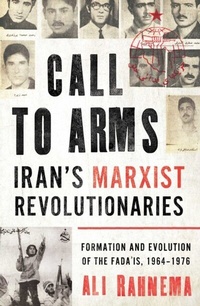
Call to Arms: Iran's Marxist Revolutionaries
Formation and Evolution of the Fada'is, 1964-1976
1. Auflage
Erschienen am 7. Januar 2021
608 Seiten
978-1-78607-986-2 (ISBN)
Beschreibung

On 8 February 1971, Marxist revolutionaries attacked the gendarmerie outpost at the village of Siyahkal in Iran's Gilan province. Barely two months later, the Iranian People's Fada'i Guerrillas officially announced their existence and began a long, drawn-out urban guerrilla war against the Shah's regime.
In Call to Arms, Ali Rahnema provides a comprehensive history of the Fada'is, beginning by asking why so many of Iran's best and brightest chose revolutionary Marxism in the face of absolutist rule. He traces how radicalised university students from different ideological backgrounds morphed into the Marxist Fada'is in 1971, and sheds light on their theory, practice and evolution. While the Fada'is failed to directly bring about the fall of the Shah, Rahnema shows they had a lasting impact on society and they ultimately saw their objective achieved.
In Call to Arms, Ali Rahnema provides a comprehensive history of the Fada'is, beginning by asking why so many of Iran's best and brightest chose revolutionary Marxism in the face of absolutist rule. He traces how radicalised university students from different ideological backgrounds morphed into the Marxist Fada'is in 1971, and sheds light on their theory, practice and evolution. While the Fada'is failed to directly bring about the fall of the Shah, Rahnema shows they had a lasting impact on society and they ultimately saw their objective achieved.
Rezensionen / Stimmen
'A definitive history of the Iranian People's Fada'i Guerrillas. Theoretical frameworks are interwoven with historical narrative, and riveting anecdotes are tempered by conceptual discussions. In one volume, Ali Rahnema has compiled a comprehensive guide to understanding the ideology, activities, and legacy of the Fada'is... He has masterfully told the Fada'is' story, including their writings, their successes, and their failures, leaving readers with the impression of the Fada'is as serious, brave, influential, and ideologically driven patriots.' * Iranian Studies * 'Ali Rahnema has produced the most comprehensive and deeply engaging narrative to date of the revolutionary left in Iran during the 1970s... A masterwork, a must-read!' -- Behrooz Ghamari-Tabrizi, Professor of Near Eastern Studies, Princeton University 'Meticulous and riveting, this book works like a time-tunnel, taking us back to experience "first-hand" the dramatic heroics and painful tragedy of radical political opposition in 1960s-1970s Iran.' * Afshin Matin-Asgari, author of Both Eastern and Western: An Intellectual History of Iranian Modernity * 'Delivers like a ray of hope... This book is an act of redemption, not just of the Iranian Marxist revolutionaries but of the spirit of the age that demanded armed uprising against tyranny.' -- Hamid Dabashi, Hagop Kevorkian Professor of Iranian Studies and Comparative Literature, Columbia University 'Call to Arms is a significant study of Iran's militant left in the 1960s and 1970s. By exploring a broad range of primary and secondary source material it closely examines the formation and operational dynamics of Iran's radical opposition during the Cold War.' -- Ali Gheissari, Professor of History, University of San Diego 'Rahnema has done the staggeringly difficult task of offering us a meticulously researched history of the life and times of the Fada?is in late-Pahlavi Iran.' -- Roham Alvandi, Associate Professor of International History, London School of Economics and Political ScienceWeitere Details
Reihe
Sprache
Englisch
Verlagsort
New York
Großbritannien
Verlagsgruppe
Oneworld Publications
Zielgruppe
Für Beruf und Forschung
Dateigröße
2,75 MB
ISBN-13
978-1-78607-986-2 (9781786079862)
Copyright in bibliographic data and cover images is held by Nielsen Book Services Limited or by the publishers or by their respective licensors: all rights reserved.
Schweitzer Klassifikation
Weitere Ausgaben
Andere Ausgaben
Ali Rahnema
Call to Arms: Iran's Marxist Revolutionaries
Formation and Evolution of the Fada'is, 1964-1976
Buch
01/2021
Oneworld Academic
44,00 €
Versand in 3-4 Wochen
Person
Ali Rahnema is Professor of Economics at the American University of Paris. He is the author of An Islamic Utopian: A Political Biography of Ali Shari'ati, Behind the 1953 Coup in Iran and Superstition as Ideology in Iranian Politics.
Inhalt
Preface and Acknowledgements
Introduction
1 Violence as a political option?
Demonizing the armed opposition
Why resort to political violence?
The four Iranian Marxist theoreticians of armed struggle
2 Hasan Zia-Zarifi's account of why armed struggle
The culprit: Absolutist despotic monarchism
Reflections from prison
3 Amir-Parviz Pouyan's account of why armed struggle
Literature in the service of politics
Armed struggle: Rational or irrational? A necessary theoretical digression
Pouyan on the necessity of armed struggle as a rational choice
Refutation of the theory of survival
Pouyan's incisive impact
4 Mas?oud Ahmadzadeh's accounts of why armed struggle
Demystifying classical notions of how and when to take up arms
The fruitful retreat
The Debray factor: From Havana to Tehran via Mashhad
Learning from the past
Breaking with the old sacred cows
Armed struggle by the revolutionary vanguard
5 Bijan Jazani's accounts of why armed struggle
Mysteries around What a Revolutionary Should Know
To confront a monarchical military dictatorship
Revolutionary intellectuals: The dynamite of the revolutionary movement
Jazani's paradoxical hints
Revolutionary agents and the question of leadership in a despotic or democratic Iran
6 The Tudeh Party's awkward tango with armed struggle
Ideological rift over revolution-making
Iranian students take sides
The Tudeh Party's reluctant approval of armed struggle
The Tudeh Party pushes back against armed struggle
Revolution means employing peaceful methods of struggle
The Tudeh Party denounces armed struggle
What did the revolutionary Marxists think of the Tudeh Party?
7 Monarchists, Maoists, and the Tudeh Party in unison: armed struggle is counterrevolutionary adventurism
For Nikkhah the red revolution turned white
Kourosh Lasha?i's rejection of romanticism and embrace of realism
The Tudeh Party: We told you so
8 Armed struggle and Marxist canonists
Historical determinism or revolutionary voluntarism?
Marx and Engels: Wavering over the role of violence?
Lenin on violence, unequivocal?
Trotsky: Dissonance between intellectual revolutionary consciousness and backward economic conditions invites violence
9 Armed struggle and Marxist revolutionaries
Mao Tse-tung's revolutionary authority
Che Guevara's revolution-making to overthrow dictators
Carlos Marighella: Unleashing violence to end dictatorial violence
Marighella in Iran via Baghdad
10 Formative years of the Jazani group
Jazani the entrepreneur
Whence it came
Student political activities
First phase of the Jazani Group
Jazani and The Message of University Students
Second phase of the Jazani Group
The political and propaganda branch
The operational and military branch
The military operation that should have happened but did not
Ghafour Hasanpour's networks: Recruiting behind the scenes
11 Jazani Group compromised
First raids
The remnants of the Jazani Group under siege
Bank robberies
The decision to leave the country
The final nabs
12 The new Hasanpour, Ashraf, and Safa?i-Farahani Group: Preparations and operations
Picking up the broken pieces
Organizing armed struggle: Three teams
The first urban operations of the H-A-S Group
13 The Pouyan, Ahmadzadeh, and Meftahi Group
The dissimilar but inseparable Pouyan and Ahmadzadeh
Enter ?Abbas Meftahi
Pouyan's circles at Mashhad and Tabriz
Ahmadzadeh's membership in Hirmanpour's circle
Meftahi's Sari and Tehran circles
The P-A-M Group's military operations before Siyahkal
An ethical digression: To press or not to press the trigger
14 Armed struggle in Iran: Rural or urban
Theoretical positioning
Ahmadzadeh gently parts with the Cuban model
Jazani: Rural Iran not the ideal revolutionary base
Jazani's change of heart: Emphasis on rural/mountainous warfare
15 Merger discussions for "Iran's revolutionary armed movement"
The painful and slow process of negotiation
Last hurdle: Convincing the P-A-M rank and file
The mountain group's five-month reconnaissance mission
Postponements
16 The H-A-S Group hounded
The beans are spilled
The arrests begin
The mountain team compromised
17 The Siyahkal operation
Assault on the Siyahkal Gendarmerie Station on 19 Bahman
The aftermath of the assault
The nineteen-day odyssey of the retreating guerrillas
18 Assessing the Siyahkal strike
Objectives of the Siyahkal strike: Ahmadzadeh, Ashraf, Safa?i-Farahani
Siyahkal as a military operation: Fumbles and blunders
The regime's first public response to the Siyahkal strike
The Ranking Security Official's spectacle
19 The Hamid Ashraf factor
Schooling
Ashraf in the eyes of fellow combatants
Three years of guerrilla struggle in perspective
Ashraf violent and authoritarian?
20 Hemming the guerrillas or cultivating a guerrilla culture?
The Shah declares the end of terrorist activities in Iran
The Golesorkhi affair
Revolutionaries of the Film School of the Iranian National Television
Slaying heroes: Fuel on fire
21 Jazani's questioning of armed struggle
Challenging the theory and practice of the Fada?is
Looking for new forms of struggle
Underlining the role of legal methods of struggle
A matter of trade-off
22 Softly disarming armed struggle to regain the trust of the masses
Step one: The correct stage in the movement
Step two: Walking on two legs
Step three: Iran's paradoxical political condition, democratic and despotic
Step four: The guerrillas' conflicting remits, or unity of opposites
Step five: Armed propaganda and the combined method of struggle
Two interpretations of armed struggle
The issue of objective conditions of revolution
How long would it take the masses to join the movement?
Saving the armed movement from the unhealthy leftist tendency
23 Jazani's ideological offensive in prison
Spreading the good word
Open schism in prison
Where did the original members of the Jazani Group stand?
The secretive delinking of armed struggle from the movement
The misunderstood or conflicted theoretician
24 The Fada?i interface, inside, outside prison
Indirect interactions between Ashraf and Jazani in 1973
On the correct method of struggle: The Fada?is and the Star Group
Summer 1974: Armed struggle as strategy and tactic has the upper hand
Reading about the correct method of struggle in People's Combat
Familiarity with and reaction to Jazani's works outside prisons
25 Fada?i leadership debating correct methods of struggle
A discreet Jazani special issue of People's Combat
Growing a second leg?
Political activities in 1976 discussions with the Marxist Mojahedin
Does Ashraf take sides in May/June 1976?
26 Bird's-eye view of armed struggle (1971-1976)
The guerrillas' persistent presence
Guerrillas highlighted: Partial transparency
The news blackout and the Fada?is' rising success
Changing tides: Expansion, exposure, and beleaguered
The Fada?is' relations with Libya, Palestinian groups, and the Soviet Union
The shock of state terrorism
Fada?is under attack
The Fada?is without Ashraf
27 Guerrillas conducting the regime's requiem
Students at home beat on the drums of war
University turmoil and campus guards
Policy of zero tolerance
The student backlash to the Golesorkhi affair
Winds of change
28 The regime's requiem: The players abroad
Iranian students abroad rallying against the regime
Iranian students abroad take their cue from the guerrillas
Radical methods to put the Shah's regime on the spot
29 Prelude to the Shah's free fall
The Western press reveals secrets
Disdain for torture
The grand anti-Shah conspiracy
A last-ditch effort against the guerrilla-CISNU coalition
Beating a fatal retreat
Conclusion
Chronology
Bibliography
Index
Introduction
1 Violence as a political option?
Demonizing the armed opposition
Why resort to political violence?
The four Iranian Marxist theoreticians of armed struggle
2 Hasan Zia-Zarifi's account of why armed struggle
The culprit: Absolutist despotic monarchism
Reflections from prison
3 Amir-Parviz Pouyan's account of why armed struggle
Literature in the service of politics
Armed struggle: Rational or irrational? A necessary theoretical digression
Pouyan on the necessity of armed struggle as a rational choice
Refutation of the theory of survival
Pouyan's incisive impact
4 Mas?oud Ahmadzadeh's accounts of why armed struggle
Demystifying classical notions of how and when to take up arms
The fruitful retreat
The Debray factor: From Havana to Tehran via Mashhad
Learning from the past
Breaking with the old sacred cows
Armed struggle by the revolutionary vanguard
5 Bijan Jazani's accounts of why armed struggle
Mysteries around What a Revolutionary Should Know
To confront a monarchical military dictatorship
Revolutionary intellectuals: The dynamite of the revolutionary movement
Jazani's paradoxical hints
Revolutionary agents and the question of leadership in a despotic or democratic Iran
6 The Tudeh Party's awkward tango with armed struggle
Ideological rift over revolution-making
Iranian students take sides
The Tudeh Party's reluctant approval of armed struggle
The Tudeh Party pushes back against armed struggle
Revolution means employing peaceful methods of struggle
The Tudeh Party denounces armed struggle
What did the revolutionary Marxists think of the Tudeh Party?
7 Monarchists, Maoists, and the Tudeh Party in unison: armed struggle is counterrevolutionary adventurism
For Nikkhah the red revolution turned white
Kourosh Lasha?i's rejection of romanticism and embrace of realism
The Tudeh Party: We told you so
8 Armed struggle and Marxist canonists
Historical determinism or revolutionary voluntarism?
Marx and Engels: Wavering over the role of violence?
Lenin on violence, unequivocal?
Trotsky: Dissonance between intellectual revolutionary consciousness and backward economic conditions invites violence
9 Armed struggle and Marxist revolutionaries
Mao Tse-tung's revolutionary authority
Che Guevara's revolution-making to overthrow dictators
Carlos Marighella: Unleashing violence to end dictatorial violence
Marighella in Iran via Baghdad
10 Formative years of the Jazani group
Jazani the entrepreneur
Whence it came
Student political activities
First phase of the Jazani Group
Jazani and The Message of University Students
Second phase of the Jazani Group
The political and propaganda branch
The operational and military branch
The military operation that should have happened but did not
Ghafour Hasanpour's networks: Recruiting behind the scenes
11 Jazani Group compromised
First raids
The remnants of the Jazani Group under siege
Bank robberies
The decision to leave the country
The final nabs
12 The new Hasanpour, Ashraf, and Safa?i-Farahani Group: Preparations and operations
Picking up the broken pieces
Organizing armed struggle: Three teams
The first urban operations of the H-A-S Group
13 The Pouyan, Ahmadzadeh, and Meftahi Group
The dissimilar but inseparable Pouyan and Ahmadzadeh
Enter ?Abbas Meftahi
Pouyan's circles at Mashhad and Tabriz
Ahmadzadeh's membership in Hirmanpour's circle
Meftahi's Sari and Tehran circles
The P-A-M Group's military operations before Siyahkal
An ethical digression: To press or not to press the trigger
14 Armed struggle in Iran: Rural or urban
Theoretical positioning
Ahmadzadeh gently parts with the Cuban model
Jazani: Rural Iran not the ideal revolutionary base
Jazani's change of heart: Emphasis on rural/mountainous warfare
15 Merger discussions for "Iran's revolutionary armed movement"
The painful and slow process of negotiation
Last hurdle: Convincing the P-A-M rank and file
The mountain group's five-month reconnaissance mission
Postponements
16 The H-A-S Group hounded
The beans are spilled
The arrests begin
The mountain team compromised
17 The Siyahkal operation
Assault on the Siyahkal Gendarmerie Station on 19 Bahman
The aftermath of the assault
The nineteen-day odyssey of the retreating guerrillas
18 Assessing the Siyahkal strike
Objectives of the Siyahkal strike: Ahmadzadeh, Ashraf, Safa?i-Farahani
Siyahkal as a military operation: Fumbles and blunders
The regime's first public response to the Siyahkal strike
The Ranking Security Official's spectacle
19 The Hamid Ashraf factor
Schooling
Ashraf in the eyes of fellow combatants
Three years of guerrilla struggle in perspective
Ashraf violent and authoritarian?
20 Hemming the guerrillas or cultivating a guerrilla culture?
The Shah declares the end of terrorist activities in Iran
The Golesorkhi affair
Revolutionaries of the Film School of the Iranian National Television
Slaying heroes: Fuel on fire
21 Jazani's questioning of armed struggle
Challenging the theory and practice of the Fada?is
Looking for new forms of struggle
Underlining the role of legal methods of struggle
A matter of trade-off
22 Softly disarming armed struggle to regain the trust of the masses
Step one: The correct stage in the movement
Step two: Walking on two legs
Step three: Iran's paradoxical political condition, democratic and despotic
Step four: The guerrillas' conflicting remits, or unity of opposites
Step five: Armed propaganda and the combined method of struggle
Two interpretations of armed struggle
The issue of objective conditions of revolution
How long would it take the masses to join the movement?
Saving the armed movement from the unhealthy leftist tendency
23 Jazani's ideological offensive in prison
Spreading the good word
Open schism in prison
Where did the original members of the Jazani Group stand?
The secretive delinking of armed struggle from the movement
The misunderstood or conflicted theoretician
24 The Fada?i interface, inside, outside prison
Indirect interactions between Ashraf and Jazani in 1973
On the correct method of struggle: The Fada?is and the Star Group
Summer 1974: Armed struggle as strategy and tactic has the upper hand
Reading about the correct method of struggle in People's Combat
Familiarity with and reaction to Jazani's works outside prisons
25 Fada?i leadership debating correct methods of struggle
A discreet Jazani special issue of People's Combat
Growing a second leg?
Political activities in 1976 discussions with the Marxist Mojahedin
Does Ashraf take sides in May/June 1976?
26 Bird's-eye view of armed struggle (1971-1976)
The guerrillas' persistent presence
Guerrillas highlighted: Partial transparency
The news blackout and the Fada?is' rising success
Changing tides: Expansion, exposure, and beleaguered
The Fada?is' relations with Libya, Palestinian groups, and the Soviet Union
The shock of state terrorism
Fada?is under attack
The Fada?is without Ashraf
27 Guerrillas conducting the regime's requiem
Students at home beat on the drums of war
University turmoil and campus guards
Policy of zero tolerance
The student backlash to the Golesorkhi affair
Winds of change
28 The regime's requiem: The players abroad
Iranian students abroad rallying against the regime
Iranian students abroad take their cue from the guerrillas
Radical methods to put the Shah's regime on the spot
29 Prelude to the Shah's free fall
The Western press reveals secrets
Disdain for torture
The grand anti-Shah conspiracy
A last-ditch effort against the guerrilla-CISNU coalition
Beating a fatal retreat
Conclusion
Chronology
Bibliography
Index
