

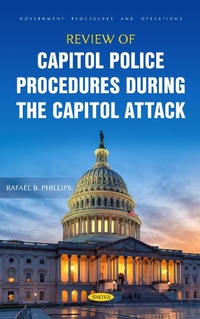
Review of Capitol Police Procedures During the Capitol Attack
Erschienen am 14. September 2022
204 Seiten
979-8-88697-280-1 (ISBN)
Beschreibung
The Capitol Police is responsible for protecting the Congress, its members, staff, visitors, and facilities. The U.S. Capitol Police's (Capitol Police) planning for January 6, 2021, did not reflect the potential for extreme violence aimed at the Capitol and did not include contingencies for support from other agencies. For example, although the Capitol Police had information protesters could be armed and were planning to target Congress, the Capitol Police's plans focused on a manageable, largely nonviolent protest at the Capitol.
Weitere Details
Weitere Ausgaben
Inhalt
- Intro
- Contents
- Preface
- Chapter 1
- Capitol Attack: Additional Actions Needed to Better Prepare Capitol Police Officers for Violent Demonstrations0F(
- Purpose of This Study
- Findings
- Recommendations
- Abbreviations
- Letter to Congressional Requesters, March 7, 2022
- Background
- Capitol Police Organization
- CDU
- CERT
- Capitol Police Board
- January 6 Attack
- The Capitol Police Had Policies and Training for Use of Force and Crowd Control
- The Capitol Police Established Use of Force and Crowd Control Policies before the January 6 Attack
- Use of Force Policy
- Less-Lethal Force
- Lethal Force
- Crowd Control Policies
- Approved and Nonapproved Demonstrations
- Incident Command System
- Active Threats
- The Capitol Police Trains All Officers on Use of Force and Crowd Control
- FLETC
- Capitol Police-Provided Training for All Officers
- Capitol Police Academy
- On-the-Job Training
- Requalification Requirements
- Crowd Control Training
- Other Mandatory Training
- The Department Provides Certain Units Specialized Training on Less-Lethal Devices and Crowd Control Tactics
- CDU
- CERT
- Officers Reported Using Various Types of Force during the January 6 Attack
- Multiple Use of Force Techniques
- Empty Hand Control Techniques
- Batons
- Chemical Spray
- Less-Lethal Munitions
- Withdrew Firearm
- Firing of Firearm
- Capitol Police Officers Responding to Our Survey Had Varying Perspectives and Suggestions for Improvement on Preparedness
- Some Officers Reported Having Little Prior Experience with Crowd Control and Others Reported They Were Assaulted during the January 6 Attack
- Years of Experience
- Prior Crowd Control Experience
- Use of Force Experience
- Interaction with Demonstrators
- Assaults on Officers
- Views Were Mixed on Whether Respondents Felt Prepared to Apply Force and Crowd Control Tactics
- Perspectives on Preparedness to Use Force
- Perspectives on Preparedness to Apply Crowd Control Tactics
- Most Respondents Were Dissatisfied with Crowd Control Guidance for January 6 Events
- Officers Responding to the Survey Expressed Other Concerns Related to Events on January 6 and Suggested Ways to Improve Preparedness
- Suggestions Related to Use of Force
- Perceived Discouragement from Using Force
- Need to Clarify Use of Force Policy
- Role of Optics and Limited Autonomy
- Differing Perspectives on Whether Additional Force Should Have Been Used
- Suggestions Related to Training
- Need for More Training
- Need for Large and Violent Crowd Control Training
- Need for More Realistic Training
- Other Improvements for Training
- Suggestions Related to Equipment
- Need for More Protective Equipment and Easier Access to Equipment
- Need for More Less-Lethal Force Equipment
- Concerns with the Department
- Suggestions Related to Information- and Intelligence-Sharing
- Suggestions Related to Physical Security
- Suggestions Related to Planning
- Suggestions Related to Officer Workforce
- Other Comments
- Difficult Situation
- Praise for the Actions of Fellow Officers
- The Capitol Police Are Taking Some Steps to Better Prepare Officers, but Additional Opportunities Exist to Further Enhance Preparedness
- Use of Force
- Equipment and Training
- Equipment
- Less-Lethal Force Training
- Crowd Control Training and CDU
- Increasing Frequency of In-Person Training
- Concerns with the Department and Morale
- Actions to Address Recommendations from Capitol Police Employees and the Office of Inspector General
- Conclusion
- Recommendations for Executive Action
- Appendix I: Objectives, Scope, and Methodology
- Objective 1
- Objective 2
- Objective 3
- Objective 4
- Appendix II: Copy of the GAO Survey of U.S. Capitol Police Officers
- Survey Introduction
- Respondent Characteristics
- Experiences on January 6, 2021
- Experiences Prior to January 6, 2021
- Training and Preparation
- "Day of" Guidance on January 6, 2021
- Reflections on January 6, 2021
- Appendix III: Survey Results
- Appendix IV: Comments from the United States Capitol Police
- Chapter 2
- Capitol Attack: The Capitol Police Need Clearer Emergency Procedures and a Comprehensive Security Risk Assessment Process89F(
- Purpose of This Study
- Recommendations
- Findings
- Abbreviations
- Letter to Congressional Requesters, February 17, 2022
- Background
- The Capitol Police's Planning for January 6 Did Not Reflect the Potential for Extreme Violence Aimed at the Capitol and Did Not Include Contingencies for Support from Other Agencies
- The Capitol Police's Planning for January 6 Was Similar to Its Planning for Demonstrations Held in 2020
- Special Event Assessment
- Operational Plans
- Capitol Police Coordination with Other Agencies Primarily Focused on the Inauguration, and Plans for January 6 Did Not Include Contingencies for Support from Other Agencies
- The Capitol Police Reacted to Evolving Events on January 6, and It and the Capitol Police Board Faced Challenges in Obtaining Outside Assistance
- The Capitol Police Took a Variety of Actions to Respond to the Events as They Occurred on January 6
- The Capitol Police and the Capitol Police Board Faced Challenges in Quickly and Effectively Using Their Authorities to Obtain Outside Assistance
- Shared Jurisdiction
- Mutual Aid Agreement
- Section 1970
- Section 1974
- The Capitol Police and the Capitol Police Board Lacked Clear Procedures for Obtaining Outside Assistance
- The Capitol Police's Process for Assessing and Mitigating Physical Security Risk Is Not Comprehensive or Documented, and Decisions about Security Recommendations Are Unclear
- The Capitol Police's Approach to Assessing Risks and Identifying Countermeasures to Mitigate Risks Is Not Comprehensive or Documented
- Identification and Assessment of Physical Security Risks Is Not Comprehensive or Documented
- Identification of Relevant Countermeasures to Mitigate Risks Is Not Comprehensive or Documented
- The Decision-Making Process for Implementing Recommended Security Countermeasures Is Unclear
- Conclusion
- Recommendations for Executive Action
- Appendix I: List of Federal, State, and Local Agencies Interviewed by GAO
- Appendix II: Key Actions and Decisions Made by the U.S. Capitol Police
- Appendix III: Comments from the Capitol Police Board
- Appendix IV: Comments from the U.S. Capitol Police
- Chapter 3
- Oversight of the United States Capitol Police Following the January 6th Attack on the Capitol, Part II145F(
- Opening Statement of Honorable Amy Klobuchar, Chairwoman, United States Senator from the State of Minnesota
- Opening Statement of Honorable Roy Blunt, United States Senator from the State of Missouri
- Opening Statement of Michael A. Bolton, Inspector General, United States Capitol Police, Washington, DC
- Statement of Michael A. Bolton, Inspector General, United States Capitol Police, Washington, DC
- Index
- Blank Page
- Blank Page
