

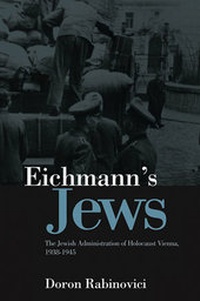
Eichmann's Jews
Beschreibung

This book is a major new study of the role of the Jews, and morespecifically the 'Judenrat' or Jewish Council, in Holocaust Vienna.It was in Vienna that Eichmann developed and tested his model for aNazi Jewish policy from 1938 onwards, and the leaders of theViennese Jewish community were the prototypes for all subsequentJewish councils. By studying the situation in Vienna, it ispossible to gain a unique insight into the way that the Nazi regimeincorporated the Jewish community into its machinery ofdestruction.
Drawing on recently discovered archives and extensiveinterviews, Doron Rabinovici explores in detail the actions ofindividual Jews and Jewish organizations and shows how all of theirstrategies to protect themselves and others were ultimately doomedto failure. His rich and insightful account enables us tounderstand in a new way the terrible reality of the victims'plight: faced with the stark choice of death or cooperation, manychose to cooperate with the authorities in the hope that theiractions might turn out to be the lesser evil.
Weitere Details
Weitere Ausgaben
Andere Ausgaben
Personen
Inhalt
1 Prologue.
Survivor guilt.
Breaching taboos.
No mass murder without victims.
2 The Vienna Kultusgemeinde before 1938.
Securing evidence - at the scene of the crime.
Jewish strategies to counter anti-Semitism.
The corporate state - in the shadow of the Third Reich.
3 Persecution.
The German invasion and the Austrian response.
Expropriation through the deprivation of rights.
The hunt for booty.
4 Struggle for survival and escape.
The decapitation of the Jewish Community.
The attempt to escape or 'Get rid of the Yids and keep theirmoney here.'
5 The Vienna Jewish community under Nazi control.
The reorganization of the Kultusgemeinde.
Jewish self-help and welfare.
'Emigration' - mass expulsion.
Illegal escape.
6 November pogrom - overture to murder.
7 The Jewish community after the pogrom.
Escape as a last resort.
Functionaries: victims and messengers of terror.
Administration during the terror.
Benjamin Murmelstein.
The employees in the system.
Lateral entrants.
8 Beginning of the end.
Nisko or the dress rehearsal for deportation.
Segregation, concentration and theft.
9 Deportation and extermination.
10 The administration of extermination.
Segregation and identification or a Jewish star for 10pfennigs.
Liquidation - expropriation to the last.
Designation and handing over of victims.
Welfare and burial service - administration in the shadow ofdestruction.
11 Die Kultusgemeinde - authorities without power.
Individual stories.
The victims' perspective.
The administration and its employees.
The conditioning of leading functionaries.
Questions of character - individual Jewish functionaries beforeand after 1945.
12 Discussion of the Jewish councils and the situation inVienna.
List of abbreviations.
Notes.
Index of persons.
2
THE VIENNA KULTUSGEMEINDE BEFORE 1938
Securing evidence - at the scene of the crime
In the late nineteenth century, anti-Semitism in Vienna assumed a political dimension and for the first time elections were won on an anti-Semitic political platform. During the Monarchy and the First Republic, anti-Semitism was not just a tacitly agreed general mood but the overt credo of the bourgeois parties. The Christian Socialist and German National parties vied with each other in their anti-Semitism, and even the Social Democrats used anti-Jewish caricatures in their propaganda.1
Karl Lueger, who was mayor of Vienna from 1897 to 1910, ignited the first mass anti-Semitic movement in the capital. He used anti-Semitism systematically to attract support. His successful concept became a model for Hitler's populism. It was here in Austria that Hitler developed his view of the world. He admired the racist German nationalism of Georg Ritter von Schönerer's pan-German movement and venerated Karl Lueger's charisma as an anti-Semitic populist and leader of the masses.
Vienna had the largest Jewish population of any city in the German-speaking world. In the bureaucratic and dynastic centre of the Catholic Habsburg monarchy, 'the Jew' was usually a negative symbol of modernism and social change. By anti-Semites, Jews were seen as profiteers of emancipation, protected by the court. In Vienna, the capital of the multiethnic state, the Jews lived at the hub of nationalist movements and calls for assimilation. They became the target of all regressive sentiments.
Vienna at the beginning of the twentieth century was a city of ideological contradictions. It was the administrative centre of the Monarchy, where Catholic taboos, social snobbery and anti-Semitic traditions were opposed by artistic and scientific innovators. Many of the Jewish personalities of the time, who were to become famous throughout the world, were for a long time repudiated by the Viennese.
A large section of the Jewish population came from the eastern parts of the Monarchy. Of the 175,000 Jews living in Vienna in 1910, only one fifth had been born there.2 The 1934 census counted 191,481 Austrian Jews, 2.8 per cent of the population. On 11 March 1938, there were only 185,028, in spite of the stream of refugees from the German Reich. The Jewish community of Vienna in 1934 had 176,034 members, 9.4 per cent of the population; in March the figure had shrunk to 169,978. Some of the Jewish population had left Austria; others had moved to the provinces.3
There were thirty-four Jewish communities in various towns and cities in Austria before 1938. In Vienna, apart from the Vienna Israelite Community (IKG), there was also a partially autonomous Turkish Sephardic community. It had been incorporated in the IKG in 1909 as the Turkish Israelite Community. The IKG was the only unified community in the large cities of Europe. It is no coincidence that it called itself 'Israelite' rather than 'Jewish', and even today people talk of the 'Mosaic faith' and the 'Israelite community'. The Vienna IKG statutes of 1890 stated that every 'Israelite' living in Vienna was required irrespective of nationality to be a member of the community. In this way the various classes and groups were united within the IKG.
The Vienna Jewish community before 1938 had around 440 associations. Of these, seventy-nine were prayer house or temple associations. This figure does not include prayer rooms that were not registered with the community. The Jewish administration was responsible for 23 synagogues. Eight associations alone belonged to the orthodox Agudath Israel. The community also had two schools, a secondary school, a trade school for girls, a library, five kindergartens, four orphanages, two girls' homes, one student residence and one day care centre. There were 24 Jewish school associations to deal with questions of education and training. Health care was provided by a hospital, a paediatric clinic, an institute for the blind and an old people's home. There was also a hospice and children's holiday home owned by the community outside Vienna.4
Apart from many volunteers, the Kultusgemeinde had over 600 salaried staff. They worked in various departments responsible for religious affairs, cemeteries, hospital care, old age care, finance, technical issues, statistics and taxes. Over 60,000 people were registered as receiving welfare support.5 There were 119 welfare associations looking after poor and needy Jews.6
The Kultusgemeinde also had a Historical Commission, which published a series on the history of the Jews in Vienna and Austria. The Jewish students had 22 fraternities, including duelling fraternities. One of these organizations called itself the Association of Palestinian Students.
The Zionist Association for Austria had 18 sections. The Zionist associations had 12,000 members and there were 82 separate Zionist groups. All questions regarding Aliyah or immigration to Palestine were dealt with by the Palestine Office, which was in contact with the Jewish Agency, the body that represented Jewish interests during the British Mandate.
The liberal Union of Austrian Jews had some 3,000 members, and the many clubs - ranging from scientific and cultural associations and sports clubs to the Association of Jewish Animal Lovers and the Austrian Association of Israelite Butchers and Meat Traders - bear witness to the diversity of Jewish life in Vienna.7
Jewish strategies to counter anti-Semitism
For decades, the Union of Austrian Jews was the most powerful faction in the Viennese Kultusgemeinde and was able to maintain its supremacy until 1932. In the first post-war elections in 1920, it obtained twenty of the thirty-six seats. The balance soon shifted, however, forcing the various parties into changing coalitions. In 1924, the Union combined with the bourgeois General Zionists and the orthodox Adath Israel to form a voting block without the newly founded Social Democrat party, the religious socialist Zionists of the Misrachi and the orthodox Beth El. In 1928, the coalition changed again. The Union and Adath Israel, the political representatives of the anti-Zionist orthodoxy within the Jewish community, amassed eighteen of the thirty-six seats.8 Both of these Jewish factions distanced themselves from any Zionist or Jewish national identity.
The Union described itself as a 'non-Jewish national party' and proudly claimed to represent 'not Austrian Jews but Jewish Austrians'.9 It was not that it did not espouse Jewish positions, nor was it a supporter of assimilation, but it believed in the Austrian state and strove for constitutional equality and emancipation within society. It sought to counter anti-Semitism by legal means or through interventions and complaints to politicians. In other words, it relied on the state institutions to deal with discrimination and resentment. It also sought affiliation outside the community with other liberal forces in the fight against anti-Semitism. It called on its clientele to vote for liberal parties in the national elections. Its confidence in Austrian liberalism proved to be misplaced.
At the national level, many Jews gradually began to support the Social Democrats while turning to the Zionist movements within the community. Following the failure of its emancipatory utopia in an anti-Semitic society, the fortunes of the Union went into decline and in 1932 it lost its supremacy in the Jewish community.
The issues had changed. While the Union and Adath Israel had formed a bourgeois patriotic Austrian voting bloc in 1928, four years later these two parties were joined by the non-Zionist Social Democrats in a non-Jewish national alliance. This shows how nationalism was becoming increasingly important at the expense of social issues. In 1928, the Social Democrats had had both Zionist and non-Zionist members. In 1929, these two factions parted company.
The Zionist Socialists managed in 1932 to win almost as many votes as the Social Democrat list, consisting of Zionists and non-Zionists, had achieved together in 1928. The vast majority of Socialist Jews within the Jewish community voted Zionist. All of the Zionist parties gained seats to take control of the Kultusgemeinde.
The Union's members came in part from established Viennese families, mostly from the 'west', i.e., Austria, Hungary or Czechoslovakia, whereas many of the Zionists were 'Ostjuden' from Galicia and other places. In fact, many years earlier the Zionists had already established their predominance among the Jews arriving in Vienna from eastern Europe. The Union also increasingly lost the support of orthodox Jews.
The Zionists proposed a completely different way of dealing with anti-Semitism and discrimination. In 1920, Robert Stricker, a Zionist member of parliament and one of the movement's leading personalities, had submitted a motion for recognition of Jewish nationality. Although his proposal still allowed Jews to choose between German or Jewish nationality, it caused a storm of protest among the Unionists, who feared that it would be seen as a form of separatism and could reinforce anti-Semitism. Indeed, independently of the Zionist motion, the anti-Semitic politician Leopold Kunschak called for a law discriminating against Jews as an alien minority.10 There was no need for Zionist demands to fuel the anti-Semitic imagination. On the contrary, the Zionist movement reacted to the anti-Semitic reality in...
