

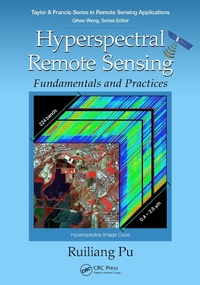
Hyperspectral Remote Sensing
Fundamentals and Practices
Erschienen am 16. August 2017
490 Seiten
978-1-351-64693-2 (ISBN)
Beschreibung

Advanced imaging spectral technology and hyperspectral analysis techniques for multiple applications are the key features of the book. This book will present in one volume complete solutions from concepts, fundamentals, and methods of acquisition of hyperspectral data to analyses and applications of the data in a very coherent manner. It will help readers to fully understand basic theories of HRS, how to utilize various field spectrometers and bioinstruments, the importance of radiometric correction and atmospheric correction, the use of analysis, tools and software, and determine what to do with HRS technology and data.
Rezensionen / Stimmen
"Hyperspectral Remote Sensing: Fundamentals and Practices is an excellent resource for both research and classroom needs. Concepts and applications are presented clearly and in a user-friendly fashion. The book is an innovative tool for environmental science practitioners interested in getting up-to-date on remote sensing techniques. The hyperspectral sections, especially, provide excellent content both in theory and applications. This is and will be a wonderful resource for the current generation of remote sensing scientists and students."- Arturo Sanchez-Azofeifa, University of Alberta, Canada
"This masterful book provides a comprehensive and much-needed overview of hyperspectral remote sensing and imaging spectroscopy. Covering all aspects of the field, including characteristics of field, aerial and satellite borne sensors, the pre-processing and analysis of hyperspectral data, available software packages, and a wide array of applications, this book will be the key reference for students and those working in the field. The engaging style, detailed theoretical background, and numerous practical insights offer an unparalleled treatment of the subject."
- Timothy Warner, West Virginia University, USA
"The quantitative retrieval of biophysical properties of the earth's surface from remote sensing has become a reality over the past twenty years, largely because of the synergistic development of hyperspectral sensors and detailed physical models of the interaction of electromagnetic radiation for a range of earth surface classes. Implicit in these successes is an in-depth understanding of the corrections to be applied to the sensor data and the specific analysis approaches for each surface type, suited to the available spectral detail. Ruiliang Pu's comprehensive and timely book reflects the author's intimate experience with all aspects of hyperspectral remote sensing, including applications --- an invaluable work for students and professionals alike!"
-John R. Miller, York University, Toronto, Ontario, Canada
"This book provides a comprehensive and timely overview on all aspects of hyperspectral remote sensing combined with various applications. As such, it is an excellent book of reference for both students and professionals active in the field of optical remote sensing. It deals with all aspects of retrieving quantitative information on biophysical properties of the Earth's surface, the data corrections needed and the range of analysis approaches available."
-International Journal of Applied Earth Observation and Geoinformation, January 2018
"Hyperspectral Remote Sensing: Fundamentals and Practices book is likely to prove valuable to upperclassmen, graduate students, and practitioners. It covers the field in depth and draws heavily on extensive literature."
-Photogrammetric Engineering & Remote Sensing, September 2018 "Hyperspectral Remote Sensing: Fundamentals and Practices is an excellent resource for both research and classroom needs. Concepts and applications are presented clearly and in a user-friendly fashion. The book is an innovative tool for environmental science practitioners interested in getting up-to-date on remote sensing techniques. The hyperspectral sections, especially, provide excellent content both in theory and applications. This is and will be a wonderful resource for the current generation of remote sensing scientists and students."
- Arturo Sanchez-Azofeifa, University of Alberta, Canada
"This masterful book provides a comprehensive and much-needed overview of hyperspectral remote sensing and imaging spectroscopy. Covering all aspects of the field, including characteristics of field, aerial and satellite borne sensors, the pre-processing and analysis of hyperspectral data, available software packages, and a wide array of applications, this book will be the key reference for students and those working in the field. The engaging style, detailed theoretical background, and numerous practical insights offer an unparalleled treatment of the subject."
- Timothy Warner, West Virginia University, USA
"The quantitative retrieval of biophysical properties of the earth's surface from remote sensing has become a reality over the past twenty years, largely because of the synergistic development of hyperspectral sensors and detailed physical models of the interaction of electromagnetic radiation for a range of earth surface classes. Implicit in these successes is an in-depth understanding of the corrections to be applied to the sensor data and the specific analysis approaches for each surface type, suited to the available spectral detail. Ruiliang Pu's comprehensive and timely book reflects the author's intimate experience with all aspects of hyperspectral remote sensing, including applications --- an invaluable work for students and professionals alike!"
-John R. Miller, York University, Toronto, Ontario, Canada
"This book provides a comprehensive and timely overview on all aspects of hyperspectral remote sensing combined with various applications. As such, it is an excellent book of reference for both students and professionals active in the field of optical remote sensing. It deals with all aspects of retrieving quantitative information on biophysical properties of the Earth's surface, the data corrections needed and the range of analysis approaches available."
-International Journal of Applied Earth Observation and Geoinformation, January 2018
"Hyperspectral Remote Sensing: Fundamentals and Practices book is likely to prove valuable to upperclassmen, graduate students, and practitioners. It covers the field in depth and draws heavily on extensive literature."
-Photogrammetric Engineering & Remote Sensing, September 2018
Weitere Details
Reihe
Sprache
Englisch
Verlagsort
London
Großbritannien
Verlagsgruppe
Taylor & Francis Ltd
Zielgruppe
Für Beruf und Forschung
Produkt-Hinweis
Reflowable
Illustrationen
scatter color:
Dateigröße
10,28 MB
ISBN-13
978-1-351-64693-2 (9781351646932)
Copyright in bibliographic data and cover images is held by Nielsen Book Services Limited or by the publishers or by their respective licensors: all rights reserved.
Schweitzer Klassifikation
Weitere Ausgaben
Andere Ausgaben
Buch
08/2017
1. Auflage
CRC Press
155,56 €
Versand in 10-20 Tagen
Buch
08/2017
1. Auflage
CRC Press
288,89 €
Versand in 15-20 Tagen
Person
Dr. Ruiliang Pu is currently an Associate Professor with the School of Geosciences, University of South Florida (USF). He earned a Ph.D. (Cartography & Geographic Information System) in 2000, conducted at University of California at Berkeley, from Chinese Academy of Sciences. He was a visiting scholar in Institute for Space and Terrestrial Sciences, Ontario, Canada and a visiting scholar at The University of Calgary.He was an Assistant Researcher at UC Berkeley, and a Visiting Research Scientist with Earth System Science Interdisciplinary Center, University of Maryland at College Park before moving to University of South Florida (USF) in 2006. His research experience and interests are in remote sensing, GIS and spatial statistics with direct applications to natural hazard monitoring, land use/cover change detection, biophysical and biochemical parameters extraction, and coastal and terrestrial ecosystems modeling. He has published more than 82 (41 related to hyperspectral remote sensing application studies on vegetation/plants
Inhalt
Overview of Hyperspectral Remote Sensing. Field Spectrometers and Plant Biology Instruments for HRS. Imaging Spectrometers, Sensors, Systems, and Missions. Hyperspectral Image Radiometric Correction. Hyperspectral Data Analysis Techniques. Hyperspectral Data Processing Software. Hyperspectral Applications in Geology and Soil Sciences. Hyperspectral Applications to Vegetation. Hyperspectral Applications to Environments.
