

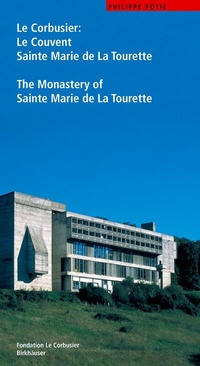
Le Corbusier. Le Couvent Sainte Marie de La Tourette / The Monastery of Sainte Marie de La Tourette
Corbusier. Le Couvent Sainte Marie de La Tourette / The Monastery of Sainte Marie de La Tourette
1. Auflage
Erschienen am 24. April 2015
136 Seiten
978-3-0356-0314-9 (ISBN)
Beschreibung
Ein informativer und handlicher Le Corbusier-Führer: die Klosteranlage Sainte Marie de La Tourette bei Lyon (1953-1960), ein Meisterwerk der modernen Sakralarchitektur.
Weitere Details
Sprache
Englisch
Französisch
Verlagsort
Basel/Berlin/Boston
Schweiz
Verlagsgruppe
Birkhäuser Verlag GmbH
Zielgruppe
Für Beruf und Forschung
US School Grade: College Graduate Student
Illustrationen
20 farbige Abbildungen, 72 s/w Abbildungen
72 b/w and 20 col. ill.
Dateigröße
6,81 MB
ISBN-13
978-3-0356-0314-9 (9783035603149)
Schweitzer Klassifikation
Weitere Ausgaben
Person
Inhalt
- Intro
- Contents / Sommaire
- Introduction Introduction
- Orientation Guide Parcours de visite
- Promenade architecturale/Promenade architecturale
- The Site/Situation
- The Living Quarters:/Habiter:
- Entrance L'entrée
- Roof Terrace Le toit terrasse
- Monastic Cells Les cellules
- Communal Living Space Les espaces communautaires
- Circulation Zones Les circulations
- The Pilotis Les pilotis
- Prayer Quarters:/Prier:
- The Oratory, Sacristy, Church, and Side Chapel/L'oratoire, la sacristie les cryptes, l'église
- Tour of the Grounds/Parcours extérieur
- Tour of the Interior/Parcours intérieur
- History of the Project/Histoire du projet
- The Client: Father Marie-Alain Couturier / Le commanditaire:le Père Marie-Alain Couturier
- Co-ordinating Architects: Iannis Xenakis and André Wogenscky/Les collaborateurs: Iannis Xenakis et André Wogenscky
- The Design Phase (1953-1956)/Histoire du projet: 1953-1956
- History of the Construction Process/ Histoire du chantier
- The Contracting Firm/Les entrepreneurs
- The Structural Frame/La structure
- The Three Wings/Les trois ailes
- The Construction Phase (1956-1960)/Le chantier: 1956-1960
- The Lesson of the Monastery / Les leçons du couvent
- Points of Reference/Les références:
- From the Charterhouse of Ema to the Unités d'Habitation/ De la Chartreuse d'Ema aux Unités d'Habitation
- Thoronet Abbey and the Monastery of Mt. Athos/ De l'abbaye du Thoronet au monastère du mont Athos
- Pilotis, Roof Terrace and Ramp / Pilotis, toit terasse, rampe
- Pilotis: le jardin ouvert / Pilotis: le jardin ouvert
- The Roof Terrace: A Garden of Meditation / Le toit terrasse:jardin de méditation
- The Ramp / La rampe
- Materials and Their Application / Matière et mise en oeuvre
- Concrete / Matière: le béton Au-delà du rationalisme
- «Hiératisme»/«Hiératisme»
- Marks, Motifs and Imprints / Trace, motif, empreinte
- The Machine and Rationality:The Engineer/Machine et rationalité: l'ingénieur
- Arbitrary Forms: The Architect/Arbitraire: l'architecte
- Profiling/Modénature
- Sketching the Outline/Le dessin: tracer
- Measurements and Proportions/Le nombre: mesurer
- The Music of Numbers/La musique des nombres
- The Sculptor/Le plasticien
- Notes Notes
- Bibliography Bibliographie
