

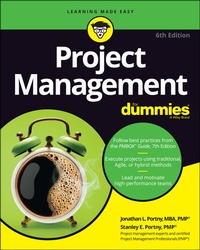
Project Management For Dummies
Beschreibung

In these days when projects seem to be bigger and more challenging than ever before, you need to make sure tasks stay on track, meet the budget, and keep everyone in the loop. Enter Project Management For Dummies. This friendly guide starts with the basics of project management and walks you through the different aspects of leading a project to a successful finish. After you've navigated your way through a couple of projects, you'll have the confidence to tackle even bigger (and more important) projects!
In addition to explaining how to manage projects in a remote work environment, the book offers advice on identifying the right delivery approach, using social media in project management, and deploying agile project management. You'll also discover:
* What's new in project management tools and platforms so you can choose the best application for your team
* How to perfect your project management business document with an emphasis on strategy and business knowledge
* Details on the shift from process-based approaches to more holistic, principle-based strategies focused on project outcomes
* Examples of how to turn the strategies into smooth-flowing processes
* Best practices and suggestions for dealing with difficult or unexpected situations
If you're planning to enroll in a project management course or take the Project Management Professionals Certification exam, Project Management For Dummies is the go-to resource to help you prepare. And if you simply want to improve your outcomes, this handy reference will have you and your team completing project goals like ninjas!
Weitere Details
Weitere Ausgaben
Andere Ausgaben
Personen
Inhalt
PART 1: GETTING STARTED WITH PROJECT MANAGEMENT 7
CHAPTER 1: Project Management: The Key to Achieving Results 9
CHAPTER 3: Beginning the Journey: The Genesis of a Project 41
CHAPTER 4: Knowing Your Project's Stakeholders: Involving the Right People 63
CHAPTER 5: Clarifying What You're Trying to Accomplish -- And Why 85
CHAPTER 6: Developing Your Game Plan: Getting from Here to There 113
PART 2: PLANNING TIME: DETERMINING WHEN AND HOW MUCH 143
CHAPTER 7: You Want This Project Done When? 145
CHAPTER 8: Establishing Whom You Need, How Much of Their Time, and When 181
CHAPTER 9: Planning for Other Resources and Developing the Budget 207
CHAPTER 10: Venturing into the Unknown: Dealing with Risk 221
PART 3: GROUP WORK: PUTTING YOUR TEAM TOGETHER 243
CHAPTER 11: Aligning the Key Players for Your Project 245
CHAPTER 12: Defining Team Members' Roles and Responsibilities 263
CHAPTER 13: Starting Your Project Team Off on the Right Foot 287
PART 4: STEERING THE SHIP: MANAGING YOUR PROJECT TO SUCCESS 309
CHAPTER 14: Tracking Progress and Maintaining Control 311
CHAPTER 15: Keeping Everyone Informed 339
CHAPTER 16: Encouraging Peak Performance by Providing Effective Leadership 361
CHAPTER 17: Bringing Your Project to Closure 377
PART 5: TAKING YOUR PROJECT MANAGEMENT TO THE NEXT LEVEL 391
CHAPTER 18: Using Newer Methods and Resources to Enhance Your Project Management 393
CHAPTER 19: Monitoring Project Performance with Earned Value Management 413
PART 6: THE PART OF TENS 431
CHAPTER 20: Ten Questions to Ask Yourself as You Plan Your Project 433
CHAPTER 21: Ten Tips for Being a Better Project Manager 439
APPENDIX: COMBINING THE TECHNIQUES INTO SMOOTH-FLOWING PROCESSES 443
INDEX 449
Introduction
Projects have been around since ancient times. Noah building the ark, Leonardo da Vinci painting the Mona Lisa, J.R.R. Tolkien writing The Hobbit, Moderna and Pfizer developing their COVID-19 vaccines - all projects. And as you know, these were all masterful successes. Well, the products were a spectacular success, even if schedules and resource budgets were drastically overrun!
Why, then, is the topic of project management of such great interest today? The answer is simple: The audience has changed and the stakes are higher.
Historically, projects were large, complex undertakings. The first project to use modern project management techniques - the Polaris weapons system in the early 1950s - was a technical and administrative nightmare. Teams of specialists planned and tracked the myriad of research, development, and production activities. They produced mountains of paper to document the intricate work. As a result, people started to view project management as a highly technical discipline with confusing charts and graphs; they saw it as inordinately specialist-driven and definitely off-limits for the common person!
Because of the growing array of huge, complex, and technically challenging projects in today's world, people who want to devote their careers to planning and managing those projects are vital to their successes. Over the past 30 to 35 years, the number of projects in the regular workplace has skyrocketed. Projects of all types and sizes are now the way that organizations accomplish their work.
At the same time, a new breed of project manager has emerged. This new breed may not have set career goals to become project managers - many among them don't even consider themselves to be project managers, at least not as their primary role. But they do know they must successfully manage projects to move ahead in their careers. Clearly, project management has become a critical skill, not a career choice.
Even though these people realize they need special tools, techniques, and knowledge to handle their new types of assignments, they may not be able to devote large amounts of time to acquiring them without adversely impacting other responsibilities, which is where this book comes into play. This book is devoted to this silent majority of project managers.
About This Book
This book helps you recognize that the basic tenets of successful project management are simple. The most complex analytical technique takes less than ten minutes to master! In this book, we discuss information that's necessary to plan and manage projects and provide important guidelines for developing and using this information. Here, you discover that the real challenge to a successful project is dealing with the multitude of people whom the project may affect or need for support. There are plenty of tips, hints, and guidelines for identifying key players and then involving them.
But knowledge alone won't make you a successful project manager - you need to apply it. This book's theme is that project management skills and techniques aren't burdensome tasks you perform because some process requires it. Rather, they're a way of thinking, communicating, and behaving. They're an integral part of how we approach all aspects of our work every day.
So this book is intended to be direct and (relatively) easy to understand. But don't be misled - the simple text still navigates all the critical tools and techniques you'll need to support your project planning, scheduling, budgeting, organizing, and controlling. So buckle up!
This information is presented in a logical and modular progression. Examples and illustrations are plentiful - so are the tips and hints. And we (attempt to) inject humor from time to time to keep it all in perspective. The goal is that you finish reading this book feeling that good project management is a necessity and that you're determined to practice it!
Of course, we want you to read every single word in this book, but we understand your life is busy and you may have time to read only what's immediately relevant to you. In that case, feel free to skip the sidebars. Although the sidebars offer interesting, real-life stories of our own experiences, they're not vital to grasping the concepts.
Foolish Assumptions
When writing this book, we assumed that a widely diverse group of people would read it, including the following:
- Senior managers and junior-level staff (who'll become tomorrow's senior managers)
- Experienced project managers and people who've never been on a project team
- People who've had significant project management training and people who've had none whatsoever
- People who've had years of real-world business and government experience and people who've only recently entered the workforce
After reading this book, we hope you wonder (and rightfully so) why all projects aren't well-managed - because you'll think these techniques are so logical, straightforward, and easy to use. But we also assume you recognize there's a big difference between knowing what to do and doing it. We assume you realize you'll have to work hard to overcome the forces that conspire to prevent you from using these tools and techniques.
Finally, we assume you'll realize that you can read this book repeatedly and learn something new and different each time. Think of this book as a comfortable resource that has more to share as you experience new situations.
Icons Used in This Book
We include small icons in the left margins of the book to alert you to special information in the text. Here's what they mean:
We use this icon to point out important information you should keep in mind as you apply the techniques and approaches.
This icon highlights techniques or approaches you can use to improve your project management practices.
This icon highlights potential pitfalls and danger spots that you should attempt to avoid or be prepared to address if they come to fruition.
Beyond the Book
In addition to the material in the print or e-book you're reading right now, you can access free companion materials online. Simply navigate to www.dummies.com and search for "Project Management For Dummies Cheat Sheet." From there you'll be able to read or print several useful articles about confirming your project's justification, developing meaningful project objectives, developing achievable project schedules, eliciting and sustaining commitment for projects, holding people accountable, and avoiding common project pitfalls.
Where to Go from Here
You can read this book in many ways, depending on your own project management knowledge and experience and your current needs. However, we suggest you first take a minute to scan the table of contents and thumb through the parts of the book to get a feeling for the topics we cover.
If you're new to project management and are just beginning to form a plan for a project, first read Parts 1 and 2, which explain how to plan outcomes, activities, schedules, and resources. If you want to find out how to identify and organize your project's team and other key people, start with Part 3. If you're ready to begin work or you're already in the midst of your project, you may want to start with Part 4. Or feel free to jump back and forth, hitting the chapters with topics that interest you the most.
The most widely recognized reference of project management best practices is A Guide to the Project Management Body of Knowledge (PMBOK), published by the Project Management Institute (PMI). The seventh and most recent edition of PMBOK (PMBOK 7) was published in 2021. The Project Management Professional (PMP) certification - the most recognized project management credential throughout the world - includes an examination (administered by PMI) with questions based on PMBOK 7.
Because we base this book on best practices for project management activities, the tools and techniques we cover are in accordance with PMBOK 7. However, if you're preparing to take the PMP examination, use this book as a companion to PMBOK 7, not as a substitute for it.
As you read this book, keep the following points in mind:
- PMBOK 7 identifies what best practices are but doesn't address in detail how to perform them or deal with difficulties you may encounter as you try to perform them. In contrast, this book focuses heavily on how to perform these project management techniques and processes.
- We've revised and updated the book so that all the tools and techniques discussed and all the terminology used to describe those tools and techniques are in agreement with those used in PMBOK 7 and, when possible, prior PMBOK editions.
- Where appropriate, we include a section at the end of each chapter that specifies where the topics in the chapter are addressed in PMBOK 7.
- PMBOK 7 often contains highly technical language and detailed processes, which people mistakenly dismiss as being relevant only for larger projects. This book, however, deliberately frames terms and discussions to be user-friendly. As a...
