

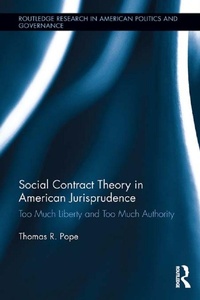
Social Contract Theory in American Jurisprudence
Too Much Liberty and Too Much Authority
Erschienen am 7. Juni 2013
134 Seiten
978-1-135-93525-2 (ISBN)
Beschreibung

Despite decades of attempts and the best intentions of its members, the United States Supreme Court has failed to develop a coherent jurisprudence regarding the state's proper relationship to the individual. Without some objective standard upon which to ground jurisprudence, decisions have moved along a spectrum between freedom and authority and back again, affecting issues as diverse as individual contractual liberties and the right to privacy.
Social Contract Theory in American Jurisprudence seeks to reintroduce the lessons of modern political philosophy to offer a solution for this variable application of legal principle and to lay the groundwork for a jurisprudence consistent in both theory and practice. Thomas R. Pope's argument examines two exemplary court cases, Lochner v. New York and West Coast Hotel v. Parrish, and demonstrates how the results of these cases failed to achieve the necessary balance of liberty and the public good because they considered the matter in terms of a dichotomy. Pope explores our constitution's roots in social contract theory, looking particularly to the ideas of Thomas Hobbes for a jurisprudence that is consistent with the language and tradition of the Constitution, and that is also more effectually viable than existing alternatives. Pope concludes with an examination of recent cases before the Court, grounding his observations firmly within the developments of ongoing negotiation of jurisprudence.
Addressing the current debate between individual liberty and government responsibility within the context of contemporary jurisprudence, Pope considers the implications of a Hobbesian founding for modern policy. This book will be particularly relevant to scholars of Constitutional Law, the American Founding, and Modern Political Theory.
Social Contract Theory in American Jurisprudence seeks to reintroduce the lessons of modern political philosophy to offer a solution for this variable application of legal principle and to lay the groundwork for a jurisprudence consistent in both theory and practice. Thomas R. Pope's argument examines two exemplary court cases, Lochner v. New York and West Coast Hotel v. Parrish, and demonstrates how the results of these cases failed to achieve the necessary balance of liberty and the public good because they considered the matter in terms of a dichotomy. Pope explores our constitution's roots in social contract theory, looking particularly to the ideas of Thomas Hobbes for a jurisprudence that is consistent with the language and tradition of the Constitution, and that is also more effectually viable than existing alternatives. Pope concludes with an examination of recent cases before the Court, grounding his observations firmly within the developments of ongoing negotiation of jurisprudence.
Addressing the current debate between individual liberty and government responsibility within the context of contemporary jurisprudence, Pope considers the implications of a Hobbesian founding for modern policy. This book will be particularly relevant to scholars of Constitutional Law, the American Founding, and Modern Political Theory.
Rezensionen / Stimmen
"Pope breathes new life into the old debate in constitutional law between defenders of liberty and defenders of the interest of the community. He shows the futility of the unqualified acceptance of either alternative as a consistent guide to constitutional adjudication, and returns to the roots of modernity to explain how Thomas Hobbes brought these two principles together to provide a solid foundation for modern liberal politics. Both political theorists and constitutional scholars have much to learn from this subtle and thoughtful analysis."-David K. Nichols, Baylor University
"A fascinating rumination on the relationship between individual liberty and the government's 'police power' to serve the common good that will challenge readers of all political persuasions to reconsider cherished nostrums."
-David E. Bernstein, George Mason University School of Law
Weitere Details
Reihe
Sprache
Englisch
Verlagsort
London
Großbritannien
Verlagsgruppe
Taylor & Francis Ltd
Zielgruppe
Für höhere Schule und Studium
Illustrationen
2 b/w images, 2 tables and 2 line drawings
Dateigröße
1,60 MB
ISBN-13
978-1-135-93525-2 (9781135935252)
Copyright in bibliographic data and cover images is held by Nielsen Book Services Limited or by the publishers or by their respective licensors: all rights reserved.
Schweitzer Klassifikation
Weitere Ausgaben
Andere Ausgaben
Thomas R. Pope
Social Contract Theory in American Jurisprudence
Too Much Liberty and Too Much Authority
Buch
07/2015
1. Auflage
Routledge
62,30 €
Versand in 10-20 Tagen
Thomas R. Pope
Social Contract Theory in American Jurisprudence
Too Much Liberty and Too Much Authority
Buch
05/2013
1. Auflage
Routledge
231,00 €
Versand in 15-20 Tagen
Person
Thomas R. Pope is Assistant Professor and Discipline Coordinator in the Department of Political Science at Lee University.
Inhalt
1. An Introduction 2. Learning from Lochner 3. Why Hobbes? 4. Hobbes on Contract 5. Hobbes on Police Power 6. Applying Hobbesian Lessons
