

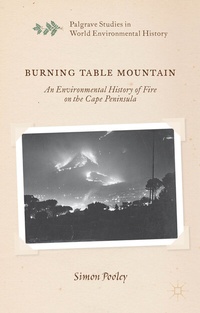
Burning Table Mountain
Beschreibung

Rezensionen / Stimmen
"A fascinating study of fire on the Cape Peninsula of South Africa . will appeal to audiences with interests in history of science, fire history and policy, South African history, as well as global environmental history. It would also be a fine addition to a graduate seminar. . Pooley's book demonstrates the distinctive insights of that an environmental history perspective can offer to wildfire management . which attests to the book's relevance to an urgent global environmental issue." (Michelle M. Steen-Adams, Environmental History, Vol. 21 (4), October, 2016)
"Burning Table Mountain is a work of history, and, as such, Simon Pooley tells the story based on painstakingly detailed evidence from state archives, historical newspapers, and the like, but he also relies on interviews with fire researchers and environmental managers. ... The book covers a lot of useful ground, and will certainly interest students of environmental history, fire management, and South Africa." (Christian A. Kull, Journal of Historical Geography, Vol. 51 (1), January, 2016)
"Australia, Canada, Russia, and the United States constitute the world's primary ecological firepowers. Save for Isle of Fire, Christian Kull's study of Madagascar, scholarly history has not inquired much beyond them. That makes Burning Table Mountain a welcome addition to a limited genre that deserves wider appreciation. At least next time Table Mountain erupts in a daisy-chain of flames, followed by a riot of flowering geophytes, we'll have a reference to why the fire was inevitable and why humanity, nominally the keeper of the planetary flame, seems so impotent before its best friend and worst enemy." (Steve Pyne, Journal of Southern African Studies, August 26, 2015)
"Written in a highly readable style ... will be particularly useful for professionals in the fynbos field academics, managers, policy-makers, for example. But it is also well worth reading by all of us 'amateurs' who love this flat-topped mountain and the unique fynbos vegetation that clothes it." (John Yeld, Veld & Flora, Vol.101 (1), March, 2015)
"Simon Pooley has produced an excellent review of this issue, using the Cape Peninsula as a case study. ... this is an excellent and well-written book that has been thoroughly researched. Unlike scientific accounts, which rely heavily on the peerreviewed literature, this account uses a myriad of additional sources, including newspaper articles, minutes of meetings, annual reports and interviews to produce an account of fire that reflects the evolving opinions and actions of scientists, policymakers, managers and the public at large. It is the first serious treatment of the interrelated development of fire science and fire policy in South Africa, and it takes the reader into the topsy-turvy world of divided opinion and competing institutions that ultimately have more influence on responses to environmental issues than does science. As such, it should be regarded as compulsory reading for students and practitioners of fynbos management." (Brian W. van Wilgen, South African Journal of Science, Vol. 111 (1-2), January-February, 2015)
Weitere Details
Weitere Ausgaben
Andere Ausgaben
Person
Simon Pooley is Lambert Lecturer in Environment, Department of Geography, Birkbeck University of London, UK. He has a D.Phil in Environmental History (University of Oxford) and has published on wildfire, biological invasions, crocodilian conservation, human-wildlife conflicts and doing interdisciplinary research, in several books and the major environmental history and conservation science journals.
