

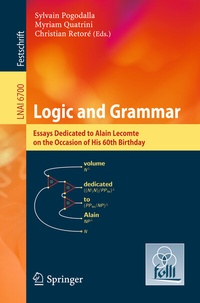
Logic and Grammar
Essays Dedicated to Alain Lecomte on the Occasion of His 60th Birthday
Erschienen am 14. Juni 2011
XV, 159 Seiten
978-3-642-21490-5 (ISBN)
Beschreibung

This book contains selected papers from the Colloquium in Honor of Alain Lecomte, held in Pauillac, France, in November 2007. The event was part of the ANR project "Prélude" (Towards Theoretical Pragmatics Based on Ludics and Continuation Theory), the proceedings of which were published in another FoLLI-LNAI volume (LNAI 6505) edited by Alain Lecomte and Samuel Tronçon. The selected papers of this Festschrift volume focus on the scientific areas in which Alain Lecomte has worked and to which he has contributed: formal linguistics, computational linguistics, logic, and cognition.
Weitere Details
Weitere Ausgaben
Andere Ausgaben
Sylvain Pogodalla | Myriam Quatrini | Christian Retoré
Logic and Grammar
Essays Dedicated to Alain Lecomte on the Occasion of His 60th Birthday
Buch
06/2011
1. Auflage
Springer
53,49 €
Versand in 7-9 Tagen
Inhalt
- Title
- Preface
- Organization
- Table of Contents
- Logic and Grammar
- Bare Nouns in Predicate Position in French
- Introduction
- Contrasts between Bare Nouns and Indefinite Nouns in Copular Sentences
- Two Types of Judgments: Predication vs. Equation
- Alternation between il and ce in French Copular Sentences
- Modified Bare Nouns in Predicate Positions
- Conclusion
- References
- Covert Movement in Logical Grammar
- Introduction
- Toward a New, Nontransformational Synthesis
- Syntax, Semantics, and Their Interface
- Semantics
- Syntax
- The CVG Syntax-Semantics Interface
- Analysis of Quantifier Raising in English
- Background for the Analysis of Wh-in-Situ
- Chinese Interrogatives
- Conclusion
- References
- Categorial Grammars and Minimalist Grammars
- Introduction
- Merge and AB Grammars
- AB Grammars
- Trees and Substitution
- Merge
- Move and Extensions of Lambek Grammars
- The Non-associative Lambek Calculus
- Extensions of NL
- Move
- Different Categorial Perspectives on Move
- Extracting Grammars from Corpora
- The Spoken Dutch Corpus
- Grammar Extraction
- Conclusion
- References
- Minimalist Grammars and Minimalist Categorial Grammars: Toward Inclusion of Generated Languages
- Minimalist Grammars
- Minimalist Tree Structures
- Linguistic Structures in Trees
- Minimalist Grammars
- Features
- MG Rules
- Minimalist Categorial Grammars (MCG)
- Mixed Calculus
- Minimalist Categorial Grammars
- Derivations
- Conclusion
- References
- Minimalist Grammars in the Light of Logic
- Preliminaries
- Linear $\lambda$-Calculus
- Minimalist Grammars
- Minimalist Grammars and MELL
- Emptiness of k-VATAs Reduced to Emptiness of MGs
- Representing MG Derivations as Proofs in MELL
- Interpreting Minimalist Derivations
- The Shortest Move Constraint
- Saving Computation
- The Point of View of Monadic Second Order Logic
- Conclusion
- References
- Good Types Are Useful for Learning
- Introduction
- Preliminaries
- Categorial Grammars
- Semantic Types
- Grammar Systems and Learnability Theory
- Learning Lambek Grammars from Typed Examples
- Learnability Theorems
- Learning Strategy
- Properties of the Algorithm
- Implementation
- Extensions
- Conclusion
- References
- Dialogues in Ludics
- Preliminary Remarks
- Action Dynamics
- Exploration Dynamics
- Inside Dynamics
- Ludics in a Nutshell
- The Objects of Ludics
- The Interaction
- Dialogues in Ludics
- Elementary Decomposition
- Refined Approach
- Towards More Complex Dialogues
- Conclusion
- References
- Author Index
