

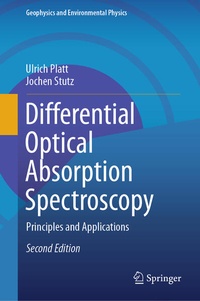
Differential Optical Absorption Spectroscopy
Beschreibung

This second edition of Differential Optical Absorption Spectroscopy (DOAS) has been meticulously updated to enhance its clarity and relevance. Responding to the growing popularity of DOAS techniques, this edition expands the sections on atmospheric radiative transfer, covering new and crucial topics such as the ring effect and profile inversion techniques. Additionally, the book presents a comprehensive array of DOAS applications and techniques, ranging from research applications using imaging and satellite DOAS to emission monitoring from volcanoes and industrial facilities by LED long-path DOAS, as well as mobile MAX-DOAS and Cavity-Enhanced DOAS. The discussion of DOAS retrieval algorithms has significantly broadened to incorporate the latest developments, particularly pertinent to the satellite community.
The first part of the book provides a thorough review of atmospheric chemistry, radiation transport, and optical spectroscopy fundamentals, serving as a crucial foundation for a detailed exploration of the principles underpinning DOAS. The subsequent part delves into the design, application, and assessment of DOAS instruments, accompanied by a comprehensive guide to result interpretation. The book also embraces the application of DOAS in imaging trace gas distributions through ground, aircraft, and satellite-based instruments.
Structured with the needs of graduate students and researchers with a foundational background in environmental physics in mind, this book serves as an invaluable resource. It particularly caters to researchers engaged in atmospheric chemistry, pollution monitoring, and volcanology.
Weitere Details
Weitere Ausgaben
Andere Ausgaben
Vorauflage
Personen
Ulrich Platt is former Director of the Institute of Environmental Physics and Professor emeritus at the Ruprecht-Karls-Universität Heidelberg, Germany. He is External Scientific Member of the Max-Planck Society. Together with Dieter Perner, he introduced the idea of Differential Optical Absorption Spectroscopy (DOAS) for which he won the Robert-Wichard-Pohl-Preis 2010 of the Deutsche Physikalische Gesellschaft (German Physics Society, DPG). He published more than 200 peer-reviewed publications and wrote and edited a number of books.
Jochen Stutz
is Professor in the Department of Atmospheric and Oceanic Sciences at the University of California Los Angeles. His group works on the development of spectroscopic remote sensing instruments to measure atmospheric trace gases and its application to study atmospheric chemistry. He has published over 130 peer-reviewed publications. In recent years, his group has worked on improving long-path DOAS instruments for the measurement of BTEX compounds with the goal of further establishing this method as an accurate monitoring tool for refineries and air quality regulators.
