

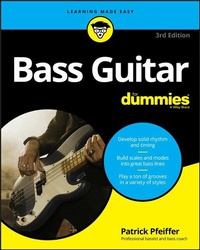
Bass Guitar For Dummies
Beschreibung
Whatever you're playing--funk, soul, rock, blues, country--the bass is the heart of the band. Bassists provide a crucial part of driving force and funky framework that other members of any and work off. From John Paul Jones of Led Zeppelin, to "The Pixies'' Kim Deal, to James Brown's favored bassist, Jimmy Nolan, bass players have made big names for themselves and commanded respect throughout music history.
In Bass Guitar For Dummies, Patrick Pfeiffer--who coached U2's Adam Clayton, among others--is your friendly guide to laying down the low end. Starting from the beginning with what bass and accessories to buy, the book shows you everything from how to hold and position your instrument to how to read music and understand chords. You'll develop your skills step-by-step until you're confident playing your own solos and fills.
* Sharpen skills with instructional audio and video
* Discipline your play with exercises
* Understand chords, scales, and octaves
* Care for your instrument
Whether you're new to the bass or already well into the groove, Bass Guitar For Dummies gives you the thorough balance of theory and practice that distinguishes the titanic Hall of Famer from the just so-so.
P.S. If you think this book seems familiar, you're probably right. The Dummies team updated the cover and design to give the book a fresh feel, but the content is the same as the previous release of Bass Guitar For Dummies (9781118748800). The book you see here shouldn't be considered a new or updated product. But if you're in the mood to learn something new, check out some of our other books. We're always writing about new topics!
Weitere Details
Weitere Ausgaben
Person
Inhalt
Introduction
Shake the earth with deep, sonorous vibrations. Let your melodies swoop and soar like swallows over a meadow. Be the force that relentlessly drives the music with percussive, percolating emanations from your speaker. Rumble like the ominous thunder of an approaching storm. Whisper, growl, roar your grooves into the universe. For you, it's not enough just to be heard; you will be felt. You are . the bass player.
Imagine your favorite music without bass. It doesn't work, does it? The bass is the heartbeat of the music, the foundation for the groove, and the glue that holds together all the different instruments. You can hear the music sing as it's carried along by the bass groove. You can sense the music come to life. You can feel the vibrations of those low notes - sometimes subtle and caressing, sometimes literally earthshaking - as they propel the song. The bass is the heart of it all.
Leave center stage to the other musicians - you have more important work to do. The limelight may be cool, but bassists rule!
About This Book
You can find everything you need to master the bass in Bass Guitar For Dummies, 3rd Edition - from the correct way to strike a note to the way to play a funk groove in the style of Jaco Pastorius. It's all here.
Each chapter is independent of the others. You can skip the stuff you already know and go straight to the parts that interest you without feeling lost. To find the subject you're looking for, just check out the table of contents. You also can look up specific topics in the index at the back of the book. Or you can read from front to back and build up your bass-playing skills step by step. Whatever you choose, just remember to enjoy the journey.
I structure this book so you can decide for yourself how far you want to take your skills on the instrument. As I was writing, I checked out the entrance requirements for music schools and conservatories, and I included the information that fulfills those requirements (without getting too theoretical - after all, you don't want to spend all your time theorizing . you want to play). In fact, this book goes well beyond the minimum requirements and shows you how to actually apply all this information to real-life bass playing. I show you how to play in different styles and how to create your own grooves and solos so you don't have to copy someone else's bass line note-for-note.
No bass guitar? No problem. This book doesn't assume you have your own bass. If you don't, just head over to Part 5 to find out how to choose the right bass and accessories to get started. If you already have a bass, you can start with the maintenance section in Chapter 18 and find out how to set up your instrument so it's easiest to play.
You don't need to read music to figure out how to play the bass guitar. (You can unknit your eyebrows now . it's true.) So how can you get the information you need from this book? Here's how:
- Look at the grids. The grids are pictures of the notes you play on the fingerboard of the bass guitar. The grids show you where the notes are in relation to each other and which fingers you use to play them. They also provide you with an additional advantage: If you use the grid to finger a certain pattern of notes, you can then transfer the same pattern (fingering and all) onto any other section of the fingerboard to play the note pattern in a different key. That's why reading music isn't necessary. The notes on a page of regular music notation look completely different for each new key, but if you use the grid, you'll find that, as far as note patterns go, one size fits all.
- Read the tablature. Tablature is a shorthand notational technique that shows you which string to strike and where to hold the string down to sound a note. The short name for tablature is tab (just in case anyone asks).
-
Listen to the audio tracks. You can hear all the exercises and grooves that are shown in the figures by simply going online to
www.dummies.com/go/bassguitarand listening to audio tracks for each one. You can listen to the sound of a groove, take a look at the grid and the tab, put your hand in the proper position on the fingerboard, and then reproduce the sound. While you're there, you may as well check out the video clips that show you the details for playing certain figures.After you master a groove, you can pan to one side to remove the sound of the bass. Then you can play the groove in the example with just the drums and the guitar (in other words, with real musicians). Or you can create your own groove in the feel and style of the example.
- As you improve, try reading the music notation. As you get better, you can look at the notation and begin to learn to read music. After you figure out how to play a few phrases, you quickly discover that reading music notation isn't as difficult as it's made out to be. In fact, you'll realize that it makes your musical life easier.
I use the following conventions in Bass Guitar For Dummies, 3rd Edition, to help keep the text consistent and make it easy to follow:
- Right hand and left hand: Instead of saying striking hand and fretting hand, I say right hand for the hand that strikes the string and left hand for the hand that frets the note. My apologies to left-handed players. If you're left-handed, please read right hand to mean left hand and vice versa.
- Up and down, higher and lower: Moving your left hand up the neck of the bass means moving it up in pitch (moving your hand toward the body of the bass). Moving your left hand down the neck means moving it down in pitch (moving your hand away from the body). I use the same principle for the right hand. Going to the next higher string means playing the string that has a higher sound (the string closer to the floor). The next lower string is the string that has a lower sound (the string closer to the ceiling). Just think of whether the sound is higher or lower and you'll be fine.
- Triple music notation: In the figures, the music for the grooves and the exercises is printed with the standard music notation on top, the tablature below, and the grid next to them. You don't have to read all of them at the same time (good heavens - that would be worse than reading piano music). Simply pick the one you feel most comfortable with, and then use the others to double-check that you're playing the groove or exercise correctly. Of course, you also can listen to the audio tracks to hear what the music is supposed to sound like.
- The numbers: In the text, the numbers between 1 and 8 (1, 2, 3, 4, 5, 6, 7, and 8) represent notes in a chord or scale (for example, the number 3 represents the third note in a given scale). The designation 7th, on the other hand, refers to a particular chord, such as a major 7th chord. Finally, the distance between two notes (the interval) is called a 2nd, 3rd, 4th, and so on.
Foolish Assumptions
As I wrote this book, I made one assumption about you, the reader: I assume that you want to play the bass guitar. But that's it. I don't assume anything else. No matter what style you're interested in, this book covers them all. It doesn't even matter whether you want to play a four-, five-, or six-string bass. The grids featured in this book can be used for any bass guitar, and the shapes of the patterns never change. All you have to do is read this book with an open mind, and I assure you, you'll be playing bass . and quickly. Of course, you can master the bass even more quickly if you use this book in conjunction with private lessons from an experienced bass guitar teacher who can help you tackle specific weak spots in your playing. And any experience you've had playing another instrument won't go to waste, either.
Icons Used in This Book
In the margins of Bass Guitar For Dummies, 3rd Edition (as in all For Dummies books), you find icons to help you maneuver through the text. Here's what the icons mean:
This icon points out expert advice to help you become a better bassist.
Be careful! This icon helps you avoid doing damage to the instrument, yourself, or someone's ears.
Brace yourself for some technical facts and information that may come in handy some day. If you want, you can skip over this stuff - and still not miss a beat.
Certain techniques are worth remembering. Take note of the information that's highlighted by this icon.
This icon helps you better understand what you're hearing when you listen to the audio samples and watch the videos of the different techniques.
Beyond the Book
This book provides a solid foundation for learning bass guitar, but you can find many more resources on Dummies.com:
- There are more than 100 audio tracks that accompany the chapters of this book. I also give video demonstrations of more than 30 key lessons. You can download the audio tracks and watch the videos at
www.dummies.com/go/bassguitar. - You can download the book's Cheat Sheet at...
