

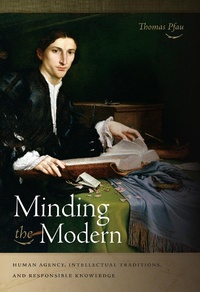
Minding the Modern
Beschreibung

A clear sign of this regression is the present crisis in the study of the humanities, whose role is overwhelmingly conceived (and negatively appraised) in terms of scientific theories, methods, and objectives. The ultimate casualty of this reductionism has been the very idea of personhood and the disappearance of an adequate ethical language. Minding the Modern is not merely a chapter in the history of ideas; it is a thorough phenomenological and metaphysical study of the roots of today's predicaments.
Rezensionen / Stimmen
"The sheer depth of Pfau's scholarship must deter criticism. His philosophical claims are underwritten by his dazzling erudite close readings, and he traverses with ease a vast intellectual terrain. . . . The case that Pfau makes is compelling, and its urgency . . . is hardly over-stated." -European Romantic Review"As with many cartographies of modernity, Pfau covers enormous intellectual ground here. But by limiting his scope to the metamorphosis affecting the relationship between the will and the intellect, he sheds much needed light on how the once indissoluble, metaphysical link between human agency and responsible knowledge gradually became severed. . . . This is, above all, a scholarly work of remembering: both what it once meant to be human and how those ancient possibilities might revitalize a contemporary area of decay." -Religious Studies Review
"Thomas Pfau's argument is bold: concepts of personhood-rationality, consciousness, judgment, responsibility, and will-have, since the thirteenth century, been so shorn of their distinction and truth value that they have crippled all modern formulations of human agency. More than a decline narrative, Minding the Modern is a thick narration of the systematic forgetting of the hard-won content of these concepts, counterilluminated by a few resilient thinkers who refused to participate in modernity's collective amnesia. . . . the consequent depth and richness of the interpretation of these canonical texts-nimbly supported with scholarly citation and counterinterpretation-will not fail to impress and, I think, consistently persuade." -The Journal of Religion
"Thomas Pfau's Minding the Modern, a groundbreaking work that may aptly be compared to studies by Charles Taylor and Alasdair MacIntyre, develops a sustained argument about the concept of human agency from Aristotle to the present day. Against the loss of deliberative agency, Pfau persuasively demonstrates why the idea of the person remains indispensable to humanistic inquiry today." -Journal of Theological Studies
". . . Minding the Modern is highly stimulating, methodologically self-aware and admirably audacious . . . . Part One offers a brilliant methodological reflection on the commitments and aims of the book. The seventy pages of these Prolegomena count among the most original and inspiring parts of the book and hopefully find a wide readership . . . . Minding the Modern will rightfully be seen as a serious, lucid contribution to the search of a new method for the humanities after modernity." -Reviews in Religion and Theology
"Minding the Modern is an immensely rich genealogy and critique of modernity. For years to come, its innovative phenomenological approach promises to be at the center of debates in theology, philosophy, and other humanistic disciplines about what it means to be human and about the direction the humanities themselves should take." -The Review of Metaphysics
"Pfau's book is rich and deserving a look. . . . Anyone interested in the history of philosophy or teaching in a humanities program should have this book on their shelves to help build their lectures, giving them a perspective to share with students that provides opportunities for questioning some of our key humanistic terms." -Augustinian Studies
"Thomas Pfau's Minding the Modern offers its readers one of the most substantial historical discussions now available on the relationship between human will, intellect and reason." -The Immanent Frame
". . . like Charles Taylor (A Secular Age) and Brad Gregory (The Unintended Reformation), Pfau is a man equipped for the enormous cartographic task of remapping the rise of modernity. . . . Minding the Modern is not history, nor is Pfau a historian. Instead, it is an extended, historically grounded close reading of texts that an accomplished literature professor is well equipped to provide. . . . Pfau focuses his wide-ranging account by choosing the (admittedly enormous) category of human personhood, and its corollaries of will and agency, as the vehicle in which he takes his tour of the ages. His express aim is 'to capture the intrinsic idea of will and person through a series of forensic readings of representative arguments.'" -Books & Culture
"By returning the concerns of the 'big books' to literary studies, Pfau hopes to deliver the humanities in general from the methodological dead ends of historicism and reductionist approaches imported from the hard sciences. . . . Whether sympathetic or hostile to Pfau's arguments, readers will find them a useful provocation. The ensuing debate, and the intellectual traditions it will engage, could help restore seriousness and urgency to the humanities." -The Hedgehog Review
"This brilliantly written and concise work examines the cost of forfeiting the past for modernity, and offers a historical account for how the human will and intellect were understood from Greek antiquity until the modern era. Pfau argues that, from Plato to Aquinas, the human will and intellect were essentially subordinated to a divine form of reason that pervaded the cosmos." -History of European Ideas
"Minding the Modern is a refreshing and timely book that offers a sharp focus on the unity of reason and will. Thomas Pfau advances his argument on intellectual history not by lacing big ideas together, but through close readings of exemplary texts." -The Thomist
Weitere Details
Weitere Ausgaben
Andere Ausgaben
Person
Inhalt
List of Abbreviations
Exordium: Modernity's Gaze
Part I. Prolegomena
1. Frameworks or Tools? On the Status of Concepts in Humanistic Inquiry
2. Forgetting by Remembering: Historicism and the Limits of Modern Knowledge
3. "A large mental field": Intellectual Traditions and Responsible Knowledge after Newman
Part II. Rational Appetite: An Emergent Conceptual Tradition
4. Beginnings: Desire, Judgment, and Action in Aristotle and the Stoics
5. Consolidation: St. Augustine on Choice, Sin, and the Divided Will
6. Rational Appetite and Good Sense: Will and Intellect in Aquinas
7. Rational Claims, Irrational Consequences: Ockham Disaggregates Will and Reason
Part III. Progressive Amnesia: Will and Crisis of Reason
8. Impoverished Modernity: Will, Action, and Person in Hobbes's Leviathan
9. The Path toward Non-Cognitivism: Locke's Desire and Shaftesbury's Sentiment
10. From Naturalism to Reductionism: Mandeville's Passion and Hutcheson's Moral Sense
11. Mindless Desires and Contentless Minds: Hume's Enigma of Reason
12. Virtue without Agency: Sentiment, Behavior, and Habituation in A. Smith
13. After Sentimentalism: Liberalism and the Discontents of Modern Autonomy
Part IV. Retrieving the Human: Coleridge on Will, Person, and Conscience
14. Good or Commodity? Modern Knowledge and the Loss of Eudaimonia
15. The Persistence of Gnosis: Freedom and "Error" in Philosophical Modernity
16. Beyond Voluntarism and Deontology: Coleridge's Notion of the Responsible Will
17. Existence before Substance: The Idea of "Person" in Humanistic Inquiry
18. Existence as Reality and Act: Person, Relationality, and Incommunicability
19. "Consciousness has the appearance of another": On Relationality as Love
20. "Faith is fidelity . . . to the conscience": Coleridge's Ontology
Works Cited 619
Index
