

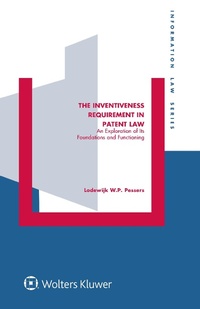
The Inventiveness Requirement in Patent Law
An Exploration of Its Foundations and Functioning
Erschienen am 20. April 2016
428 Seiten
978-90-411-8339-2 (ISBN)
Beschreibung

Although the pivotal role of the inventiveness requirement in patent law is broadly accepted, it has long remained an ill-defined concept, and in current debates the question is often raised whether the requirement is capable of functioning as an adequate 'gate-keeper'. By providing a broad and historical perspective on the inventiveness concept in patent law, this groundbreaking work lays a very thorough conceptual basis for further and more in-depth discussions on current standards of inventiveness.
In a method guided by geography and chronology, the author weaves developments in numerous countries - focusing primarily on the United States, the United Kingdom, Germany, and the Netherlands - into a fullscale analysis of the inventiveness concept. Among the questions raised and examined are the following:
- - How do industrial-economic considerations influence the requirement?
- - Are there different doctrinal 'schools of thought' that can be distinguished?
- - Should the current requirement stay in close relationship with its predecessors or is it fundamentally different?
- - Which socio-economic and political forces have influenced or diverted the evolution of the requirement?
- - What are the most conspicuous similarities and dissimilarities among the jurisdictions under examination? And how can they be explained?
- - To what extent is the 'inventive step' requirement applied in a uniform manner within the European Patent Convention area?
- - To what extent has the enormous recent growth of patent grants been brought about by relaxation of the inventiveness requirement?
This book provides crucially important fundamental commentary for lawyers, jurists, and scholars coming to grips with a hugely complex legal phenomenon: the dramatic growth worldwide in recent years of patents as instruments for the protection of industrial property. Particularly welcome in these times of intensifying scrutiny of patent law, this incomparable analysis will quickly become a cornerstone resource for intellectual property lawyers, patent officers, in-house counsel in multinational manufacturing companies, and other interested practitioners.
In a method guided by geography and chronology, the author weaves developments in numerous countries - focusing primarily on the United States, the United Kingdom, Germany, and the Netherlands - into a fullscale analysis of the inventiveness concept. Among the questions raised and examined are the following:
- - How do industrial-economic considerations influence the requirement?
- - Are there different doctrinal 'schools of thought' that can be distinguished?
- - Should the current requirement stay in close relationship with its predecessors or is it fundamentally different?
- - Which socio-economic and political forces have influenced or diverted the evolution of the requirement?
- - What are the most conspicuous similarities and dissimilarities among the jurisdictions under examination? And how can they be explained?
- - To what extent is the 'inventive step' requirement applied in a uniform manner within the European Patent Convention area?
- - To what extent has the enormous recent growth of patent grants been brought about by relaxation of the inventiveness requirement?
This book provides crucially important fundamental commentary for lawyers, jurists, and scholars coming to grips with a hugely complex legal phenomenon: the dramatic growth worldwide in recent years of patents as instruments for the protection of industrial property. Particularly welcome in these times of intensifying scrutiny of patent law, this incomparable analysis will quickly become a cornerstone resource for intellectual property lawyers, patent officers, in-house counsel in multinational manufacturing companies, and other interested practitioners.
Weitere Details
Weitere Ausgaben
Andere Ausgaben
Lodewijk Pessers
The Inventiveness Requirement in Patent Law
An Exploration of Its Foundations and Functioning
Buch
05/2016
Kluwer Law International
280,66 €
Versand in 10-20 Tagen
Inhalt
- Intro
- Halftitle Page
- Volume
- Title Page
- Copyright Page
- Table of Contents
- Acknowledgements
- List of Abbreviations
- Introduction
- 1 The Inventiveness Requirement
- 2 'Global Patent Warming'
- 3 Aim of This Study
- 4 Methodology
- 5 Demarcation and Chronology
- 6 Jurisdictions
- 7 Terminology and Translations
- Part I The Early History of the Inventiveness Requirement
- Chapter 1 The Early History of the Inventiveness Requirement: Preliminary Remarks
- Chapter 2 Antiquity and Medieval Europe
- 2.1 Introduction
- 2.2 Sybaris, Saxony and the Alps
- 2.3 Renaissance Italy
- 2.4 Conclusion
- Chapter 3 The Republic of Venice
- 3.1 Introduction
- 3.2 The Early Venetian (Quasi-)patents Practice
- 3.3 The Venetian Patent Statute (1474)
- 3.4 The Requirement of Inventiveness
- 3.5 Conclusion
- Chapter 4 The Venetian Patent Practice Spreading through Europe
- 4.1 Introduction
- 4.2 Background
- 4.3 France
- 4.4 Germany
- 4.5 The Netherlands
- 4.6 Floating Standards
- 4.7 Conclusion
- Chapter 5 England
- 5.1 Introduction
- 5.2 Collective and Individual Grants in the Middle Ages
- 5.3 The Sixteenth Century
- 5.4 The Odious Monopolies
- 5.5 The Statute of Monopolies
- 5.6 The Inventiveness Requirement: Textual and the Contextual Indications
- 5.7 Developments after 1624
- 5.8 The Early Nineteenth Century
- 5.9 Conclusion
- Chapter 6 United States
- 6.1 Introduction
- 6.2 The Colonial Period
- 6.3 Patent Policy after the Declaration of Independence (1776)
- 6.4 A Short Legislative History of the Patent Act of 1790
- 6.5 The Patent Act of 1790
- 6.6 The Patent Act of 1793
- 6.7 Conclusion
- Part II The Inventiveness Requirement in Its Modern Phase
- Chapter 7 The Inventiveness Requirement in Its Modern Phase: Preliminary Remarks
- Chapter 8 Inventiveness in the Age of Modernization
- 8.1 Introduction
- 8.2 United States
- 8.3 United Kingdom and the Patent Law Amendment Act (1852)
- 8.4 Conclusion
- Chapter 9 The Further Rise of the Inventiveness Standard
- 9.1 Introduction
- 9.2 The Patent Debate in Europe
- 9.3 Internationalization
- 9.4 United States
- 9.5 United Kingdom
- 9.6 Germany and Its Reichspatentgesetz (1877)
- 9.7 Conclusion
- Chapter 10 The Invention, the Inventor and the Workman
- 10.1 Introduction
- 10.2 United States
- 10.2.1 Two Schools of Thought
- 10.2.2 A Wary Eye on Patents (the 1930s and 1940s)
- 10.3 United Kingdom
- 10.3.1 Consolidation of the Requirement
- 10.3.2 Obviousness and the Perspective of the Skilled Workman
- 10.4 Germany
- 10.4.1 Technical Advance and Inventive Height
- 10.4.2 Focusing on the Inventor
- 10.5 The Netherlands
- 10.5.1 The Patent Act (1910)
- 10.5.2 Application of the Open Standard
- 10.6 Conclusion
- Chapter 11 Systematization
- 11.1 Introduction
- 11.2 United States
- 11.2.1 The Patent Act (1952)
- 11.2.2 The Pro-patent Era
- 11.2.3 The Supreme Court Steps In
- 11.3 The European Patent Convention
- 11.3.1 The Road towards Harmonization
- 11.3.2 The Interpretation of Article 5 6 EPC
- 11.4 United Kingdom
- 11.5 Germany
- 11.6 The Netherlands
- 11.7 Conclusion
- Summary and Conclusion
- 1 The Inventiveness Requirement through History
- 1.1 The Medieval Phase
- 1.2 The Mercantilist Phase
- 1.3 The Pre-modern Phase
- 1.4 The Modern Phase and the Qualitative-Quantitative Dichotomy
- 2 Some Questions for the Future
- 2.1 Problems Ahead
- 2.2 Sources of Change
- 2.3 The Future of the Qualitative Standard
- Bibliography
- Table of Cases
- Index
