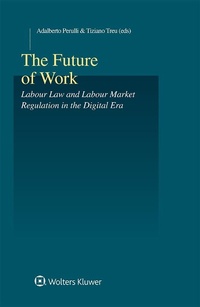
Future of Work
Beschreibung

Studies in Employment and Social Policy Volume 56
Digitalization, far from being solely a technological issue, has broad implications in the social, labour, and economic spheres. It leads to dangers as well as to new chances for the workforce, and thus labour law must develop effective ways to both protect workers and allow them to profit from new technological developments. The most thorough book of its kind, this collection of expert essays provides an abundance of well-thought-out material for understanding the consequences of digitalization for the labour market and industrial relations.
Recognizing that only an international perspective can make it possible to face the challenges of the present (and the future), renowned authorities from the International Labour Organization and the International Society for Labour and Social Security Law, as well as outstanding labour law professors, examine in depth such salient issues as the following:
- transformation of production systems;
- the spread of artificial intelligence;
- precariousness and exploitation in the gig economy;
- lessons learned from COVID-19;
- employment status of platform workers;
- new cross-border issues;
- rights to trade union association and collective bargaining;
- role of the State in the new digital labour market; and
- blurred lines between work and private life.
Thanks to the international team of contributors, the issues are dealt with from a variety of overlapping perspectives and points of view, combining aspects of labour law, commercial law, corporate governance, and international law.
Highlighting the need to adapt, especially through the right to training, work, and professionalism with respect to the new technological landscape, the book draws on legislative, judicial, and theoretical initiatives suggesting ways of responding positively to the requests for protection that arise in the new forms of production. A uniquely valuable tool for study and reflection for policymakers and academics, the book is also sure to be valued by entrepreneurs, managers, consultants, corporate lawyers, judges, human rights experts, and trade unionists who are interested in the issues of labour, industrial relations, and social rights in European and international contexts.
Weitere Details
Weitere Ausgaben
Andere Ausgaben