

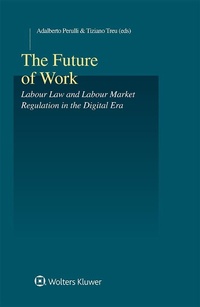
Future of Work
Labour Law and Labour Market Regulation in the Digital Era
Erschienen am 10. Dezember 2020
352 Seiten
978-94-035-2861-8 (ISBN)
Beschreibung

Studies in Employment and Social Policy Volume 56 Digitalization, far from being solely a technological issue, has broad implications in the social, labour, and economic spheres. It leads to dangers as well as to new chances for the workforce, and thus labour law must develop effective ways to both protect workers and allow them to profit from new technological developments. The most thorough book of its kind, this collection of expert essays provides an abundance of well-thought-out material for understanding the consequences of digitalization for the labour market and industrial relations. Recognizing that only an international perspective can make it possible to face the challenges of the present (and the future), renowned authorities from the International Labour Organization and the International Society for Labour and Social Security Law, as well as outstanding labour law professors, examine in depth such salient issues as the following: transformation of production systems; the spread of artificial intelligence; precariousness and exploitation in the gig economy; lessons learned from COVID-19; employment status of platform workers; new cross-border issues; rights to trade union association and collective bargaining; role of the State in the new digital labour market; and blurred lines between work and private life. Thanks to the international team of contributors, the issues are dealt with from a variety of overlapping perspectives and points of view, combining aspects of labour law, commercial law, corporate governance, and international law. Highlighting the need to adapt, especially through the right to training, work, and professionalism with respect to the new technological landscape, the book draws on legislative, judicial, and theoretical initiatives suggesting ways of responding positively to the requests for protection that arise in the new forms of production. A uniquely valuable tool for study and reflection for policymakers and academics, the book is also sure to be valued by entrepreneurs, managers, consultants, corporate lawyers, judges, human rights experts, and trade unionists who are interested in the issues of labour, industrial relations, and social rights in European and international contexts.
Weitere Details
Weitere Ausgaben
Andere Ausgaben
Adalberto Perulli | Tiziano Treu
The Future of Work
Labour Law and Labour Market Regulation in the Digital Era
Buch
12/2020
Kluwer Law International
157,04 €
Versand in 15-20 Tagen
Inhalt
- Intro
- Half-Title Page
- Title Page
- Copyright Page
- Editors
- Contributors
- Summary of Contents
- Table of Contents
- Introduction
- PART I The Future of Work in the ILO Perspective
- CHAPTER 1 The ILO and the Future of Work
- 1.1 The History and the Mission of the ILO
- 1.2 A Basic Principle: The Universality of Social Rights
- 1.3 How to Regulate the Informal Economy and Informal Employment
- 1.4 The Principles of Fair Globalization: Uneven Implementation
- 1.5 The Role of the National States: Protectionism and Legitimate Defence of Social Standards
- 1.6 The Human-Centred Agenda: Investing in People's Capabilities and in the Institutions of Work
- 1.7 Expanding Time Sovereignty: Work-Life Balance and Smart Working
- 1.8 The Individualization of Work and the Future of Collective Action: Reduction of Working Time?
- 1.9 Social Security: Beyond Insurance Schemes
- 1.10 To Cope with an Uncertain Future: Reinvigorating the Social Contract
- References
- CHAPTER 2 Technology and Decent Work: Observations on the Report of the Global Commission on the Future of Work
- 2.1 On Employment
- 2.2 On Platforms
- 2.3 On Algorithms
- CHAPTER 3 Rethinking Labour Law for the Twenty-First Century
- 3.1 Introduction
- 3.2 The Purpose of Labour Law
- 3.3 The Collective Versus Individual Dichotomy
- 3.4 Labour Law in the Straitjacket of 'Employment'
- 3.4.1 The Emergence of Labour Law
- 3.5 Rethinking Labour Law
- 3.5.1 Timeless Values but Changing Modes of Application
- CHAPTER 4 Labour Law and Digital Platforms
- 4.1 Introduction
- 4.2 Digital Platform
- 4.3 Regulatory, Policy Challenges and Options of Digital Labour Platform
- 4.4 Digital Platform and the Employment Relationship
- 4.5 Policy Options in Relation to Digital Labour Platforms
- 4.6 Digital Platforms and Fundamental Principles and Rights at Work
- 4.7 Conclusions
- CHAPTER 5 The Division of Labor in the Digital Era
- 5.1 Technology, Cooperation, Conflict
- 5.2 Innovation and Its Determinants
- 5.3 Labor Fragmentation Versus Social Homogenization
- 5.4 Does the Digital Economy Imply Polarization?
- 5.5 Conclusion
- Bibliography
- CHAPTER 6 For a Human-Centred Approach to the Future of Work
- 6.1 The Urgency of Now
- 6.2 Labour Is Not a Commodity
- 6.3 The Framework
- 6.4 So Let Us Summarize Some of the Key Policies
- 6.5 Universal Labour Guarantee for All
- 6.6 Collective Bargaining: The Critical Component
- 6.7 It Is Not Just the Technology
- 6.8 Platform Regulation
- 6.9 Jobs for Tomorrow
- 6.10 ILO as Needed Now
- CHAPTER 7 Technological Change, Institutions, and the Labour Market
- 7.1 The Impact of ICT Progress on Labour Productivity: Does Technological Progress Destroy Jobs?
- 7.2 Does ICT Change Labour Forces' Composition? If Yes, in Which Way?
- 7.3 The Effect of ICT Progress on Employment Levels, Labour Forces' Composition and Wages: A Focus on Italy
- 7.4 Future Scenarios and Policy Implications
- 7.5 Concluding Remarks
- References
- PART II The Challenges of Digitization to the Regulatory Categories of Labour Law
- CHAPTER 8 Platform Capitalism and Labour Law
- 8.1 Work Through Digital Platforms: Between Poiesis and Domination of Technology
- 8.2 The New Forms of Work Mediated by Platforms: Between Subordination and Autonomy
- 8.3 The Qualification of Employment Relationships: A Problem of 'Instrumental' or 'Axiological' Rationality?
- 8.3.1 The Option of Subordination 'At All Costs'
- 8.3.2 The 'Remedial' Perspective and the Modulation of Protection by Thresholds
- 8.4 Are Digital Platforms Employers?
- 8.5 More on the Qualification of Relationships: The EC Point of View and the Comparative Perspective
- 8.6 The National Jurisprudence: A Comparative Analysis
- 8.7 The Intermediate Categories: Independent but Economically Dependent
- 8.8 The Intervention of the Law: The French and Italian Cases
- 8.9 Conclusions
- CHAPTER 9 Digitalization and Its Impacts of De-spatialization and De-temporalization of Work and De-territorialization of the Labour Market: Is It Time to Rethink a 'Sustainable' Labour Law?
- 9.1 Introduction
- 9.2 Digitalization and the Resulting Transformations on the Organization of Work: De-spatialization and De-temporalization of Work Through Working Platform and Smart Work
- 9.2.1 The Matter of Work Relationship Qualification and Social Rights Recognition
- 9.2.2 Some Very Recent Victories for Gig-Workers in France, UK and Italy
- 9.3 Digitalization and the De-territorialization of the Labour Market
- 9.4 Is It Time to Rethink Labour Law? A Question That Can No Longer Be Postponed
- CHAPTER 10 Platform Work: A Call to Reconsider the Institutions of Social Law
- 10.1 Introduction
- 10.2 Social Law as a Place of Harmonization Between the Two Sides of Work
- 10.3 Platform Work as a Commodity
- 10.4 Platform Work as the Expression of a Human Person?
- 10.5 Conclusion
- PART III Digitalization in the Organization of Work and the Employment Relationship
- CHAPTER 11 Challenges for Labour Law in the Era of Digitalization: With Special Reference to Germany
- 11.1 Introduction
- 11.2 Examples of Regulatory Problems and Possible Solutions
- 11.2.1 Workers' Participation in Introducing and Using Digital Tools
- 11.2.2 Training
- 11.2.3 Classification
- 11.2.4 Hours of Work
- 11.2.5 Data Protection
- 11.2.6 Right to Home Office
- 11.2.7 Collective Voice
- 11.3 Conclusion
- CHAPTER 12 Artificial Intelligence: The Third Element of the Labour Relations
- 12.1 Outlining the Issue: The Hidden Revolution - Job Tasks, Staff Classification, Law and Collective Bargaining in Italy
- 12.2 The Necessary Updates in the Labour Legal Systems: Individual and Collective Procedures for Improving Workplace Regulations
- 12.3 Intelligent Machines as the 'Third Element' of the Labour Relations
- 12.4 Conclusions: The 'Labour-Robot Law' Challenges and Scenarios
- CHAPTER 13 Regulating the Employment Relationship in the Organization 4.0: Between Social Justice and Economic Efficiency
- 13.1 Introduction
- 13.2 Digitization, the Organization 4.0 and the Employment Contract
- 13.3 The Contents of the Employment Contract in the Digital Workplace from the Employer's Perspective
- 13.4 The Impact of Organizational Choices on the Worker's Sphere: Interests and Employment Conditions
- 13.4.1 The Work Obligation
- 13.4.2 Health, Safety and Wellbeing
- 13.5 Conclusion: The Elements of a Win-Win Regulatory Approach to Work Relations in the Organization 4.0
- CHAPTER 14 The Impact of Digitalisation on Individual Labour Relations: Working Time as an Outdated Concept?
- 14.1 Introduction
- 14.2 The Impact of Digitalisation on Individual Labour Relations in Traditional Businesses and Industries
- 14.3 Working Time Issues in the Digital Era
- 14.3.1 The Additional Work Beyond Regular Working Time
- 14.3.1.1 The Existing Regulatory Framework
- 14.3.1.2 Working Time or Not?
- 14.3.2 Permanent Availability of ICT-Based Mobile Workers
- 14.4 Conclusion
- PART IV Institutional Aspects of Regulation: Between European Sources and Collective Bargaining
- CHAPTER 15 Adapting Labor Law to "Digital" Work: Between Scholarly Interpretation, Case Law and Legislative Intervention
- 15.1 Introduction
- 15.2 Employment Status
- 15.3 Working Time in the Health and Safety Perspective
- 15.4 The Transnational Nature of "Digital" Work
- 15.5 Collective Rights of "Digital" Workers
- 15.6 Conclusion: A Bright Future for "Digital" Workers?
- CHAPTER 16 Platforms, Unions and Workers: Is Collective Bargaining Possible?
- 16.1 Protecting the Values of Decent Work and Workers' Dignity
- 16.2 EU Competitive Law Inapplicable to False Employed and Dependent Self-Employed
- 16.3 Employment, Self-Employment and Work: The Italian Lawsuit of Foodora Riders
- 16.4 Rise and Decline of the Umbrella Companies
- 16.5 The First Examples of Platform Workers Collective Agreements
- 16.6 Suggestions for the Collective Bargaining to Come
- 16.7 Labour, Even in a Digital Environment, Is Not a Commodity
- CHAPTER 17 The Labour Market and the Digital Revolution: Focus on Some Effects, Legislative Implications and the Role of Collective Bargaining
- 17.1 The Labour Market at the Time of the Digital Revolution: The Transformations on Evolutionary Dynamics
- 17.2 The Effect of 'Job Polarisation' Between the Rigidity of the System and New Needs
- 17.2.1 Briefly on Practical Experience
- 17.3 A Strategic Role of Social Partners Faced with the Guarantees of Labour Law?
- PART V Platform Work and Business 4.0: Analysis of Some National Cases
- CHAPTER 18 Gig Work: Employees or Independent Contractors? Data and Regulatory Challenges in the Swedish Experience
- 18.1 Introduction: Labour Is Not a Commodity . but a Service Is
- 18.2 The Swedish Experience
- 18.2.1 The Challenge Posed by the Gig Economy to the Grounds of the Employment Relationship Itself
- 18.2.2 The Legal Challenges under the Present Legal Frame
- 18.3 Conclusion
- CHAPTER 19 Protection from Discriminatory Dismissal According to ILO Norms in the Context of German and Turkish National Law
- 19.1 Introduction
- 19.2 Protection Against Discrimination
- 19.2.1 Convention No. 100
- 19.2.2 Convention No. 111
- 19.3 Protection Against Unfair Dismissal: Convention No. 158
- 19.4 Enforcement Mechanisms
- 19.5 Conclusion
- CHAPTER 20 Digital Nomads on Polish Labour Market: Legal Situation, Risks and Expectations
- 20.1 Introduction
- 20.2 Digitalization and Nomadism
- 20.3 Polish Legal Framework for Digital Nomadism
- 20.4 Freelancers' Reports: Working Conditions Versus Expectations
- 20.5 Working Conditions Based on Platform Regulations
- 20.6 Conclusions
- CHAPTER 21 Platform Work and 'Double Alienness'
- 21.1 Introduction
- 21.2 The Idea of 'Double Alienness' in Italian Labour Law
- 21.3 Relevant Case Law
- 21.4 The 'Double Alienness' of the Platform Worker
- 21.5 Platforms Case Law and Double Alienness
- 21.6 Final Remarks
- CHAPTER 22 Some Thoughts on Industry 4.0 and Trade Unions
- 22.1 The Considerable Decline of the Fourth Industrial Revolution
- 22.2 Looking at Some Implementation Experiences of Industry 4.0
- 22.3 The Emphasis of the Individual Contract: Some Doubts
- 22.4 The Collective Agreement, the Recent Arrangements of the Union System and the Renewed Attention to Union Democracy
- 22.5 Towards an Uncertain Future, but Without Losing the Awareness of the Present
- STUDIES IN EMPLOYMENT AND SOCIAL POLICY
