

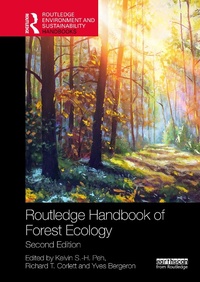
Routledge Handbook of Forest Ecology
2. Auflage
Erschienen am 7. Oktober 2024
720 Seiten
978-1-040-13032-2 (ISBN)
Beschreibung

The Routledge Handbook of Forest Ecology is an essential resource covering all aspects of forest ecology from a global perspective.
This new edition has been fully revised and updated throughout to reflect the profound and unprecedented changes in both forests and climates since the publication of the first edition in 2015. The handbook reflects key developments in the field of forest dynamics and large-scale processes, as well as the changes that are now manifesting in different types of forests across the globe as a result of climate change. It covers both natural and managed forests, from boreal, temperate, sub-tropical and tropical regions of the world. In this second edition, the breadth of the handbook has been expanded with new chapters on mountain forests, monodominance, pathogens and invertebrate pests and amphibians and reptiles in forest ecosystems. Original author teams are complemented by the addition of new authors to offer fresh perspectives, and the second edition places greater emphasis on the applicability of each topic at a global level. The handbook is divided into seven parts:
Part I: The forest
Part II: Forest dynamics
Part III: Forest flora and fauna
Part IV: Energy and nutrients
Part V: Forest conservation and management
Part VI: Forest and climate change
Part VII: Human ecology
The Routledge Handbook of Forest Ecology is an essential reference text for a wide range of students and scholars of ecology, environmental science, forestry, geography and natural resource management.
This new edition has been fully revised and updated throughout to reflect the profound and unprecedented changes in both forests and climates since the publication of the first edition in 2015. The handbook reflects key developments in the field of forest dynamics and large-scale processes, as well as the changes that are now manifesting in different types of forests across the globe as a result of climate change. It covers both natural and managed forests, from boreal, temperate, sub-tropical and tropical regions of the world. In this second edition, the breadth of the handbook has been expanded with new chapters on mountain forests, monodominance, pathogens and invertebrate pests and amphibians and reptiles in forest ecosystems. Original author teams are complemented by the addition of new authors to offer fresh perspectives, and the second edition places greater emphasis on the applicability of each topic at a global level. The handbook is divided into seven parts:
Part I: The forest
Part II: Forest dynamics
Part III: Forest flora and fauna
Part IV: Energy and nutrients
Part V: Forest conservation and management
Part VI: Forest and climate change
Part VII: Human ecology
The Routledge Handbook of Forest Ecology is an essential reference text for a wide range of students and scholars of ecology, environmental science, forestry, geography and natural resource management.
Weitere Details
Reihe
Auflage
2nd edition
Sprache
Englisch
Verlagsort
London
Großbritannien
Verlagsgruppe
Taylor & Francis Ltd
Zielgruppe
Für höhere Schule und Studium
Illustrationen
26 Tables, black and white; 63 Line drawings, black and white; 67 Halftones, black and white; 130 Illustrations, black and white
ISBN-13
978-1-040-13032-2 (9781040130322)
Copyright in bibliographic data and cover images is held by Nielsen Book Services Limited or by the publishers or by their respective licensors: all rights reserved.
Schweitzer Klassifikation
Weitere Ausgaben
Andere Ausgaben

Kelvin S.-H. Peh | Richard T. Corlett | Yves Bergeron
Routledge Handbook of Forest Ecology
Buch
ca. 07/2026
2. Auflage
Routledge
82,95 €
Noch nicht erschienen
Kelvin S. -H Peh | Richard T. Corlett | Yves Bergeron
Routledge Handbook of Forest Ecology
Buch
11/2024
Routledge
Preis leider unbekannt
Lieferbar (Termin auf Anfrage)
Kelvin S.-H. Peh | Richard T. Corlett | Yves Bergeron
Routledge Handbook of Forest Ecology
Buch
10/2024
2. Auflage
Routledge
355,20 €
Versand in 10-20 Tagen
Personen
Kelvin S.-H. Peh is an associate professor of conservation science in the Faculty of Environmental and Life Sciences, University of Southampton, UK.
Richard T. Corlett is an Emeritus professor at the Xishuangbanna Tropical Botanical Garden, Chinese Academy of Sciences, Yunnan, China, and an honorary research fellow at the Royal Botanic Gardens, Kew, UK. He was previously a professor at the National University of Singapore and the University of Hong Kong, China.
Yves Bergeron is an Emeritus professor of forest ecology and management at Universite du Quebec en Abitibi- Temiscamingue and Universite du Quebec a Montreal, Canada.
Richard T. Corlett is an Emeritus professor at the Xishuangbanna Tropical Botanical Garden, Chinese Academy of Sciences, Yunnan, China, and an honorary research fellow at the Royal Botanic Gardens, Kew, UK. He was previously a professor at the National University of Singapore and the University of Hong Kong, China.
Yves Bergeron is an Emeritus professor of forest ecology and management at Universite du Quebec en Abitibi- Temiscamingue and Universite du Quebec a Montreal, Canada.
Inhalt
1. Introduction Kelvin S.-H. Peh, Yves Bergeron and Richard T. Corlett Part 1: The Forest 2. Boreal Forests Jean-Pierre Saucier, Ken Baldwin, Pavel Krestov and Torre Jorgenson 3. Temperate Forests Lee E. Frelich and Rebecca Montgomery 4. Subtropical Forests Richard T. Corlett and Alice C. Hughes 5. Tropical Forests Richard T. Corlett 6. Temperate and Boreal Mountain Forests Christopher Carcaillet and Peter Z. Fule Part 2: Forest Dynamics 7. Insect Disturbances in Forest Ecosystems Dan Kneeshaw, Brian R. Sturtevant, Barry Cooke, Timothy Work, Deepa Pureswaran, Louis DeGrandpre and Dave MacLean 8. Fire in Forest Ecosystems David F. Greene, Madeleine A. Lopez and Sean T. Michaletz 9. Ecological Effects of Strong Wind on Forests Stephen M. Turton and Mohammed Alamgir 10. Forest Succession and Gap Dynamics Rebecca Montgomery and Lee E. Frelich 11. Tree Genetic Diversity and Gene Flow in Forest Ecosystems Francine Tremblay 12. Monodominance in Tropical Lowland Forests Kelvin S.-H. Peh Part 3: Forest Flora and Fauna 13. The Ecology of Lianas and Their Increasing Influence in Tropical Forests Stefan A. Schnitzer 14. Vascular Epiphytes in Forest Ecosystems Amanda Taylor 15. Insects in Forest Ecosystems Andrea Battisti 16. Bryophytes in Forest Ecosystems Nicole J. Fenton, Kristoffer Hylander Emma Pharo and Charles E. Zartman 17. Lichens in Forest Ecosystems Per-Anders Esseen, Goeran Thor and Darwyn Coxson 18. Mammals in Forest Ecosystems Richard T. Corlett and Alice C. Hughes 19. Ecology and Conservation of Forest Birds Malcolm C.K. Soh, Ding Li Yong, Richard T. Corlett and Kelvin S.-H. Peh 20. Amphibians and Reptiles of Forest Ecosystems David Bickford, Adrian Garda, Seshadri K.S, Umilaela Arifin, Hiral Naik, Hanyeh Ghaffari and Barbod Safaei-Mahroo 21. Global Patterns of Biodiversity in Forests Christine B. Schmitt and Joao de Deus Vidal Jr. Part 4: Energy and Nutrients 22. Mycorrhizal Symbiosis in Forest Ecosystems Leho Tedersoo 23. Biogeochemical Cycling David Pare, Daniel Markewitz and Hakan Wallander 24. Forest Hydrology Andre St-Hilaire 25. Primary Production and Allocation in Forest Ecosystems Frank Berninger and Kelvin S.-H. Peh Part 5: Forest Conservation and Management 26. Natural Regeneration after Harvesting Nelson Thiffault, Lluis Coll, Douglass F. Jacobs, Marie Ange Ngo Bieng and Eliott Maurent 27. Tropical Deforestation, Forest Degradation and the Role of REDD+ in Climate Change Mitigation John A. Parrotta 28. Restoration of Forest Ecosystems John A. Stanturf 29. Forest Fragments and Fragmentation Michael David Pashkevich, Badrul Azhar, Damayanti Buchori, Robert J. Fletcher, Jr., Jake L. Snaddon and Edgar C. Turner 30. The Ecology of Logged Forests Paul Woodcock, Panu Halme and David P. Edwards 31. Pollution in Forests Mikhail V. Kozlov and Elena L. Zvereva 32. Biological Invasions in Forests and Forest Plantations Marcel Rejmanek 33. Pathogens and Invertebrate Pests in North American Forest Ecosystems Sandy M. Smith and Louis Bernier Part 6: Forest and Climate Change 34. Fire and Climate: Using the Past to Predict the Future Marion Lestienne, Justin Waito, Cheima Barhoumi, Laurent Bremond, Martin P. Girardin, Jacques C. Tardif, Adam A. Ali, Hermann Behling, Julia Unkelbach and Christelle Hely 35. The Ecological Consequences of Droughts in Forests Richard T. Corlett 36. From Wood Formation to Tree Ring: How Tree Growth Responds to Climate Change Roberto Silvestro, Minhui He, Jian-Guo Huang and Hubert Morin and Sergio Rossi 37. Plant Movements in Response to Rapid Climate Change Richard T. Corlett 38. Forest Carbon Budgets and Climate Change Yadvinder Malhi, Tina Christmann, Xiongjie Deng, Huanyuan Zhang-Zheng, Sam Moore and Terhi Riutta Part 7: Human ecology 39. Multiple Roles of Non-timber Forest Products in Ecologies, Economies and Livelihoods Charlie M. Shackleton 40. Agriculture in the Forest: Ecology and Rationale of Shifting Cultivation Olivier Ducourtieux 41. Indigenous Forest Knowledge Hugo Asselin 42. Wild Meat Hunting in Tropical Forests Julia E. Fa and Stephan M. Funk
