

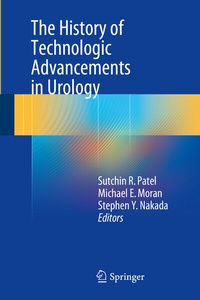
The History of Technologic Advancements in Urology
Beschreibung

This text explores the history and development of the many technologies that have led to how we treat contemporary urologic problems. From the development of the cystoscope, the advances in laparoscopy, the birth of the field of endourology, to the era of robotics today, urologists have pushed the envelope in technologic innovation.
The editors highlight the development of the cystoscope and the early tools used to treat ureteral stones, the development of ureteroscopy, and the applications of lasers and shock wave lithotripsy in the treatment of urolithiasis. Furthermore, they explore the history of minimally invasive treatments in urologic oncology from the story behind the first laparoscopic nephrectomy, the application of hand-assisted technology to the development of robotics and percutaneous treatment approaches (radiofrequency ablation and cryoablation).
As the field of urology continues to evolve, urologists will continue to look to the future with the recent applications of histotripsy and regenerative medicine.
This text chronicles the creativity, innovation and discovery of the developments of the instruments that allow to practice urology today, as well as glimpse what the future of urology holds.
Rezensionen / Stimmen
"This is an excellent book covering the dramatic developments that have resulted in the technologies of modern urology. . Anyone at all interested in the history of medicine, radiology and urology should buy this book. It would make a great present for your urologist colleague." (Professor Adrian Thomas, RAD Magazine, December, 2017)Weitere Details
Weitere Ausgaben
Andere Ausgaben
Personen
Sutchin R. Patel, MD, FACS
Dr Patel is a Clinical Adjunct Assistant Professor at the Department of Urology, University of Wisconsin School of Medicine and Public Health and serves as a consultant for the William P. Didusch Center for Urologic History. He has edited Ureteral Stone Management: A Practical Approach (Springer 2015).
Michael E. Moran, MD
Dr Moran is the Curator of the William P. Didusch Center for Urologic History and is an Adjunct Associate Professor at the Department of Urology, University of Florida. He has written Urolithiasis: A Comprehensive History (Springer, 2014).
Stephen Y. Nakada, MD, FACS
Dr Nakada is the Chairman of the Department of Urology and the David T. Uehling Chair and Professor of Urology at the University of Wisconsin School of Medicine and Public Health. He has edited multiple texts including: Ureteral Stone Management: A Practical Approach (Springer 2015); Minimally Invasive Urology: AnEssential Clinical Guide to Endourology, Laparoscopy, LESS and Robotics (Springer, 2015); Surgical Management of Urolithiasis (Springer, 2013); Practical Controversies in the Medical Management of Stone Disease (Springer, 2014); Essential Urologic Laparoscopy (Springer, 2010).
