

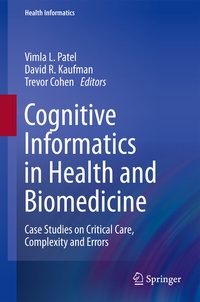
Cognitive Informatics in Health and Biomedicine
Beschreibung

Rezensionen / Stimmen
From the book reviews:
"'Cognitive Informatics in Health and Biomedicine: Case Studies on Critical Care, Complexity, and Errors' qualifies as required reading for those interested in healthcare safety and quality, for those engaged in clinical care delivery in complex settings, for those interested in understanding cognitive aspects of clinical decision-making, for future researchers investigating clinical errors, and for informaticians planning interventions to reduce the effects of errors." (Randolph A. Miller, Journal of Biomedical Informatics, Vol. 49, 2014)Weitere Details
Weitere Ausgaben
Andere Ausgaben
Personen
Dr Vimla Patel is a Senior Research Scientist and Director of the Center for Cognitive Studies in Medicine and Public Health at the New York Academy of Medicine. Dr. Patel is an accomplished researcher in the areas of biomedical informatics, cognitive psychology and their application in health and medical care settings, especially in the areas of translation of evidence into practice. A leader in adapting methods and theories from cognitive science and in innovating new approaches to translating knowledge into action, Dr. Patel's research explores the role of cognition in designing a safer clinical workplace, the complexity of group decision making underlying critical-care decisions, the generation of medical errors, and the impact of technology on human cognition for competent performance.
Dr. David R. Kaufman is a visiting Scholar at the New York Academy of Medicine. Dr. Kaufman's primary research interests include human computer interaction in the context of health information technologies, information seeking behavior and decision making in healthcare contexts, and conceptual understanding of biomedical information and decision making by lay people. Trained as an educational psychologist and cognitive scientist, he has conducted several usability evaluation studies with a range of populations. Dr.
Trevor A. Cohen is an Assistant Professor in the School of Biomedical Informatics at the University of Texas Health Science Center, Houston and is affiliated with the Center for Cognitive Informatics and Decision Making. His primary research interest is in empirical distributional semantics - what machines can learn about meaning from unannotated text - and how this learning relates to human cognition. In addition, he has researched how humans detect and recover from error, in particular medical error.
