

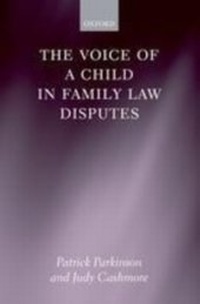
Voice of a Child in Family Law Disputes
1. Auflage
Erschienen am 18. Dezember 2008
249 Seiten
978-0-19-155340-0 (ISBN)
Beschreibung

When relationships break down, disputes commonly arise over the parenting arrangements for children, whose living arrangements have to be reorganized at a time of great conflict and turmoil. Most such disputes are resolved without a judicial determination through private agreement, negotiation between lawyers, mediation, or a combination of these methods. This book examines whether and how children should be involved in the process of resolving family law disputes. Although there is widespread acceptance in the Western world that the views of children should be taken into account, and that the weight given to those views should depend on their age and maturity, there is much less agreement about how children's voices should be heard. There are many benefits to giving children a voice in decisions that affect their lives, and the UN Convention on the Rights of the Child identifies this as a right for children. However, there are difficulties and dangers in seeking to hear from children, not least because they may be subject to pressure from each parent to express views that support his or her case. Courts dealing with family law issues are constantly faced with a dilemma. Is it better to keep children out of the conflict, or to give them a say, so that the arrangements are as workable for them as possible? This book integrates examinations of these issues with empirical data from interviews which explore the views and experiences of children, parents, counsellors, mediators, lawyers, and judges involved in such disputes in Australia. Drawing on this research, the authors suggest ways in which children can better be heard without placing them at the centre of their parents' conflicts. They argue that the focus should not just be on how children are heard in legal proceedings, but on how they can be better heard in those families who resolve their conflicts without going to court.
Weitere Details
Weitere Ausgaben
Andere Ausgaben
Patrick Parkinson | Judy Cashmore
The Voice of a Child in Family Law Disputes
Buch
12/2008
Oxford University Press
149,90 €
Versand in 15-20 Tagen
Inhalt
- Intro
- Contents
- Preface
- 1 The Debate About Children's Voices
- 1.1 The Protective Approach to Children
- 1.2 Views on the Capacities of Children
- 1.3 Children as Participants
- 1.3.1 Understanding children as social actors
- 1.3.2 Understanding children as citizens
- 1.4 The Pitfalls of Listening to Children
- 1.4.1 Children may be placed in the middle of their parents' conflicts
- 1.4.2 The risk of undue influence
- 1.4.3 Children may be given the decision-making authority that the parents need to exercise
- 1.4.4 Children's voices may provide an excuse for adults to avoid hard decisions
- 1.4.5 The risk that children's voices will be used to facilitate irresponsible adult decisions
- 1.5 Different Levels and Forms of Participation
- 1.6 The Purpose of this Book
- 2 The Research
- 2.1 The Importance of Multiple Perspectives
- 2.1.1 The importance of children's and parents' views
- 2.1.2 The importance of professionals' views: judges, lawyers and welfare professionals
- 2.2 Research Method
- 2.2.1 The participants and the interviews
- 2.3 Practical and Ethical Issues in Research with Children
- 2.3.1 Consent for children's participation
- 2.3.2 Confidentiality and privacy of children's responses
- 2.3.3 Format of interviews with children
- 3 The Different Ways of Hearing the Voice of the Child
- 3.1 Legislative Principles for Participation
- 3.2 Child-inclusive Mediation
- 3.3 Family Reports
- 3.4 Child Representatives
- 3.5 Children as Parties to Proceedings
- 3.6 Judicial Interviewing
- 3.7 Evidence from Children
- 3.8 The Filtering of Children's Voices
- 4 Children's and Parents' Views of Children's Participation
- 4.1 Preconditions for Children's Participation
- 4.2 Children's Views
- 4.2.1 Children's reasons for wanting to have a say
- 4.2.2 Children's reasons for not wanting to have a say
- 4.2.3 Children's actual and perceived involvement
- 4.2.4 How much say did children want?
- 4.2.5 Having a say and the fairness of the arrangements
- 4.3 Parents' Views
- 4.3.1 Should children have a say?
- 4.3.2 Age, maturity and parental influence
- 4.3.3 Parents' views on the benefits of children having a say
- 4.4 Children's and Parents' Views Compared
- 4.4.1 Similarities and differences in children's and parents' views
- 4.4.2 Differences between those who had experienced contested proceedings and those who had not
- 4.5 Voice and Choice in Children's Participation
- 5 Professional Views of Children's Participation
- 5.1 The Importance of Professional Perspectives
- 5.2 Family Lawyers
- 5.2.1 Age, maturity and parental influence
- 5.2.2 Workability and children's happiness
- 5.2.3 Protection from participation
- 5.2.4 Children as decision-makers
- 5.2.5 Children's participation as about choices between adult positions
- 5.2.6 Changing the system
- 5.3 Mediators and Counsellors
- 5.3.1 Enlightenment
- 5.3.2 Empowerment
- 5.3.3 The involvement of children in mediation
- 5.3.4 Workability
- 5.3.5 Therapeutic benefits
- 5.3.6 Concerns about pressure and manipulation
- 5.3.7 Age, maturity and self-determination
- 5.3.8 The risks of involving children in the litigation process
- 5.4 Judges
- 5.4.1 Children's voices in the context of all the evidence
- 5.4.2 Evaluating children's wishes
- 5.5 Lawyers v Welfare Professionals on Children's Participation
- 5.6 Participation, Decision-making and Parental Influence
- 6 Children's Involvement in The Litigation Process
- 6.1 The Voice of the Child in Family Reports
- 6.1.1 Entering the child's world
- 6.1.2 Assessing the child's views
- 6.1.3 Family reports and children's secrets
- 6.1.4 Following up on outcomes
- 6.2 The Role of Child Representatives
- 6.2.1 Meeting with the child
- 6.2.2 Ascertaining the views of the child
- 6.2.3 Representing the child
- 6.2.4 Respecting confidentiality
- 6.2.5 Advising the child
- 6.3 Counsellors, Lawyers and the Interpretation of Children's Voices
- 6.4 Parents' Views
- 6.4.1 What did parents think of the family report process?
- 6.4.2 What did parents think of the children's lawyers?
- 6.5 Children's Views
- 6.5.1 What did children think of the family report process?
- 6.5.2 What did children think of their legal representative?
- 6.6 Filtering, Confidentiality and Feedback Mechanisms
- 7 Judicial Conversations With Children
- 7.1 The Views of the Children
- 7.1.1 Who would be the best person to talk with?
- 7.1.2 Specific questions on talking with judges in chambers
- 7.1.3 Children's reasons for wanting to talk with the judge
- 7.1.4 Children's reasons for not wanting to talk with the judge
- 7.2 Parents' Views
- 7.2.1 Parents' reasons for favouring judges talking with children
- 7.2.2 Parents' reasons for not favouring judges talking with children
- 7.2.3 The preferred process
- 7.3 Professionals in the Family Law System
- 7.3.1 Areas of agreement
- 7.3.2 Objections to judicial conversations with children
- 7.3.3 Judges' experiences of talking with children in parenting disputes
- 7.3.4 The benefits of talking with children in chambers
- 7.4 Truth, Justice and Due Process
- 8 Towards a More Responsive Legal System
- 8.1 The Consensus on Children's Participation
- 8.2 The Benefits and Risks of Children's Participation
- 8.2.1 Why listen to children?
- 8.2.2 The risks of listening to children
- 8.2.3 Paradoxes in views of children's participation
- 8.3 Improving Children's Participation
- 8.3.1 Distinguish between voice and choice
- 8.3.2 Redefine the significance of age and maturity
- 8.3.3 Explore children's perspectives, not their 'wishes'
- 8.3.4 Distinguish between different kinds of decisions on which children's views may be invited
- 8.3.5 Follow certain guidelines about judicial interviews
- 8.3.6 Consider children's views with the aid of social-science expertise
- 8.3.7 Move beyond the focus on hearing children in trials
- 8.4 Conclusion
- References
- Index
- C
- E
- F
- H
- I
- J
- L
- M
- P
- R
- S
- U
- V
- W
