

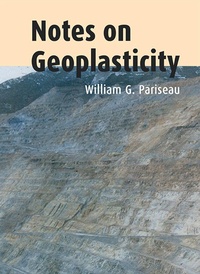
Notes on Geoplasticity
1. Auflage
Erschienen am 5. November 2019
242 Seiten
978-0-429-76650-3 (ISBN)
Beschreibung

This book is about geoplasticity, solid mechanics of rock, jointed rock and soil beyond the domain of a purely elastic deformation. Plastic deformation is irreversible and begins at the limit to elasticity with any attempt at further loading. Stress at the limit to elasticity is "strength" which is described by a functional relationship amongst stresses, that is, by a yield function or failure criterion. Mohr-Coulomb, Drucker-Prager and Hoek-Brown criteria are well-known examples in geomechanics.
Beyond the elastic limit, but still within the realm of small strain increments, a total strain increment is the sum of an elastic increment and a plastic increment. The elastic increment is computed through an incremental form of Hooke's law, isotropic or anisotropic as the case may be. Computation of the plastic part is at the core of any plasticity theory and is approached through the concept of a plastic potential. The plastic potential is a function of stresses and perhaps other material parameters such as plastic strain and temperature. Derivatives of the plastic potential with respect to stress lead to the plastic part of the total strain increment. If the yield criterion and plastic potential are the same, then the plastic stress-strain relationships are "associated rules of flow" and follow a "normality" principle. Normality is in reference to a graphical portrayal in principal stress space where the plastic strain increment is perpendicular to the yield surface. If the plastic potential and yield criterion are different, as is often the case in geoplasticity, then the rules of flow are "non-associated". Drucker's famous stability postulate implies normality at a smooth point on the yield surface, convexity of the yield function and other important features of plasticity theory in geomechanics.
However, there is no point to proceeding to theoretical analyses without physical justification. Hence, the physical foundations for application of plasticity theory to rock, jointed rock and soil are examined in Chapter 2 of this book. A brief review of continuum mechanics principles is given in Chapter 3. Chapter 4 focuses on plane plastic strain and "sliplines". The technical literature is replete with numerous diagrams of sliplines, especially in discussions of foundations on soils, but the relevant mathematics is often lacking and with it genuine understanding. Examples illustrate application of theory to traditional geomechanics problems such as computation of retaining wall forces in soils, foundation bearing capacity of soil and rock, wedge penetration of rock under confining pressure and others. Brief discussions of anisotropy, visco-plasticity and poro-plasticity are presented in Chapters 6, 7 and 8.
This book will be of interest to civil, geological and mining engineers, particularly those involved in reliable design of excavations and foundations beyond elasticity, especially in jointed rock.
Beyond the elastic limit, but still within the realm of small strain increments, a total strain increment is the sum of an elastic increment and a plastic increment. The elastic increment is computed through an incremental form of Hooke's law, isotropic or anisotropic as the case may be. Computation of the plastic part is at the core of any plasticity theory and is approached through the concept of a plastic potential. The plastic potential is a function of stresses and perhaps other material parameters such as plastic strain and temperature. Derivatives of the plastic potential with respect to stress lead to the plastic part of the total strain increment. If the yield criterion and plastic potential are the same, then the plastic stress-strain relationships are "associated rules of flow" and follow a "normality" principle. Normality is in reference to a graphical portrayal in principal stress space where the plastic strain increment is perpendicular to the yield surface. If the plastic potential and yield criterion are different, as is often the case in geoplasticity, then the rules of flow are "non-associated". Drucker's famous stability postulate implies normality at a smooth point on the yield surface, convexity of the yield function and other important features of plasticity theory in geomechanics.
However, there is no point to proceeding to theoretical analyses without physical justification. Hence, the physical foundations for application of plasticity theory to rock, jointed rock and soil are examined in Chapter 2 of this book. A brief review of continuum mechanics principles is given in Chapter 3. Chapter 4 focuses on plane plastic strain and "sliplines". The technical literature is replete with numerous diagrams of sliplines, especially in discussions of foundations on soils, but the relevant mathematics is often lacking and with it genuine understanding. Examples illustrate application of theory to traditional geomechanics problems such as computation of retaining wall forces in soils, foundation bearing capacity of soil and rock, wedge penetration of rock under confining pressure and others. Brief discussions of anisotropy, visco-plasticity and poro-plasticity are presented in Chapters 6, 7 and 8.
This book will be of interest to civil, geological and mining engineers, particularly those involved in reliable design of excavations and foundations beyond elasticity, especially in jointed rock.
Weitere Details
Auflage
1. Auflage
Sprache
Englisch
Verlagsort
London
Großbritannien
Verlagsgruppe
Taylor & Francis Ltd
Zielgruppe
Für höhere Schule und Studium
Für Beruf und Forschung
ISBN-13
978-0-429-76650-3 (9780429766503)
Copyright in bibliographic data and cover images is held by Nielsen Book Services Limited or by the publishers or by their respective licensors: all rights reserved.
Schweitzer Klassifikation
Weitere Ausgaben
Andere Ausgaben
William G. Pariseau
Notes on Geoplasticity
Buch
06/2021
1. Auflage
CRC Press
74,40 €
Versand in 10-20 Tagen
William G. Pariseau
Notes on Geoplasticity
Buch
11/2019
1. Auflage
CRC Press
233,20 €
Versand in 10-20 Tagen
Person
William Pariseau obtained his B.S. degree in Mining Engineering at the University of Washington (Seattle) following the geological option and subsequently earned a Ph.D. in Mining Engineering at the University of Minnesota with emphasis on rock mechanics and with a minor in applied mathematics. Prior to his Ph.D., he obtained practical experience working for the City of Anchorage, the Alaska Department of Highways, the Mineral Resources Division of the U.S. Bureau of Mines (Spokane), the Anaconda Copper Co. in Butte, Montana, the New York-Alaska Gold Dredging Corp. in Nyac, Alaska. He served in the United States Marine Corps (1953-1956). He maintained a strong association with the former U.S. Bureau of Mines, first with the Pittsburgh Mining Research Center and later with the Spokane Mining Research Center. He is a registered professional engineer and has consulted for a number of commercial and government entities.
Currently, he is a professor emeritus and former holder of the Malcolm McKinnon endowed chair in mining engineering at the University of Utah. He joined the Department in 1971 following academic appointments at the Montana College of Science and Technology and the Pennsylvania State University. He has been a visiting academic at Brown University, Imperial College, London, and at the Commonwealth Science and Industrial Research Organization (CSIRO), Australia. He and colleagues have received a number of rock mechanics awards; he was recognized as a distinguished university research professor at the University of Utah in 1991. In 2010, he was recognized for teaching in the College of Mines and Earth Sciences with the Outstanding Faculty Teaching Award. The same year, he was honored by the Old Timers Club with their prestigious Educator Award. He was honored as a Fellow of the American Rock Mechanics Association in 2015.
Currently, he is a professor emeritus and former holder of the Malcolm McKinnon endowed chair in mining engineering at the University of Utah. He joined the Department in 1971 following academic appointments at the Montana College of Science and Technology and the Pennsylvania State University. He has been a visiting academic at Brown University, Imperial College, London, and at the Commonwealth Science and Industrial Research Organization (CSIRO), Australia. He and colleagues have received a number of rock mechanics awards; he was recognized as a distinguished university research professor at the University of Utah in 1991. In 2010, he was recognized for teaching in the College of Mines and Earth Sciences with the Outstanding Faculty Teaching Award. The same year, he was honored by the Old Timers Club with their prestigious Educator Award. He was honored as a Fellow of the American Rock Mechanics Association in 2015.
Inhalt
1 Introduction. 2 Physical Foundations of Theory. 3 Elements of 3D Theory. 4 2D Theory (Plane Strain). 5 Limit Theorems. 6 Anisotropy. 7 Visco-plasticity. 8 Poro-plasticity.
