

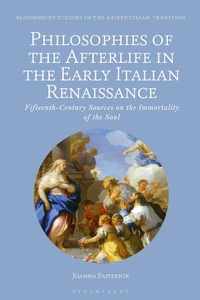
Philosophies of the Afterlife in the Early Italian Renaissance
Fifteenth-Century Sources on the Immortality of the Soul
1. Auflage
Erschienen am 21. März 2024
272 Seiten
978-1-350-34584-3 (ISBN)
Beschreibung
The immortality of the soul is one of the oldest tropes in the history of philosophy and one that gained significant momentum in 16th-century Europe. But what came before Pietro Pomponazzi and his contemporaries? Through examination of four neglected but central figures, Joanna Papiernik uncovers the rich and varied nature of the afterlife debate in 15th-century Italy.
By engaging with old prints, manuscripts and other archival material, this book reveals just how much interest there was in the question of immortality before the 16th-century boom in Aristotelian translations. In particular, Papiernik sheds light on the treatises of Agostino Dati, Leonardo Nogarola, Antonio degli Agli and Giovanni Canali, all of which have until now been overlooked in modern scholarship. From Dati's critiques of ancient and existing positions to Agli's study of immortality and its relation to the metaphysics of light, this volume investigates not only how wide-ranging the debate was but also the important impact it had on later philosophical thinking.
Deftly combining close reading with a broad intellectual survey, and including two editions of unpublished primary texts, Philosophies of the Afterlife in the Early Italian Renaissance provides a crucial insight into the development of early Renaissance Platonism and philosophy of religion.
By engaging with old prints, manuscripts and other archival material, this book reveals just how much interest there was in the question of immortality before the 16th-century boom in Aristotelian translations. In particular, Papiernik sheds light on the treatises of Agostino Dati, Leonardo Nogarola, Antonio degli Agli and Giovanni Canali, all of which have until now been overlooked in modern scholarship. From Dati's critiques of ancient and existing positions to Agli's study of immortality and its relation to the metaphysics of light, this volume investigates not only how wide-ranging the debate was but also the important impact it had on later philosophical thinking.
Deftly combining close reading with a broad intellectual survey, and including two editions of unpublished primary texts, Philosophies of the Afterlife in the Early Italian Renaissance provides a crucial insight into the development of early Renaissance Platonism and philosophy of religion.
Weitere Details
Reihe
Auflage
1. Auflage
Sprache
Englisch
Verlagsort
London
Großbritannien
Verlagsgruppe
Bloomsbury Publishing PLC
Zielgruppe
Für höhere Schule und Studium
ISBN-13
978-1-350-34584-3 (9781350345843)
Copyright in bibliographic data and cover images is held by Nielsen Book Services Limited or by the publishers or by their respective licensors: all rights reserved.
Schweitzer Klassifikation
Weitere Ausgaben
Person
Joanna Papiernik is Assistant Professor of Philosophy at the University of Lodz, Poland.
Inhalt
Acknowledgements
Introduction
1. The Divine Light in the Human Soul and Its Affinity to Eternal Things - Antonio degli Agli's On the Immortality of the Soul and His Other Works
2. The Theory of Individual Immortality "Found" in Aristotle - The Treatise On the Immortality of the Soul by Leonardo Nogarola
3. The Power of Authorities - Agostino Dati's On the Immortality of the Soul
4. The Continuation of the Compilatory Tradition - Giovanni Canali's On the Immortality of the Soul
5. Antonio degli Agli, De immortalitate animae
6. Leonardo Nogarola, De immortalitate animae
Notes
Bibliography
Index
Introduction
1. The Divine Light in the Human Soul and Its Affinity to Eternal Things - Antonio degli Agli's On the Immortality of the Soul and His Other Works
2. The Theory of Individual Immortality "Found" in Aristotle - The Treatise On the Immortality of the Soul by Leonardo Nogarola
3. The Power of Authorities - Agostino Dati's On the Immortality of the Soul
4. The Continuation of the Compilatory Tradition - Giovanni Canali's On the Immortality of the Soul
5. Antonio degli Agli, De immortalitate animae
6. Leonardo Nogarola, De immortalitate animae
Notes
Bibliography
Index
