

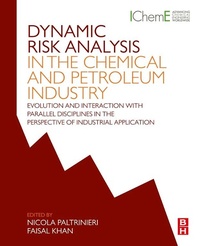
Dynamic Risk Analysis in the Chemical and Petroleum Industry
Evolution and Interaction with Parallel Disciplines in the Perspective of Industrial Application
Erschienen am 6. August 2016
284 Seiten
978-0-12-803823-9 (ISBN)
Beschreibung

Dynamic Risk Analysis in the Chemical and Petroleum Industry focuses on bridging the gap between research and industry by responding to the following questions:
- What are the most relevant developments of risk analysis?
- How can these studies help industry in the prevention of major accidents?
Paltrinieri and Khan provide support for professionals who plan to improve risk analysis by introducing innovative techniques and exploiting the potential of data share and process technologies. This concrete reference within an ever-growing variety of innovations will be most helpful to process safety managers, HSE managers, safety engineers and safety engineering students.
This book is divided into four parts. The Introduction provides an overview of the state-of-the-art risk analysis methods and the most up-to-date popular definitions of accident scenarios. The second section on Dynamic Risk Analysis shows the dynamic evolution of risk analysis and covers Hazard Identification, Frequency Analysis, Consequence Analysis and Establishing the Risk Picture. The third section on Interaction with Parallel Disciplines illustrates the interaction between risk analysis and other disciplines from parallel fields, such as the nuclear, the economic and the financial sectors. The final section on Dynamic Risk Management addresses risk management, which may dynamically learn from itself and improve in a spiral process leading to a resilient system.
- Helps dynamic analysis and management of risk in chemical and process industry
- Provides industry examples and techniques to assist you with risk- based decision making
- Addresses also the human, economic and reputational aspects composing the overall risk picture
Weitere Details
Weitere Ausgaben
Andere Ausgaben
Nicola Paltrinieri | Faisal Irshad Khan
Dynamic Risk Analysis in the Chemical and Petroleum Industry
Evolution and Interaction with Parallel Disciplines in the Perspective of Industrial Application
Buch
08/2016
Butterworth-Heinemann
93,83 €
Versand in 15-20 Tagen
Inhalt
Part I: Introduction1. A short overview of risk analysis background and recent developments2. New definitions of old issues and need for continuous improvement
Part II: Dynamic Risk AnalysisSub-section 1: Hazard Identification3. Advanced techniques for dynamic hazard identification4. Dynamic hazard identification: tutorial and examples
Sub-section 2: Frequency Analysis4. Reactive approaches of probability update based on Bayesian inference5. Proactive approaches of dynamic risk assessment based on indicators6. Coupling of reactive and proactive approaches: tutorials and examples7. Comparison and complementarity between reactive and proactive approaches
Sub-section 3: Consequence Analysis8. Dynamic consequence analysis through Computational Fluid Dynamics modelling9. Computational Fluid Dynamics modelling: tutorial and examples10. Assessing the severity of thermal hazards11. Thermal hazard assessment: tutorial and examples
Sub-section 4: Establishing the Risk Picture12. Risk metrics and dynamic risk visualization
Part III: Interaction with Parallel DisciplinesSub-section 1: Humans13. Human Reliability Analysis: from the nuclear to the petroleum sector14. HRA in the petroleum industry: tutorial and examples
Sub-section 2: Costs and Benefits15. Cost-Benefit Analysis of safety measures16. Cost-Benefit Analysis for low-probability high-impact risks: tutorial and examples
Sub-section 3: Reputation17. Reputational damage following major accidents18. Estimation of major accident reputational damage: tutorial and examples
Part IV: Dynamic Risk Management19. Dynamic Risk Management in the perspective of a resilient system
