

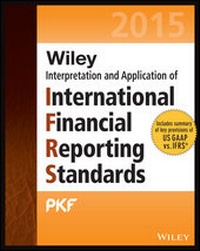
Wiley IFRS 2015
Beschreibung

Weitere Details
Weitere Ausgaben
Andere Ausgaben
Person
PKF International Limited administers the PKF network of around 300 member firms and correspondents in 440 locations in around 125 countries, providing accounting and business advisory services.
PKF International member firms have a $2.68 billion aggregate fee income (year end June 2012) and the network is a member of the Forum of Firms - an organisation dedicated to consistent and high quality standards of financial reporting and auditing practices worldwide.
PKF member firms have service and sector specialists in their own marketplace, but also deliver an international service through their relationships with other network members.
Inhalt
Chapter 1
INTRODUCTION TO INTERNATIONAL FINANCIAL REPORTING STANDARDS
Origins and Early History of the IASB
Process of IFRS Standard Setting
Convergence: The IASB and Financial Reporting in the US
Appendix B: Projects Completed the Previous Year
INTRODUCTION
The stated goal of the IFRS Foundation and the International Accounting Standards Board (IASB) is to develop, in the public interest, a single set of high-quality, understandable, enforceable and globally accepted financial reporting standards based upon clearly articulated principles.
There were once scores of unique sets of financial reporting standards among the more developed nations ("national GAAP"). The year 2005 marked the beginning of a new era in global conduct of business, and the fulfillment of a thirty-year effort to create the financial reporting rules for a worldwide capital market. For during that year's financial reporting cycle, the 27 European Union (EU) member states, plus many others in countries such as Australia, New Zealand, Russia, and South Africa adopted International Financial Reporting Standards (IFRS).
Since then, many countries, such as Argentina, Brazil, Korea, Canada, Mexico, and Russia have adopted IFRS. China has substantially converted its national standards in line with IFRS. All other major economies, such as Japan and the United States, have established time lines to converge with or adopt IFRS in the near future.
2007 and 2008 proved to be watershed years for the growing acceptability of IFRS. In 2007, one of the most important developments was that the SEC dropped the reconciliation (to US GAAP) requirement that had formerly applied to foreign private registrants; thereafter, those reporting in a manner fully compliant with IFRS (i.e., without any exceptions to the complete set of standards imposed by IASB) do not have to reconcile net income and shareholders' equity to that which would have been presented under US GAAP. In effect, the US SEC was acknowledging that IFRS was fully acceptable as a basis for accurate, transparent, meaningful financial reporting.
This easing of US registration requirements for foreign companies seeking to enjoy the benefits of listing their equity or debt securities in the US led, quite naturally, to a call by domestic companies to permit them to also freely choose between financial reporting under US GAAP and IFRS. By late 2008 the SEC appeared to have begun the process of acquiescence, first for the largest companies in those industries having (worldwide) the preponderance of IFRS adopters, and later for all publicly held companies. However, a new SEC chair took office in 2009, expressing a concern that the move to IFRS, if it were to occur, should perhaps move more slowly than had previously been indicated.
It had been highly probable that nonpublicly held US entities would have remained bound to only US GAAP for the foreseeable future, both from habit and because no other set of standards would be viewed as being acceptable. However, the body that oversees the private-sector auditing profession's standards in the US amended its rules in 2008 to fully recognize IASB as an accounting standard-setting body (giving it equal status with the FASB), meaning that auditors and other service providers in the US could now issue opinions (or provide other levels of assurance, as specified under pertinent guidelines) on IFRS-based financial statements. This change, coupled with the promulgation by IASB of a long-sought standard providing simplified financial reporting rules for privately held entities (described later in this chapter), has probably increased the likelihood that a broad-based move to IFRS will occur in the US within the next several years.
The impetus for the convergence of historically disparate financial reporting standards has been, in the main, to facilitate the free flow of capital so that, for example, investors in the United States will become more willing to finance business in, say, China or the Czech Republic. Having access to financial statements that are written in the same "language" would eliminate what has historically been a major impediment to engendering investor confidence, which is sometimes referred to as "accounting risk," which adds to the already existing risks of making such cross-border investments. Additionally, the permission to list a company's equity or debt securities on an exchange has generally been conditional on making filings with national regulatory authorities, which have historically insisted either on conformity with local GAAP or on a formal reconciliation to local GAAP. Since either of these procedures was tedious and time-consuming, and the human resources and technical knowledge to do so were not always widely available, many otherwise anxious would-be registrants forwent the opportunity to broaden their investor bases and potentially lower their costs of capital.
The historic 2002 Norwalk Agreement-between the US standard setter, FASB, and the IASB-called for "convergence" of the respective sets of standards, and indeed a number of revisions of either US GAAP or IFRS have already taken place to implement this commitment. The aim of the Boards was to complete the milestone projects of the Memorandum of Understanding (MoU) by the end of June 2011.
Although the Boards were committed to complete the milestone projects by June 2011, certain projects such as financial instruments (impairment and hedge accounting), revenue recognition, leases, and insurance contracts were deferred due to the complexity of the projects and obtaining consensus views. The converged standard on revenue recognition was finally published in May 2014. Details of these and other projects of the standard setters are included in a separate section in each relevant chapter of this book.
Despite the progress towards convergence described above, the SEC dealt a blow to hopes of future alignment in its strategic plan published in February 2014. The document states that the SEC "will consider, among other things, whether a single set of high-quality global accounting standards is achievable," which is a significant reduction in its previously expressed commitment to a single set of global standards. This leaves IFRS and US GAAP as the two comprehensive financial reporting frameworks in the world, with IFRS gaining more and more momentum.
The MoU with FASB (and with other international organizations and also jurisdictional authorities) has been replaced by a MoU with the Accounting Standards Advisory Forum (ASAF). The ASAF is an advisory group to the IASB consisting of national standard-setters and regional bodies. FASB's involvement with the IASB is now through ASAF
With the convergence projects ending, the IASB has started with a new agenda consultation process on the future work program of the IASB. The IASB has started working on the new conceptual framework and included rate-regulated activities as a major project.
ORIGINS AND EARLY HISTORY OF THE IASB
Financial reporting in the developed world evolved from two broad models, whose objectives were somewhat different. The earliest systematized form of accounting regulation developed in continental Europe in 1673. Here a requirement for an annual fair value statement of financial position was introduced by the government as a means of protecting the economy from bankruptcies. This form of accounting at the initiative of the state to control economic actors was copied by other states and later incorporated in the 1807 Napoleonic Commercial Code. This method of regulating the economy expanded rapidly throughout continental Europe, partly through Napoleon's efforts and partly through a willingness on the part of European regulators to borrow ideas from each other. This "code law" family of reporting practices was much developed by Germany after its 1870 unification, with the emphasis moving away from market values to historical cost and systematic depreciation. It was used later by governments as the basis of tax assessment when taxes on business profits started to be introduced, mostly in the early twentieth century.
This model of accounting serves primarily as a means of moderating relationships between the individual company and the state. It serves for tax assessment, and to limit dividend payments, and it is also a means of protecting the running of the economy by sanctioning individual businesses that are not financially sound or are run imprudently. While the model has been adapted for stock market reporting and group (consolidated) structures, this is not its main focus.
The other model did not appear until the nineteenth century and arose as a consequence of the industrial revolution. Industrialization created the need for large concentrations of capital to undertake industrial projects (initially, canals and railways) and to spread risks between many investors. In this model the financial report provided a means of monitoring the activities of large businesses in order to inform their (non-management) shareholders. Financial reporting for capital markets purposes developed initially in the UK, in a common-law environment where the state legislated as little as possible and left a large degree of interpretation to practice...
