

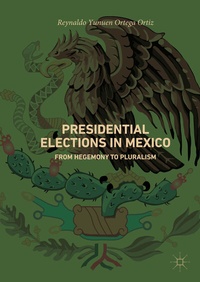
Presidential Elections in Mexico
From Hegemony to Pluralism
Erschienen am 6. Juli 2017
XIX, 188 Seiten
978-3-319-56032-8 (ISBN)
Beschreibung

This book analyzes the transformation of the Mexican political system during the last four decades, focusing on its presidential elections. As the country has shifted away from an authoritarian political system, ruled by a hegemonic party, it has become a more moderate, pluralistic society, marked by electoral competition between contestant parties. Using a mixed methodology, including historical and statistical analysis, the author argues that the fight for clean and fair elections in Mexico has a long history of contestation and conflict, entailing at once movements towards democracy yet also processes of de-democratization."
Rezensionen / Stimmen
"After the Mexican Revolution (1910-1920) México gave form to one of the most successful authoritarian systems of the 20th century. The strong roots of its undemocratic institutions and political culture have made extremely difficult and prolonged its democratic transition. By carefully examining the way in which presidential elections without meaning evolved into competitive although unfair ones, professor Reynaldo Ortega provides the reader with a good panorama of the political transformation of México in the last half a century and highlights the nature of the bumpy road still has to travel a hybrid political system before becoming a bona fide electoral democracy." (Lorenzo Meyer, Professor Emeritus, El Colegio de México)Weitere Details
Reihe
Auflage
1st ed. 2017
Sprache
Englisch
Verlagsort
Cham
Schweiz
Verlagsgruppe
Springer International Publishing
Zielgruppe
Für Beruf und Forschung
Produkt-Hinweis
Reflowable
Illustrationen
XIX, 188 p. 21 illus.
Dateigröße
3,56 MB
ISBN-13
978-3-319-56032-8 (9783319560328)
DOI
10.1007/978-3-319-56032-8
Schweitzer Klassifikation
Weitere Ausgaben
Andere Ausgaben
Buch
07/2017
Palgrave Macmillan
128,39 €
Versand in 10-15 Tagen
Person
Reynaldo Yunuen Ortega Ortiz is Professor of Political Science at the Center for International Studies at the College of Mexico. He is a Member of the National System of Researchers in Mexico and Chief Editor of the journal
Foro Internacional.
In 2012 he was awarded the National Prize of Social Research and Public Opinion.
Inhalt
Chapter 1: Introduction.- Chapter 2: The Democratization Process and Presidential Elections in Mexico - Towards a Typology of Presidential Elections.- Chapter 3: Maintaining Elections: 1970, 1976, and 1982.- Chapter 4: Converting Elections: 1988, 1994, and 2006.- Chapter 5: Realigning Elections: 2000 and 2012.- Chapter 6: Conclusions.
