

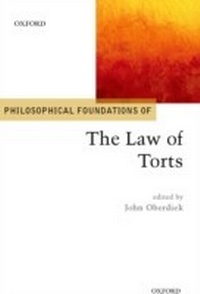
Philosophical Foundations of the Law of Torts
1. Auflage
Erschienen am 20. März 2014
488 Seiten
978-0-19-100507-7 (ISBN)
Beschreibung

Contemporary philosophy and tort law have long enjoyed a happy union. Tort theory today is an exceptionally active and wide ranging field within legal philosophy. This volume brings together established and emerging scholars from around the world and from varying disciplines that bring their distinct perspective to the philosophical problems of tort law. These ground breaking essays advance longstanding debates and open up new avenues of enquiry thus deepening and broadening the field. Contributions cover the major problematic areas of tort law, such as the relations between responsibility, fault, and strict liability; the morality of harm, compensation, and repair; and the relationship of tort with criminal and property law among many others.
Weitere Details
Weitere Ausgaben
Andere Ausgaben
John Oberdiek
Philosophical Foundations of the Law of Torts
Buch
03/2014
Oxford University Press
171,50 €
Versand in 15-20 Tagen
Person
John Oberdiek is Professor at the Rutgers University School of Law. His is also a Director of the Rutgers Institute for Law and Philosophy, Associate Graduate Faculty in the Rutgers Department of Philosophy, Co-Editor of the journal Law and Philosophy, and has been a Laurance S. Rockefeller Visiting Fellow at the University Center for Human Values at Princeton.
Inhalt
- Introduction: Philosophical Foundations of the Law of Torts
- Part I: Foundations of Tort Law
- 1: John C.P. Goldberg and Benjamin C. Zipursky: Tort Law and Responsibility
- 2: Stephen Perry: Torts, Rights, and Risk
- 3: Mark A. Geistfeld: Compensation as a Tort Norm
- 4: Scott Hershovitz: Tort as a Substitute for Revenge
- 5: John Oberdiek: Structure and Justification in Contractualist Tort Theory
- 6: Eric R. Claeys: On the "Property" and the "Tort" in Trespass
- 7: Peter Cane: Tort Law and Public Functions
- Part II: Harms, Wrongs, Responsibility, and Liability
- 8: Victor Tadros: What Might have Been
- 9: Rahul Kumar: Why Reparations?
- 10: R.A. Duff: Repairing Harms and Answering for Wrongs
- 11: Linda Radzik: Tort Processes and Relational Repair
- 12: David Enoch: Tort Liability and Taking Responsibility
- 13: Kenneth W. Simons: Exploring the Relationship Between Consent, Assumption of Risk, and Victim Negligence
- 14: Gregory C. Keating: Strict Liability Wrongs
- 15: Anthony J. Sebok: Normative Theories of Punitive Damages: The Case of Deterrence
- Part III: Distributive Justice in Tort Law
- 16: John Gardner: What is Tort Law For? Part 2. The Place of Distributive Justice
- 17: Hanoch Sheinman: Tort Law and Distributive Justice
- Part IV: Skeptical Perspectives
- 18: Heidi M. Hurd: Finding No Fault With Negligence
- 19: Larry Alexander and Kimberly Kessler Ferzan: Confused Culpability, Contrived Causation, and the Collapse of Tort Theory
- Bibliography
